
People have different passions. For Tapan Ghosh, a 35-year-old businessman from Muksudpur in Gopalganj, that passion is helping others.
With no government funding, institutional support or political ambition, Tapan spends his own earnings and labour fixing problems that affect ordinary people – broken roads, damaged tube wells, unsafe pathways and neglected public spaces.
Wherever people suffer, Tapan appears.
A pothole causing accidents, a broken road disrupting villagers’ lives, a school without safe drinking water, or an unclean mosque, temple or madrasa compound – these are the places where people now look for him.
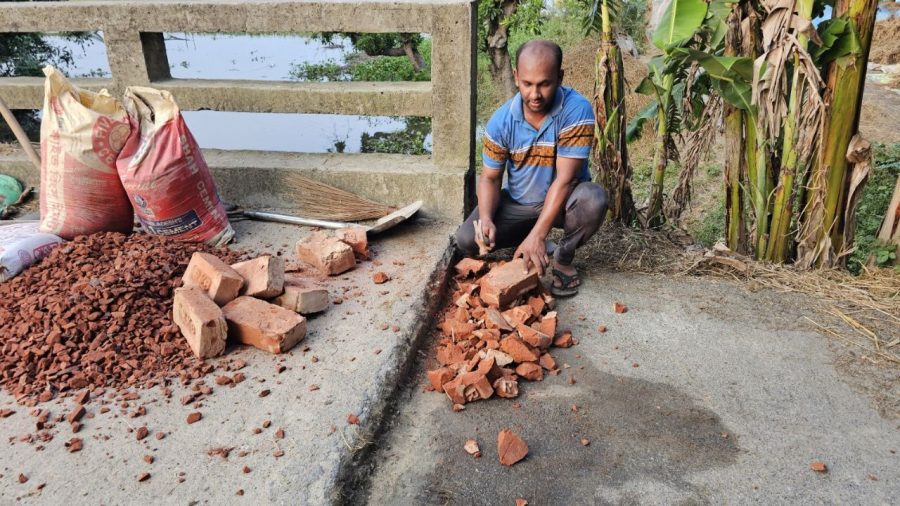
He buys bricks, sand, stone chips, cement and other materials with his own money. Sometimes he hires workers, and sometimes he works himself with a hammer or spade to repair what has long been ignored.
Tapan is the son of businessman Nilkantha Ghosh of Maharajpur Union in Muksudpur. His income comes from his father’s sweet shop, Ghosh Mistanna Bhandar.

A textile engineer by education, Tapan once worked in the corporate sector. After graduating in Textile Engineering from Primeasia University in Dhaka, he joined PN Composite Ltd in Konabari, Gazipur, in the laboratory dyeing department. Later, he worked in the dyeing production department of a company in Fatullah, Narayanganj.
But the corporate lifestyle did not suit him.
After his father’s death on 14 September 2025, Tapan returned to his village, joined the family business and decided to dedicate more time to helping people.
He still cleans the shop himself, serves customers and sells sweets without any sense of pride or privilege.




Initially, Tapan made entertainment and market-related videos for social media, but they received little response. He then shifted focus to highlighting people’s problems and finding solutions.
Every morning until noon, he runs the sweet shop. From 3pm, he travels from village to village with a van to identify problems.
He started repairing roads and public facilities with his own money and sharing the work online. His efforts won public appreciation, and his Facebook and YouTube platforms now have around 13 million subscribers and more than one crore followers.
Tapan’s first major initiative was repairing a large pothole near Dignagar Bridge on the Dhaka-Barishal highway, where frequent accidents had become common. He arranged RCC work and fixed the road himself.
Since then, he has worked across Gopalganj, Faridpur, Madaripur, Narail and different areas of Dhaka.
“I no longer calculate how much money I spend. Wherever I see people suffering, I try to help. If someone calls me about a problem, I go there. Helping people gives me the greatest satisfaction,” Tapan told TIMES.
Over the past year, he has repaired roads at more than 250 locations, restored culvert approach roads, repaired bamboo bridges, cleared bushes and fixed damaged tube wells at schools, colleges, mosques, temples and madrasas.
During the monsoon season, he also planted around 500 fruit and medicinal trees, including mango, blackberry, jackfruit, amla, haritaki, lotkon, karomcha, lemon and jamrul, hoping to create a greener Bangladesh for future generations.
Maharajpur resident Siraj Munshi told TIMES, “Such examples are rarely seen.”
Van driver Sentu Sheikh said, “At first, we laughed at him. We wondered why someone with so much education would do this. Later, we realised that society needs people like Tapan. Because of him, we can now move around more safely.”
Motorcycle rider Naeemul Islam of Batikamari village said, “It is rare to see someone spending his own money for people. I have informed Tapan Babu about problems in different places, and he went there and solved them.”
Elderly resident Liakat Mridha said, “The work that the government should do is being done by Tapan with his own money.”
For Tapan’s mother Kalyani Ghosh, her son’s work is a source of immense pride.
“Among my three sons, Tapan is the youngest. Since childhood, he has always wanted to help others. He would rush to help neighbours before anyone else. Even today, after having lunch, he goes out to serve people. When villagers praise my son, my heart fills with pride as a mother,” she said.