
A trail of explosions and bus fires has left investigators chasing shadows, with police yet to identify the alleged bomb-makers, trace the source of explosives, or uncover the network behind the attacks in the capital.
Fifteen blast sites, at least ten torched buses, and a trail of unexplained explosives have placed the Dhaka Metropolitan Police (DMP) under immense strain, as investigators remain unable to verify the perpetrators or their supply links.
Police suspect these incidents are directly linked to the “Sunday Dhaka Lockdown” programme called by the Awami Jubo League, an organisation facing a complete ban on all activities.
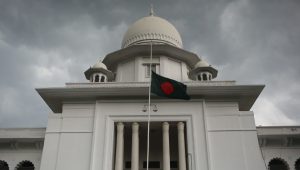
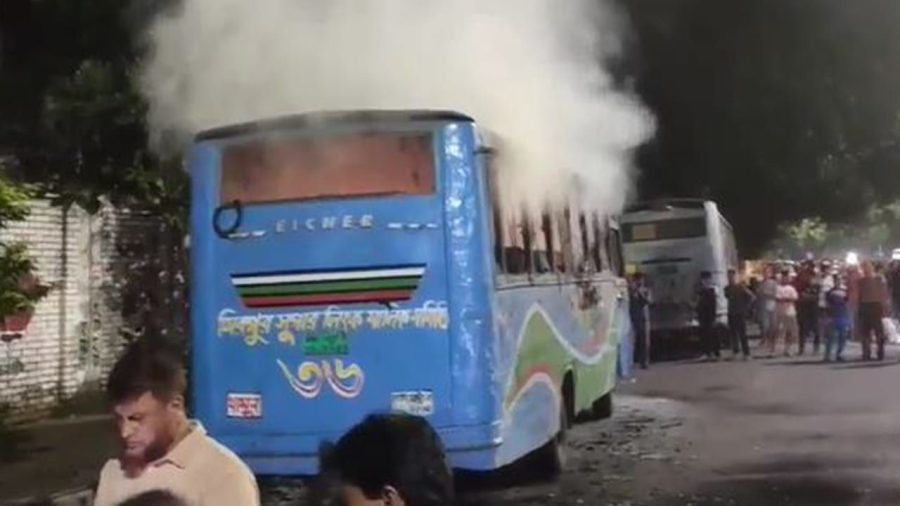
Dhaka saw fresh incidents of arson and crude bomb explosions also on Sunday, with buses set on fire in Pallabi and Kadamtali and blasts reported near the High Court and Shilpakala Academy. No casualties were reported in the incidents and police said investigations into the incidents were underway.
In response to the escalating crisis, law enforcement agencies are analysing CCTV footage, mobile network data, and advanced technology to track down those involved, according to several DMP Detective Branch (DB) officials.
DMP Additional Commissioner and DB Chief Shafiqul Islam confirmed that a specialised operation is underway, supported by 260 security checkpoints set up across the capital. Conceding that no specific information has yet been established regarding the explosive materials, their origins, or the bomb-makers themselves, he noted simply, “We are looking for the links.”

Despite the intelligence deficit, key detentions have provided initial leads for investigating officers across various zones.
A suspect named Sabuj was detained in Cox’s Bazar over his political connections and is currently undergoing interrogation at the Postogola police outpost.
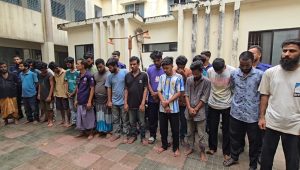
Meanwhile, DB Wari Division Deputy Commissioner Molla Md Shaheen confirmed the arrest of four active Awami League members Md Raihan Uddin, 35, Russel Khan, 32, Alauddin, 28, and Abdullah, 28, following a crude bomb explosion outside Jatrabari Police Station.


Officers recovered four unexploded hand-bombs from the group, with mobile records revealing that Raihan maintained direct communication with fugitive party leaders.
In a separate incident, Lalbagh police caught Aminul Islam Shaon red-handed as a bus was being set ablaze in Azimpur on Saturday night, and he remains in custody as interrogations continue.
Police under pressure
A Deputy Inspector General of Police, who served DMP earlier, revealed that no coordination meetings were held to strategise against the recent explosions, arson, and flash processions.
He warned that inexperienced crime division officers are stalling investigations, cautioning that violence could escalate unless field-level skills and strategies urgently improve.
Meanwhile, administrative threats to remove Detective Branch officials and station officers-in-charge if attacks occur in their zones have created immense internal pressure. However, insiders stress that penalising commanders fails to solve the core issue, as persistent intelligence deficits leave law enforcement incapable of preventing further incidents.
Blasts and arson in three days
According to police data, a three-day wave of violence hit the capital between Friday and Sunday, marked by crude bomb explosions across 15 locations and the burning of at least 10 buses.
Explosions were recorded at key sites including Malibagh, Agargaon, Mohakhali, Jatrabari, Babubazar, Moghbazar, Mouchak, Dhaka College, Kamalapur, Segunbagicha, and outside the Bangladesh Television building, the Secretariat, and the High Court.
Meanwhile, bus arson was reported in Kafrul, Mirpur-1, Mirpur-11, Maddha Badda, Matuail, Pallabi, South Keraniganj, and in front of the DEEPZ Government Market.
Who are behind the incidents
Three top Detective Branch (DB) officials have revealed to TIMES a sinister strategy behind the escalating violence, attributing the campaign directly to central and metropolitan leadership of the banned Jubo League.
According to a DB Deputy Commissioner and three Additional Deputy Commissioners, party leaders organised multiple specialised hit teams to execute coordinated strikes across the capital.
Instructions were issued stating that future organisational assessments and promotions would be determined by the successful execution of bomb explosions and bus burnings.
To prove their involvement, attackers were instructed to record video footage of each strike and submit the evidence to their handlers.
Operating in tandem, one team carries out the cocktail attacks and arson, while a secondary team films the destruction.
The immediate online release of these video clips over the past three days, designed to demonstrate operational performance to political superiors, has fuelled widespread fear and panic across the public.