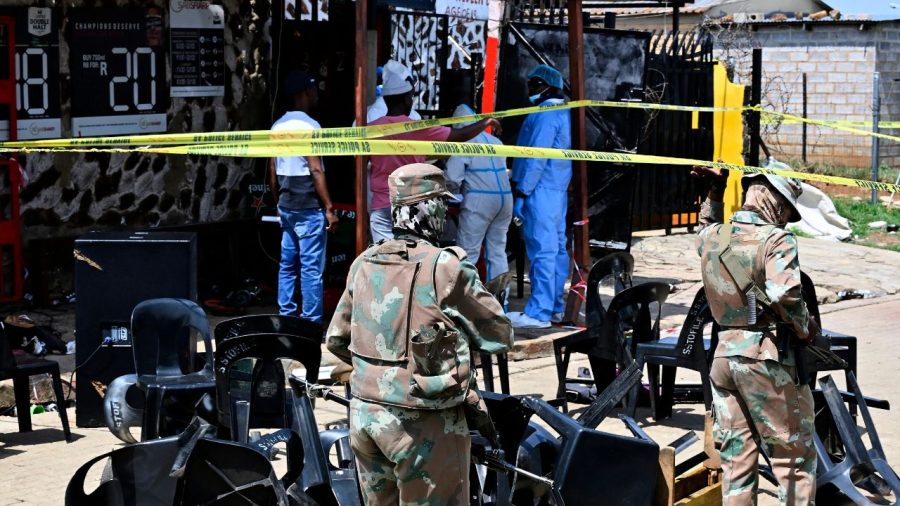



The death toll from a weekend tavern shooting near Johannesburg has risen to 18 after another victim died in hospital, South African police said on Monday.
Suspects armed with AK-47 rifles opened fire late on Saturday at the tavern in Wedela township, about 80 kilometres (50 miles) west of the city.
Police have yet to catch the perpetrators but say they obtained clear pictures of them.
One line of inquiry is that the attack was part of a turf war between the heavily armed gangs that control the illegal gold-mining trade in the area, report AP and Reuters.
Police said in a statement that four of the dead have so far been identified: two South Africans and two nationals of Lesotho.
Police say they are hunting eight suspects, who shot patrons outside the bar with AK-47 rifles and pistols before moving inside to continue the rampage.
The acting provincial commissioner said police were also investigating a possible revenge motive, as one of the victims was connected to a previous shooting.

Residents said the area has a history of violence by illegal mining gangs, which terrorise communities in gold-mining areas around Johannesburg and are involved in the lucrative illicit gold trade.
Authorities are also investigating another weekend shooting near Cape Town, where 10 people were killed at a store connected to a nightlife venue in Lwandle township; police did not say how many gunmen were involved.
On Tuesday night, three gunmen, at least one armed with an AK-47, killed 11 people at a house party in KwaMakhutha township near Durban after forcing their way in.
The three shootings, in impoverished townships near the country’s three biggest cities, unfolded within six days, with two just hours apart.


An earlier tally counted at least 38 dead and nearly 30 wounded.
Seven mass shootings have made national headlines since December.
Six of them, in which dozens of victims were killed in bars, houses, at a hostel or on the street, were carried out by multiple gunmen.
There is no standard global definition of a mass shooting; South African police define one as an attack in which three or more people are shot.
Such shootings often differ from lone gunman attacks seen in the United States and elsewhere, being mostly linked to criminality rather than ideological motive or personal grievance.
Authorities say many are linked to criminal gangs fighting turf wars or using violence to establish control over communities and areas.
Elsewhere in the country, including Cape Town, gangs involved in selling illegal drugs or extortion rackets have been responsible for mass shootings.
Violent crime remains a major challenge in South Africa despite efforts to curb one of the world’s highest per-capita murder rates.
Gun homicide rates are among the world’s highest but mostly affect impoverished communities, where police have struggled to contain the violence.
After a mass shooting killed 12 people in a poor Johannesburg neighbourhood in June, residents said they had long complained to police about gangs and illegal guns there.
Experts say distance from police stations and a lack of lighting leave poor townships vulnerable.
Innocent bystanders, including children, are often killed.
Crime mirrors South Africa’s economic inequality: affluent suburbs, sometimes only a few miles from townships, are well lit, often patrolled by armed private security and have much lower violent crime rates.
In March, President Cyril Ramaphosa deployed soldiers in a yearlong operation to support police against violent crime by organised gangs, saying crime was the biggest threat to democracy and economic development.
Illegal mining gangs in and around Johannesburg were one specific focus.
Some poor communities welcomed the soldiers as long-needed security for their neighbourhoods, but critics of the government said using the army to fight crime was effectively an admission that the police had failed.