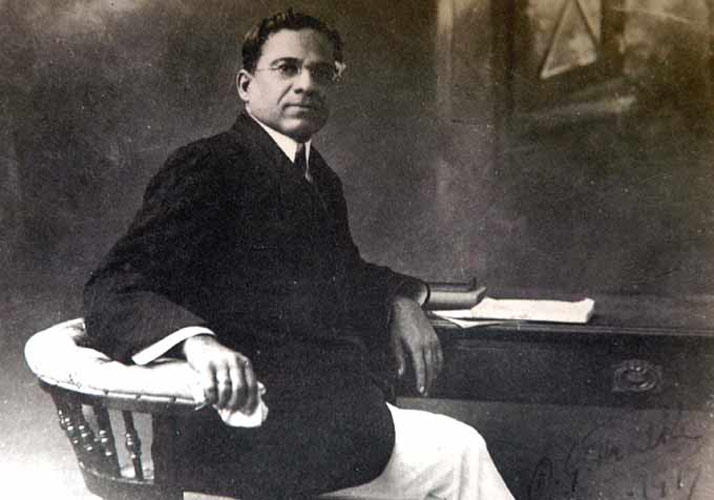

February 16 marks the 82nd death anniversary of Dhundiraj Govind Phalke, widely celebrated as Dadasaheb Phalke, the pioneering visionary who laid the foundation of Indian cinema.
Born on April 30, 1870 in Trimbak, in what was then British India, Phalke’s journey from painter and photographer to cinematic trailblazer reshaped the cultural and artistic landscape of the subcontinent.
Phalke’s fascination with moving pictures began after watching Life of Christ, a silent French film, which inspired him to travel to London to study the technical crafts of filmmaking, a bold step at a time when cinema was still in its infancy globally.

In 1913, Phalke made history with Raja Harishchandra, the first full‑length Indian feature film. This silent mythological narrative marked the birth of the Indian film industry. Despite severe resource constraints, Phalke managed every aspect of production, directing, scripting, producing and editing himself. The film’s success opened the doors for indigenous cinema and inspired generations of filmmakers.
Over the next two decades, Phalke was extraordinarily prolific, making over 95 feature films and numerous shorts, including notable works such as ‘Mohini Bhasmasur’ (1913), ‘Satyavan Savitri’ (1914), ‘Lanka Dahan’ (1917), ‘Shri Krishna Janma’ (1918) and ‘Kaliya Mardan’ (1919). His films were deeply rooted in Indian epics and mythology but also incorporated evolving cinematic techniques such as close-ups and fade-ins.




Phalke’s career was not without its struggles. He faced financial hardship, often selling personal assets to fund his projects. The advent of sound films in the early 1930s rendered his silent cinema style less popular and he eventually retired from filmmaking after his last feature, ‘Gangavataran’ (1937).
Phalke passed away on February 16, 1944 in Nashik, aged 73, leaving a legacy unparalleled in South Asian arts. Today, he is rightly remembered as the Father of Indian Cinema, not only for his films but for his audacity to envision an indigenous cinematic voice during the colonial era.
His contributions continue to be honoured annually through the Dadasaheb Phalke Award, instituted by the Government of India in 1969 as the country’s highest recognition for lifetime achievement in cinema.
Malayalam superstar Mohanlal was honoured with the award at the 71st National Film Awards, announced in September 2025. Over the decades, the award has become the most prestigious acknowledgement for artists, directors, writers, and technicians whose work has shaped Indian cinema’s cultural legacy.
On this death anniversary, the world of cinema reflects not only on Phalke’s films but also on the enduring spirit of creativity he embodied, a reminder that the soul of Indian cinema was forged by a man who believed in dreamt images long before film stocks even existed.