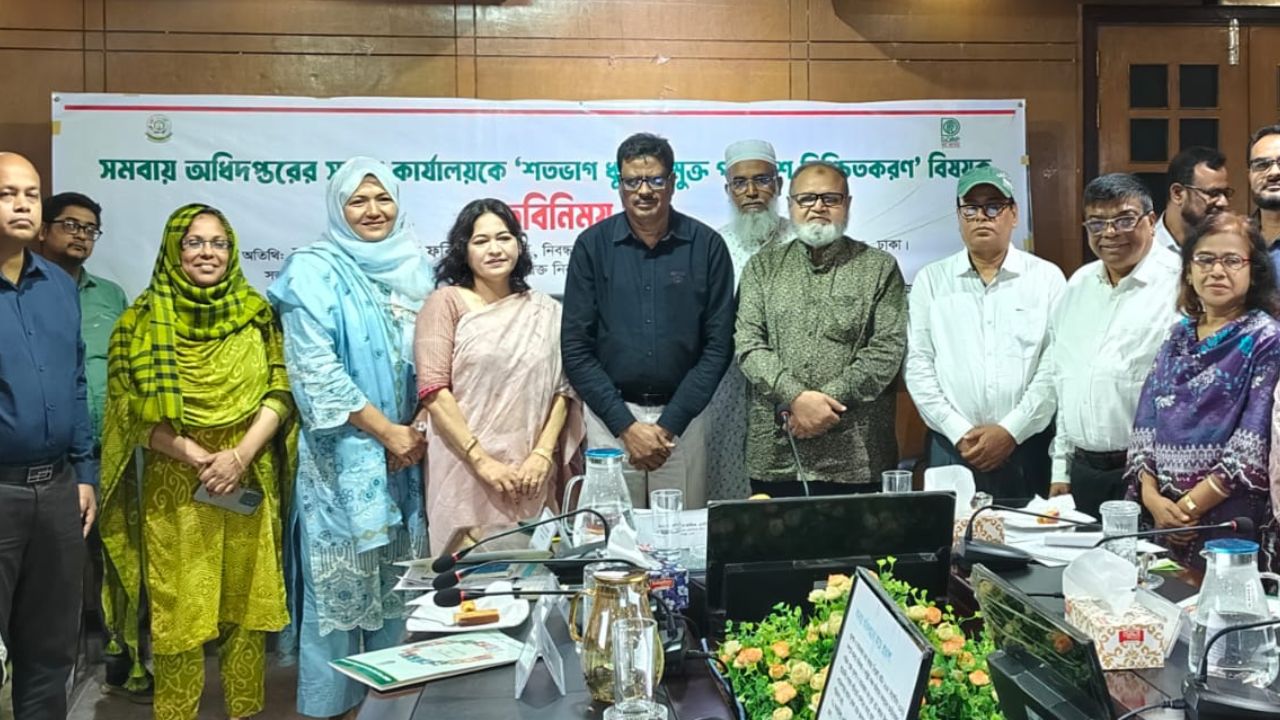



All offices under Cooperatives Department are set to become completely smoke and tobacco-free to safeguard public health and shield non-smokers from the dangers of secondhand smoke.
The commitment was announced by Md Selim Fakhir, registrar and director general (additional secretary) of Cooperative Department, on Monday.
He made these remarks at a view-exchange meeting jointly organised by the department and Development Organisation of the Rural Poor (DORP), titled “Ensuring a Smoking and Tobacco-Free Environment in All Offices of the Cooperative Department.”

Under this new drive, the department will run continuous awareness campaigns on the Smoking and Tobacco Products Usage (Control) Act, 2005 (Amendment 2026) and work closely with stakeholders to keep all its premises tobacco-free.
Presenting the keynote paper at the meeting, DORP Tobacco Control Project Coordinator Zeba Afroza highlighted key aspects of the amended 2026 tobacco control law alongside alarming statistics from the Global Adult Tobacco Survey (GATS) 2017.




According to the survey, tobacco-related illnesses claim nearly two lakh lives prematurely in Bangladesh every year, costing the country approximately Tk87,000 crore annually in healthcare expenses and lost productivity.
Afroza added that Bangladesh currently has around 3.78 crore adult tobacco users, including 1.92 crore active smokers, while nearly four crore people are exposed to passive smoking.
She expressed hope that the Cooperatives Department’s proactive steps would serve as a model for other public and private organisations, as the government prioritises tobacco control to protect public health.
The meeting’s chairperson, Md Nobirul Islam, additional registrar (administration, MAS and finance), recalled Prime Minister Tarique Rahman’s message for World No Tobacco Day 2026, where the prime minister declared the government’s commitment to protecting children, youth, and future generations from the hazards of tobacco and nicotine.
Islam pointed out that enforcing Section 4 of the 2005 Act (Amendment 2026 is a vital part of delivering on this national promise.
Other speakers at the discussion emphasised that raising public awareness, building the department’s institutional capacity, and coordinating efforts among all stakeholders are crucial to achieving a healthy, tobacco-free working environment.