


Forensic experts in Nepal are using DNA testing to identify thousands of flood victims following catastrophic flooding in the Himalayan country.
The disaster began on 26 August when a glacial and rock collapse on the Nepal-China border triggered a tsunami-like wall of freezing water and debris.
Nepal’s disaster authorities have recovered 1,454 bodies, around a third of which are only partial remains. So far, 112 bodies have been identified and returned to their families, while 5,285 people remain missing, including hundreds of foreign nationals, reports AFP.
Across the border, Chinese state media reported 43 deaths and 519 people missing, taking the combined toll across the two countries to nearly 1,500 dead and 5,800 missing.
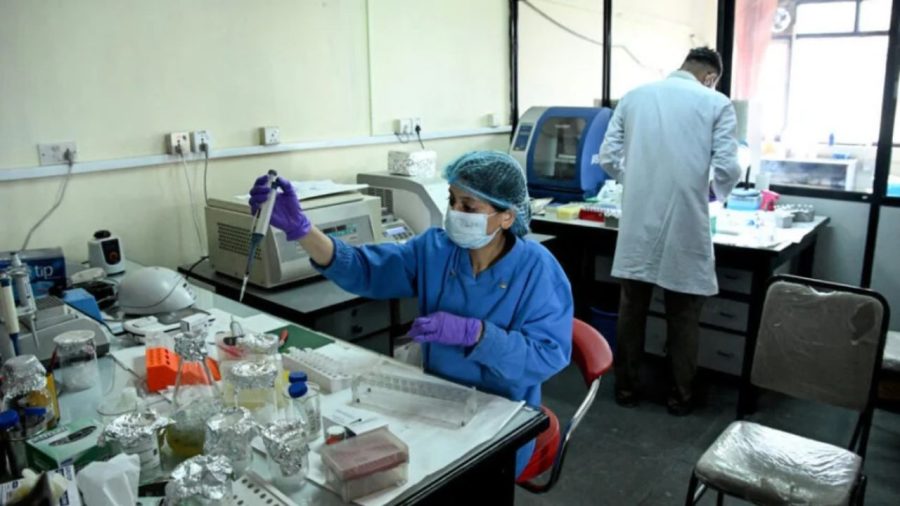
At Nepal’s two forensic laboratories, both located in Kathmandu, scientific staff are working to analyse samples and create a DNA database on a scale they have never handled before.
“In a year we would analyse 1,000-1,500 samples, often in case of paternity or crime scenes,” said Mukul Pradhan, chief scientific officer at the National Forensic Science Laboratory.

“We are now processing thousands of samples,” Pradhan added.
A total of 3,685 forensic samples are currently undergoing DNA testing, including more than 1,300 collected from recovered bodies.
The time needed to process samples varies depending on the type of specimen. Blood samples are easier to profile, while samples taken from teeth or bones can take several days.
The identification process is further complicated by the fact that floodwaters carried some bodies far downstream.



Nirajan Thapa, Chief of Biology section at the National Forensic Science Laboratory, said the situation was different from an earthquake or accident, when victims are generally recovered from a specific area.
“In an earthquake or accident, victims are recovered in a specific area, allowing experts to work in a closed scenario where a body’s DNA is compared against a limited number of samples,” Thapa said.
“But that scale has now become very large,” he added.
Thapa said extracting a DNA profile from remains was not enough to identify a victim. Authorities also need reference samples from relatives, meaning profiles from both unidentified remains and thousands of family members must be processed before matches can be established.
To manage the large number of recovered remains, Nepal has buried more than 1,200 bodies. Authorities have carefully numbered and tagged the bodies so they can be retrieved if a DNA match is found.
“A large number of people are missing, and the bodies that have been found they are difficult to identify,” said Nepali police spokesman Abi Narayan Kafle.
“We understand the pain people are in, and our teams are working diligently,” Kafle added.
Several countries have sent teams to support Nepal’s overwhelmed forensic capacity, including neighbouring India and China, as well as South Korea. Fingerprint experts from the United States and Singapore are also assisting on the ground.
Thapa said DNA matching could begin within a few weeks with the help of the international teams.
However, experts warn that matching the remains to families could ultimately take weeks because of fragmented remains, limited technical capacity and manpower constraints.
Until the results are available, families remain in a painful limbo. Some have held symbolic cremation funerals for relatives who remain missing.
Among those waiting for answers is 53-year-old Rajesh Ram, whose son Suroj Kumar, a garage mechanic from Betrawati, went missing after his town was overwhelmed by floodwaters.
Clutching a photograph of his son, Ram searched everywhere but could not find his body. He is now relying on DNA testing for an answer.
“I am waiting if I can find any remains of my son,” Ram told AFP, wondering if he will ever receive closure.