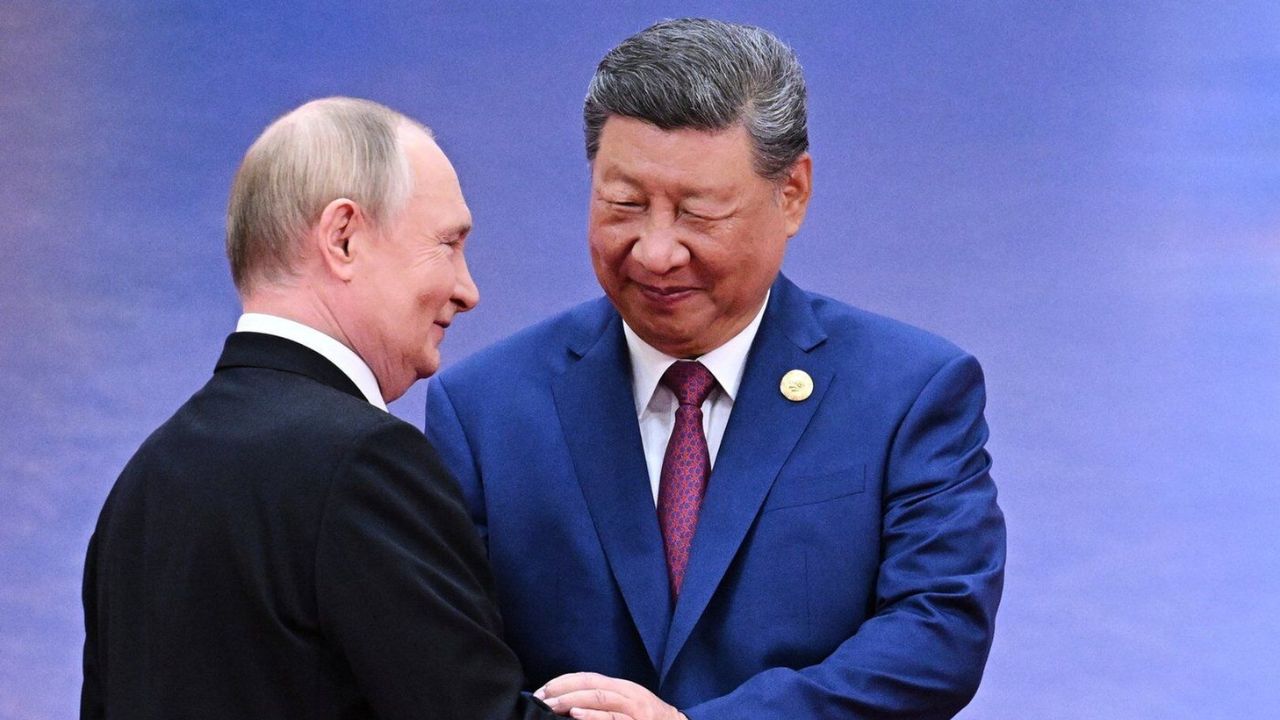



Russian President Vladimir Putin is set to visit Beijing this week to mark the 25th anniversary of the Treaty of Good-Neighbourliness and Friendly Cooperation, highlighting the enduring partnership between Russia and China.
The visit comes shortly after US President Donald Trump met Chinese President Xi Jinping, underlining Beijing’s careful balancing of relations with Moscow and Washington, reports the BBC.
The relationship between the two countries is often described as a “friendship with no limits.” Analysts say it is highly asymmetrical: China is Russia’s largest trading partner, while Russia accounts for just 4 per cent of China’s international trade.
Economic and technological ties have strengthened as Western sanctions have pushed Moscow closer to Beijing, with Russian reliance on Chinese components for its war effort in Ukraine increasing to over 90 per cent, according to recent reports.
Yet, despite the imbalance, the relationship is not without nuance. Russia remains cautious about appearing subordinate.
Dmitry Trenin, president of the Russian International Affairs Council, has stressed that Moscow seeks to maintain “an equal footing” and does not intend to be a junior partner.

Russia’s pride and independent decision-making, such as its recent stationing of nuclear weapons in Belarus despite Chinese advice, reinforce that sovereignty remains central to its foreign policy.
China, for its part, has shown restraint. “China is not pushing Russia around,” says Marcin Kaczmarski, lecturer in security studies at the University of Glasgow.
Beijing recognises the asymmetry but avoids creating backlash within Russia or among its elites. Strategic patience has allowed China to cultivate influence without provoking resentment, a dynamic evident during Xi’s 2023 Moscow visit and subsequent Russian actions in Ukraine.




The partnership extends beyond economics. Russia provides critical military technologies and energy resources, including the proposed Power of Siberia 2 pipeline, expected to deliver 50 billion cubic metres of gas annually to China via Mongolia.
These ties support China’s long-term energy security amid geopolitical volatility, while offering Moscow vital markets amid strained Western relations.
Analysts note that China and Russia are not formal allies, which gives the partnership flexibility. Bobo Lo, former Australian diplomat in Moscow, says this “strategic flexibility” allows both nations to cooperate while maintaining autonomy.
Shared borders, complementary economies, and mutual opposition to a US-led world order underpin the relationship.
Unlike Western nations, both overlook internal criticisms, including human rights issues in Xinjiang or political repression in Russia, creating a pragmatic, symbiotic alignment.
The human dimension is also emphasised. Putin and Xi project a personal friendship that reinforces diplomatic ties.
Putin has visited China 25 times, and Russian officials frequently engage with Chinese counterparts. However, analysts suggest that broader societal connections remain limited.
Former British diplomat Charles Parton observes that ordinary Russians and Chinese have little inclination to live or invest in each other’s countries, preferring Western destinations for education and property.
The partnership has also been shaped by history. Carnegie Moscow Center’s Alexander Gabuev notes that pragmatism in relations dates back to the Soviet era, through Andropov, Chernenko, Gorbachev and Yeltsin, with
Beijing maintaining a consistent approach. Today, the public presentation of unity serves political purposes, projecting stability and deterring external interference, while allowing each side to pursue distinct objectives.
While Western analysts sometimes depict the relationship as either an authoritarian axis or a fragile alliance, experts argue it is a durable, strategic partnership that balances asymmetry with mutual benefit.
China and Russia maintain separate priorities: Russia seeks a world order independent of the US, while China pursues measured, long-term gains, evident in its cautious response to US actions in Iran.
The combination of economic dependence, strategic restraint, and political pragmatism ensures that China and Russia remain closely aligned, despite differences in power and global ambitions.