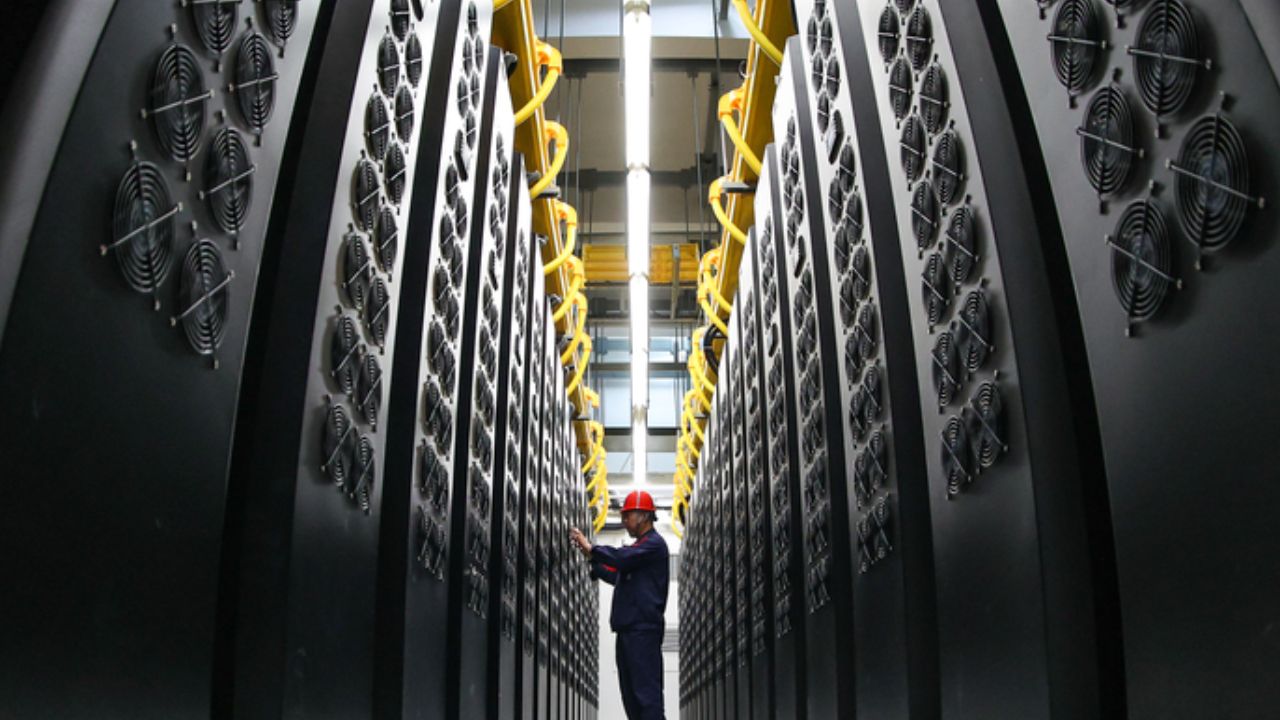



A Chinese supercomputer has overtaken its American rivals to be named the most powerful in the world, marking the first instance since 2017 that China has led the global rankings.
The LineShine machine, which is based in Shenzhen, secured the number one position in the Top500 list published on Tuesday, surpassing the previous frontrunner, the US-based El Capitan. The list is widely considered a key indicator of a nation’s technological standing and global influence.
According to project scientists, LineShine reached a performance of 2.198 exaflops, giving it the capacity to carry out more than 2 quintillion calculations per second, reports The Guardian.

In a shift from many high-performance systems that utilise graphics processors (GPUs) for AI tasks, LineShine is notable for running entirely on conventional computer chips (CPUs). The facility, located at China’s National Supercomputing Centre, has an electrical requirement of approximately 42.2 megawatts.
With El Capitan, housed at Lawrence Livermore National Laboratory in California, falling to second place, the United States now holds the second, third, and fourth positions, with the latter two located at national laboratories in Tennessee and Illinois.




Germany’s Jupiter system has moved down to fifth place. These five machines are currently the only exascale computers that have been publicly verified. Other nations featured in the top 10 include Italy, Switzerland, and Japan.
The United Kingdom is represented by 11 machines in the top 500. The highest-ranked British entry is the University of Bristol’s Isambard-AI, which dropped two places to 11th despite its 5,400 Nvidia “superchips”. Meanwhile, Western Australia’s Setonix remains the top Australian machine, placed 86th.
Functioning over 1,000 times faster than standard hardware, supercomputers are vital for scientific progress. They are used to model climate systems, seek medical breakthroughs, simulate nuclear detonations, predict human behaviour, and conduct virtual weapons testing.
To capitalise on the strategic value of this technology, the European Union has announced a €20 billion (£17b) initiative to build massive supercomputing sites for the development of next-generation AI models.
These intended AI “gigafactories” are expected to pursue “moonshot” goals in sectors including healthcare, biotech, and robotics.
However, the significant power consumption of these facilities remains an issue. EU officials have indicated that these high-energy centres should ideally be powered by green energy and employ water-recycling systems for cooling, as environmental campaigners worry that such developments could conflict with climate targets.