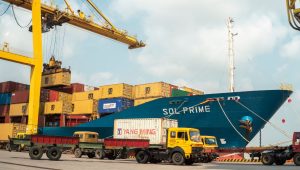
Chattogram Port, widely regarded as the “heart” of Bangladesh’s economy, handles around 3 million to 3.5 million twenty-foot equivalent units (TEUs) of containers and over 138 million tonnes of cargo annually, alongside at least 5,000 trucks and several hundred lighterage vessels each day.
The high-intensity flow of trade highlights a logistics ecosystem widely described by industry stakeholders as fragmented, costly, and structurally inefficient.
The system is governed by at least nine ministries and more than 20 agencies, creating overlapping jurisdictions that slow clearance, transport, and distribution across supply chains.
Trucks often wait for hours, and in many cases, days or weeks, to collect cargo for distribution across the country. Customs clearance remains time-consuming, forcing importers and exporters to make repeated visits to the Chattogram Customs House over extended periods.
Bangladesh’s logistics sector—long viewed as the backbone of trade—is increasingly seen as one of the country’s most inefficient and costly systems, constrained by fragmentation, congestion, weak governance, and outdated practices that erode competitiveness in domestic and global markets.

A World Bank analysis shows logistics costs vary sharply across sectors, from 4.5 per cent of sales in leather footwear to 47.9 per cent in horticulture. Inventory holding alone accounts for 17 to 56 per cent of total logistics costs, exceeding 30 per cent in most industries.

Congestion can double trucking costs and reduce average speeds to around 19 kilometres per hour, less than half of optimal conditions. At Chattogram Port, dwell times average about 11 days for imports and four days for exports, significantly above regional benchmarks. Eliminating congestion alone could reduce logistics costs by 7 to 35 per cent.
Policy Exchange Bangladesh Chairman M Masrur Reaz, citing World Bank estimates, said logistics costs account for 15 to 20 per cent of GDP, compared with a global average of 8 to 10 per cent. He added that a 25 per cent reduction in logistics costs could lift exports by about 20 per cent, while a 1 per cent reduction in transport costs could raise exports by 7.4 per cent.
Chattogram port: the heart of a strained system
After clearance at Chattogram Port, which handles over 90 per cent of the country’s trade, cargo movement remains heavily road-dependent compared to rail, which accounts for only 5–10 per cent, mainly on the Chattogram–Dhaka corridor.
Inland waterways handle about 70 per cent, largely bulk cargo, creating a structural imbalance that intensifies congestion and raises logistics costs.


Chattogram Port Chairman Rear Admiral Moniruzzaman told TIMES of Bangladesh that cargo passes through eight to ten agencies, with Customs playing the dominant role. According to him, port-side efficiency has improved, particularly vessel turnaround, but coordination across agencies has not kept pace.
“The port has improved, but the surrounding ecosystem has not evolved at the same speed,” he said.

Users report that cargo clearance can take five to ten days for imports and two to four days for exports, depending on documentation, inspections, and vessel schedules. Inefficiencies in yard management, manual processes, and inter-agency delays often extend these timelines, increasing demurrage costs and weakening supply chain reliability.
The logistics sector is governed by at least nine ministries and more than 20 agencies responsible for regulation, infrastructure, and service delivery. The fragmented structure has created siloed development across transport modes, producing mismatched infrastructure standards and weak coordination. Experts point to inconsistencies such as bridges narrower than approach roads as evidence of systemic planning gaps.
High inventory costs and supply chain pressure
Unpredictable logistics performance forces firms to maintain high inventory buffers.
Export-oriented sectors such as garments, footwear, and pharmaceuticals hold stocks ranging from several weeks to six months to manage disruptions. Inventory carrying costs account for 17 to 56 per cent of total logistics expenses, while 53 to 75 per cent of inventories are affected by transport and delivery disruptions, depending on the sector.
Truck operators report informal payments of around 11 per cent of operating costs at checkpoints and chokepoints, costs passed on through supply chains to consumers and exporters. Overloading, weak enforcement, poor maintenance, and exposure to natural disasters further degrade road conditions and transport reliability.
Dhaka-Chattogram corridor: the broken artery
Chattogram Chamber of Commerce and Industry President Amirul Haque described the Dhaka–Chattogram highway as the “main artery” of the economy. “If Chattogram Port is the heart, then this highway is the artery connecting it to the body,” he said.
He noted that the 300-kilometre journey, which should take three to four hours, currently takes around six hours due to congestion and infrastructure constraints, questioning why an expressway has not been developed. Despite basic infrastructure across road, rail, and waterways, Bangladesh lacks effective intermodal integration.
About 91 per cent of shippers rely on fragmented services for different legs of a shipment, while 80 per cent report unprofessional conduct and 60 per cent report a lack of tracking systems.

Third-party service providers are often small-scale, under-skilled, and technologically outdated. Poor driving standards alone account for around 11 per cent of truck operating costs due to accidents and inefficiencies, prompting firms to shift logistics operations in-house.
Former Bangladesh Shipping Agents Association President Syed Mohammad Arif said cargo handling at inland river terminals such as Sadarghat and Majhir Ghat remains largely manual. “Hundreds of workers carry thousands of tonnes manually when conveyor systems could handle this more efficiently,” he said.
Bangladesh Freight Forwarders Association Vice President Khairul Alam Sujan said the country has the potential to directly supply global retail markets but remains constrained by weak logistics systems and shortage of skilled manpower.
Coordinated reform urged
The National Logistics Policy 2024 aims to modernise the sector through digitalisation, infrastructure development, and integrated connectivity across ports, transport networks, and industrial zones.

However, stakeholders say weak coordination and unclear implementation mechanisms continue to delay progress. A high-level committee led by the Prime Minister’s Principal Secretary is revising the framework in phases, and the upcoming budget is expected to address automation needs.
“Logistics sector stands at a critical crossroads,” M Masrur Reaz told TIMES of Bangladesh. Without coordinated reform, he warned, logistics inefficiency will remain a persistent structural drag—eroding competitiveness, slowing trade, and constraining long-term growth.