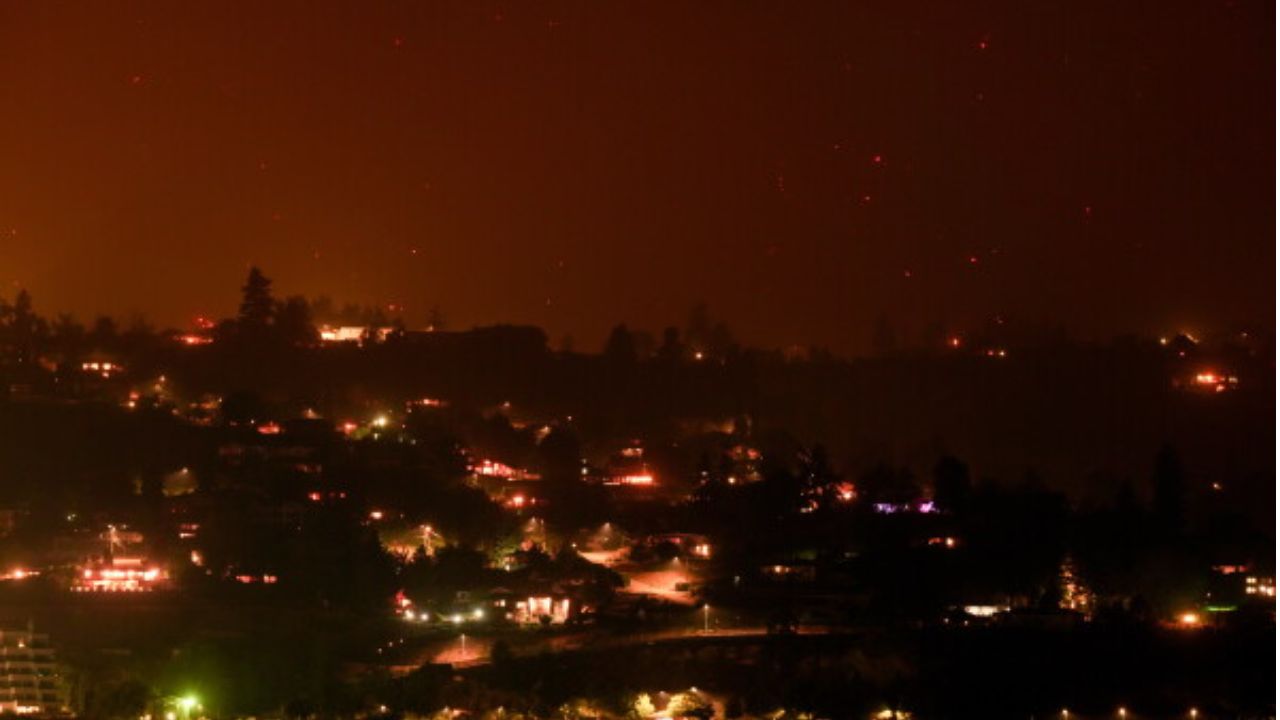



A state of emergency has been declared in western Canada after thousands of people were forced to flee their homes as a fast-moving wildfire rapidly expanded, doubling in size since it was first detected on Friday.
Police said one person had died in the Bald Range fire, which has spread across 53 square miles (136 sq km) in Summerland and other parts of British Columbia, according to the BC Wildfire Service, reports BBC.
“We have to brace ourselves for the worst,” Summerland Mayor Doug Holmes told Reuters. The Summerland area has been evacuated, along with thousands of residents in nearby communities.
Officials said the flames had become so intense that they had created their own weather systems, generating lightning.
Canadian police said on Sunday that an 80-year-old woman from Meadow Valley, north-west of Summerland, died suddenly while trying to flee her home with a family member.
“Police believe her death to be a result of the wildfire,” police said in a statement.
Keegan Radomski, a Summerland resident, said she evacuated her home only moments before the fire reached her property.

In a video she shared, burning treetops can be seen just over the hill beyond the road where Radomski escaped.
“This is right by our house,” she said in the video, her voice trembling.
Radomski said she has been unable to return home since fleeing with seven others on Friday. She is now waiting anxiously to learn whether her home will still be standing. Some neighbours who remained behind have told her that several homes on their street have burned down.
“There are homes that have been confirmed gone, and a lot are in the area near our home. So, we’re pretty scared,” she said. “The uncertainty is scary.”
Residents who spoke to the BBC described the wildfire as one that intensified dramatically with little warning before reaching its current size of 13,618 hectares (33,650 acres).




British Columbia Premier David Eby told a news conference on Saturday that one fire official had compared the blaze to “a bomb going off”.
“Homes have been lost, and properties have been destroyed. Some people became trapped as conditions changed very quickly, and needed to be rescued,” the premier said.
The state of emergency gives the provincial government access to special powers, including imposing travel restrictions, protecting supplies to prevent price gouging and deploying additional resources to co-ordinate rescue operations.
Summerland, which has a population of about 12,000, has been among the worst-hit areas and has been evacuated. Parts of Peachland, home to about 6,500 people, have also been evacuated.
“We have been on evacuation alert many times,” said Earl Kurz, a Peachland resident of 30 years. “This is the first time we were actually evacuated.”
Kurz was on a boat with his wife on Okanagan Lake on Friday afternoon when he saw clear blue skies rapidly turn hazy grey. By nightfall, dark clouds of smoke from a raging wildfire had appeared, with the flames heading towards him.
“We watched it from the lake,” he said. “It was unreal.”
Hours later, police knocked on his door and ordered him and his wife to evacuate.
Kurz said they are now safe in a camper several miles away.
The Bald Range wildfire triggered the largest evacuation event of the summer, with more than 20,000 people across British Columbia forced to leave their homes, officials said.
“A lot of farms have been affected. We don’t know how many structures have been lost. They’re still busy fighting the fire,” Summerland Mayor Doug Holmes said.
Hundreds of residents living in Summerland care facilities, including senior housing, were being moved to safer areas, according to Interior Health, a publicly funded health authority in British Columbia.
It was not immediately clear how many structures had been destroyed by the fire.
The regional districts of Central Okanagan and Okanagan-Similkameen, as well as Snpink’tn Indian Band and the districts of Summerland and Peachland, have issued evacuation orders, while some areas remain under evacuation alerts, according to wildfire officials.
In Okanagan, many residents have struggled to evacuate their horses, Canadian broadcaster CBC reported.
Those unable to relocate their animals left their gates open in the hope that the horses would find their own way to safety, local residents told CBC.
Some owners also painted markings on their animals to make them easier to identify later, according to the broadcaster.
Hundreds of wildfires have swept across Canada this summer. Nearly 200 fires were burning in Ontario in July, sending air quality in Toronto to among the worst levels in the world for several days.
Smoke from the Canadian wildfires also drifted into parts of the United States, including Minnesota and New York, prompting US President Donald Trump to threaten new tariffs on Canada’s northern neighbour.