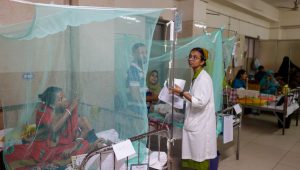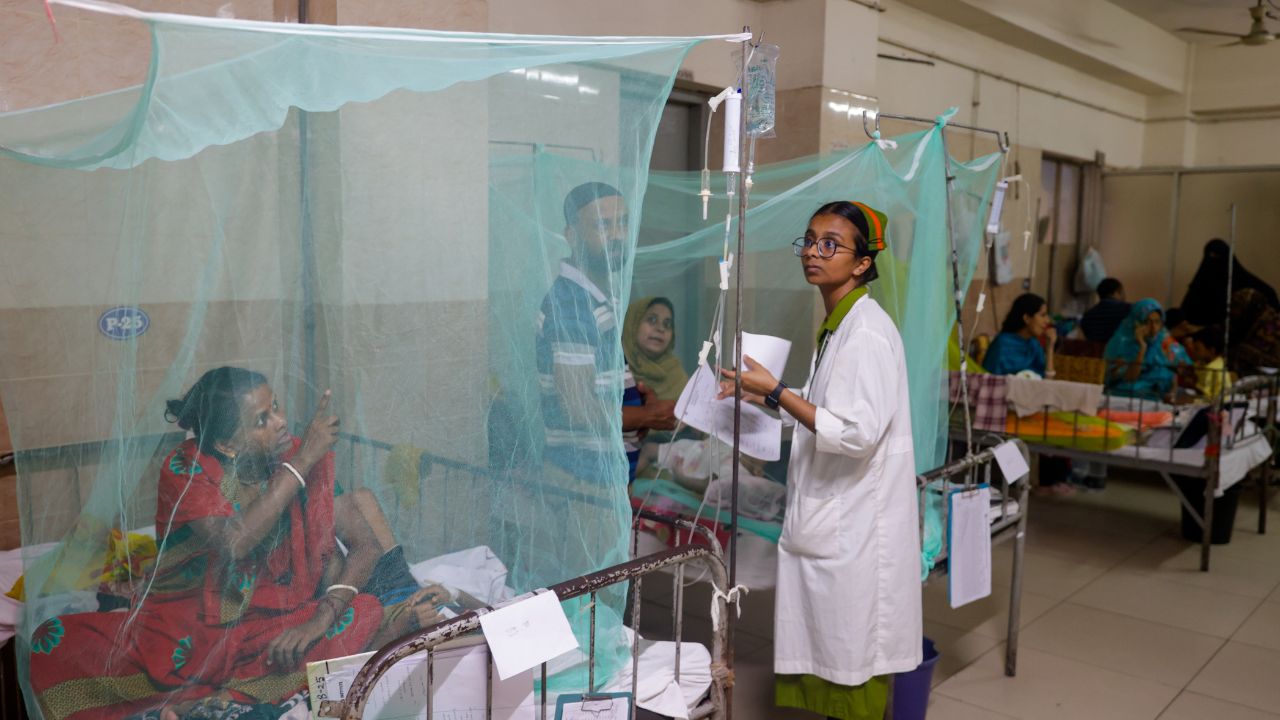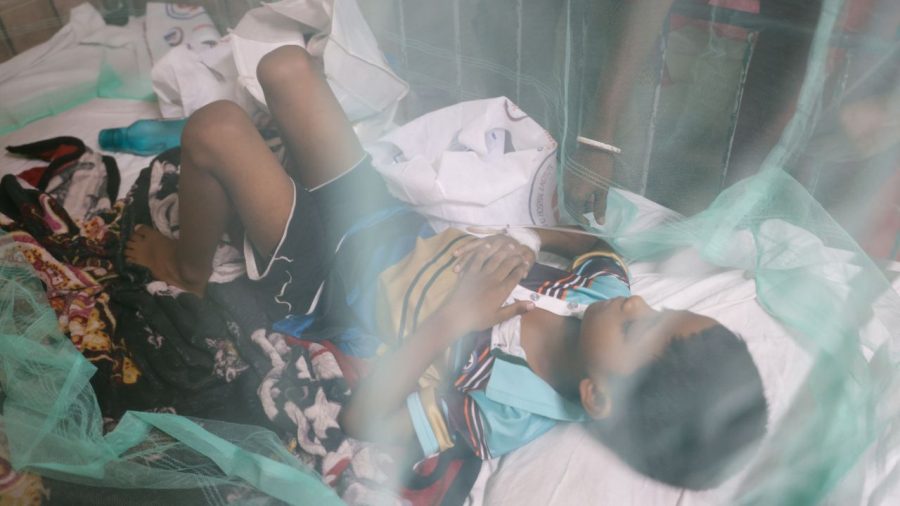



Ninety dengue patients. Two nurses on duty. One must handle admissions, discharges and paperwork, leaving the other to care for patients across the ward at Dhaka Medical College Hospital.
Marjina Akter, a senior nurse, barely has a moment to catch her breath.
During a visit to the ward last Saturday between 2pm and 3.30pm, she was constantly on the move, administering intravenous fluids to one patient before rushing to another to insert a cannula.
Her colleague, Raju Dastagir, too busy handling new admissions, discharging recovered patients and carrying out other administrative duties, stepped in to help Marjina.
“I cannot sit down for even a minute. All the patients are seriously ill, and everyone wants their treatment first,” an exhausted Marjina told TIMES.
The shortage also extends to doctors. A maximum of three are assigned to treat the 90 patients during a shift, with two working at a time while the third rests.
As dengue cases rise, hospitals are struggling to cope with the growing patient load.
Doctors and nurses face increasing numbers of critically ill patients, sudden deterioration in patients’ conditions, the risk of shock syndrome and misconceptions among patients that complicate treatment.
The mounting pressure leaves medical staff with little time to rest, while diagnosis and treatment management become increasingly difficult.

Intern doctor Roksana Akter has worked in the ward for nearly a month, completing 11 night shifts and 13 day shifts.
“On days when I have a night shift, I do not get home until 10pm. The following morning, I have to return by 8am for the next shift,” she said.
The situation was similar in another dengue ward at the hospital, where 70 patients were admitted.
Only one doctor, Shah Md Galib Alam, was seen attending to patients. He said another doctor had been on duty but was resting after becoming exhausted.
At Sir Salimullah Medical College Hospital in Old Dhaka, doctors were also struggling with the influx of dengue patients.
“A large number of critically ill patients are suddenly arriving and we have to make rounds three times a day for every patient. If someone suddenly develops shock syndrome, we have to rush to that patient as well,” said Dr Turin Ahmed.


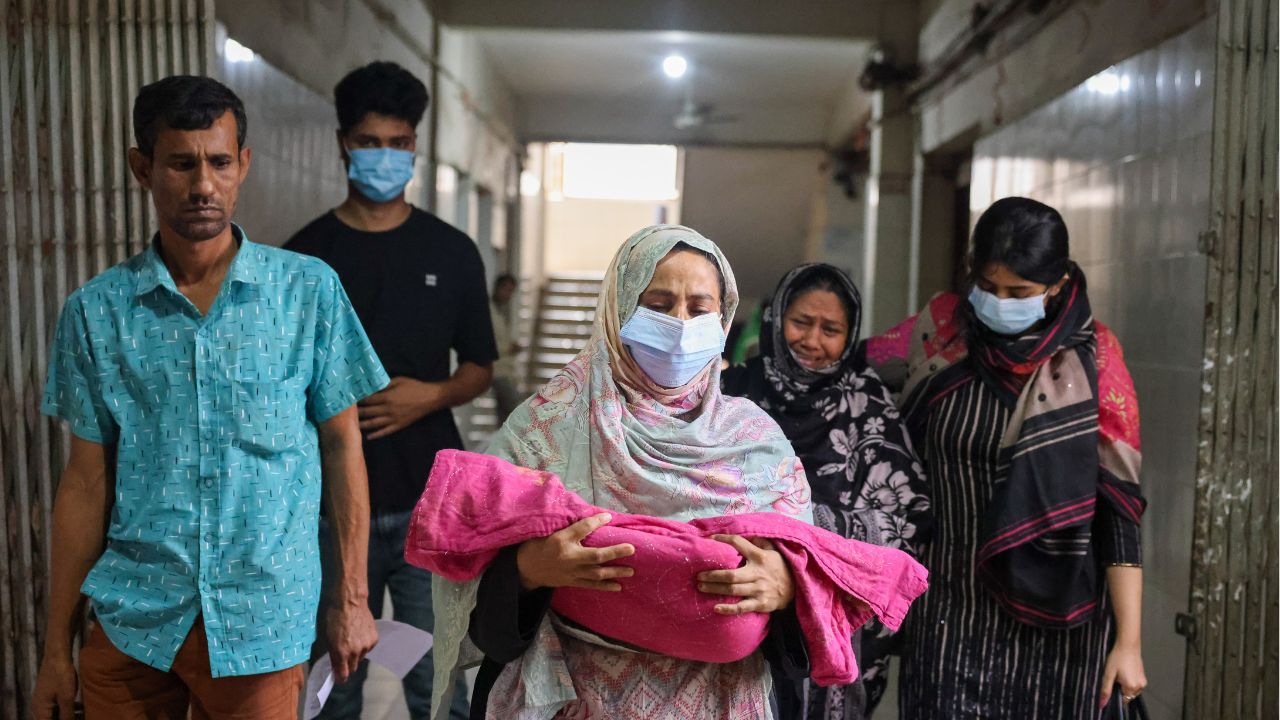

Dengue shock syndrome can cause a patient’s blood pressure and circulation to deteriorate rapidly to dangerous levels, requiring close monitoring and immediate treatment.
But doctors must respond to such emergencies while continuing regular rounds, attending to other patients and managing new admissions, often juggling several responsibilities at once.
The pressure on dengue wards reflects a wider shortage of healthcare personnel across Bangladesh’s public hospitals, where the uneven distribution of doctors and nurses and longstanding vacancies have made it increasingly difficult to manage patient numbers.
A study by the Department of Population Sciences at the University of Dhaka, titled “Potentials of Health Workforce for Harnessing Demographic Dividend in Bangladesh: Opportunities, Challenges and Policy Implications,” found that the country has just 0.73 registered doctors per 1,000 people.
Of these, only 0.18 doctors per 1,000 people work under the Directorate General of Health Services (DGHS).
Across the DGHS and other government health departments, 28.6 per cent of all positions remain vacant, while the vacancy rate among doctors stands at 22.5 per cent.
According to health ministry data, government hospitals employed 30,311 doctors as of September 2026, with another 11,495 positions vacant.
The shortage is even more acute among nurses and other healthcare workers.
Bangladesh has 12.78 healthcare workers per 10,000 people, compared with the 45.5 recommended by the World Health Organization (WHO).
The WHO says there should be three nurses for every doctor, but Bangladesh’s approved staffing structure provides only 0.74 nurses per doctor.
The organisation also sets a benchmark of five midwives for every doctor, while Bangladesh’s hospitals do not have even one midwife per doctor.
The University of Dhaka study found that Bangladesh has just 0.549 nurses per 1,000 people, against the WHO benchmark of 1.48.
Based on that comparison, the researchers estimated a nationwide shortage of around 165,552 nurses.
Beyond vacancies, absenteeism remains a longstanding obstacle to maintaining healthcare services, particularly in district towns and upazila hospitals. Staff absences place an additional burden on those who report for duty.
The strain became evident in a video featuring Sakia Haque, a doctor at Bagerhat Sadar Hospital, which recently went viral on Facebook.
She had been assigned to the emergency department from 2.30pm last Sunday until 8.30am on Monday. Throughout that period, she was the hospital’s only doctor on duty, with intern doctors assisting her.
That night, relatives of a patient attempted to assault her.
“There are around 450 patients in this 250-bed district hospital. At 1am, I am the only doctor on duty for all these patients,” she said in the video.
The pressure, she said, does not come from patients alone.
“Amid all this, doctors have to deal with calls from higher authorities, recommendations from acquaintances and various other pressures.
Many give in to these pressures for fear of losing their jobs.”
A study published in the National Library of Medicine, titled “Dengue outbreak and fragile healthcare system: Doctors at the verge of mental and physical stress,” found that 41.5 per cent of healthcare workers in dengue wards experienced high levels of emotional exhaustion.
Another 35.5 per cent showed high levels of depersonalisation, while 61.3 per cent reported a reduced sense of personal accomplishment.
Among doctors, 15.9 per cent were suffering from severe work-related exhaustion, or burnout.
DGHS Hospital Branch Assistant Director SM Mahmudur Rashid said, “We certainly have a shortage of doctors. Even so, additional doctors have been assigned in preparation for the dengue season. If there is still a shortage, the hospital administration will appoint additional doctors,” he told TIMES.