
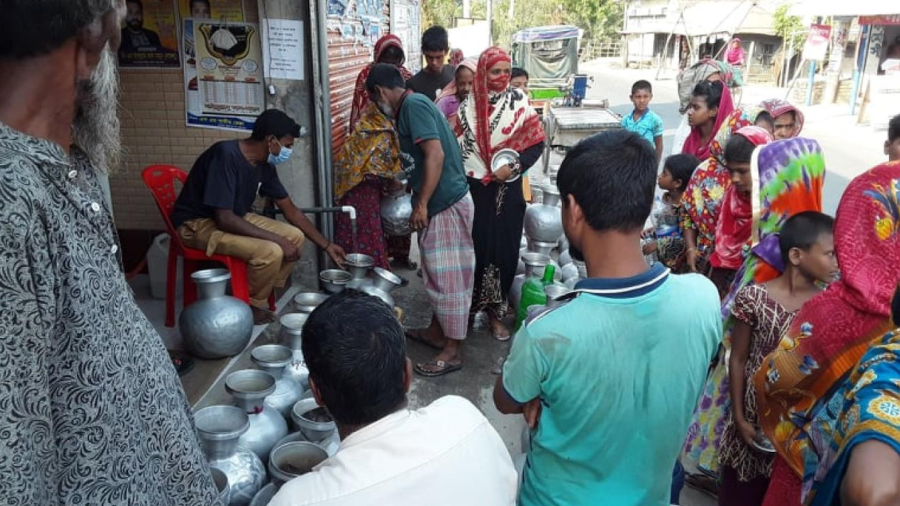



Recent national statistics and international research present a sobering reality check that we can no longer afford to ignore. According to recent data from the Department of Public Health Engineering (DPHE) and the Bangladesh Bureau of Statistics (BBS), while approximately ninety-nine percent of the population uses some form of improved water source, only slightly over fifty percent benefit from safely treated and stored drinking water. The escalating spread of harmful E. coli bacteria, arsenic contamination, and progressive salinity intrusion in household water supplies, compounded by the severe shocks of climate change, are actively slowing down our progress in public health and human capital development.
Marginalised populations, particularly in coastal regions, haor basins, the Barind tract, and northern zones, along with children, bear the heaviest brunt of these compounding health hazards. At this critical juncture, a historic ruling by the High Court Division last year illuminated a new path forward.
The judiciary explicitly declared that the right to safe drinking water is an inseparable component of the right to life enshrined under Article 32 of the Constitution, establishing the state as its ultimate guardian. Rivers, wetlands, and groundwater are now formally recognised as national assets and a public trust dedicated to collective welfare. This constitutional verdict does more than bind us within the narrow parameters of domestic legislation; it firmly anchors Bangladesh to international human rights obligations, the United Nations-recognised human right to safe water and sanitation, and shared global objectives. It serves as a powerful catalyst toward achieving Sustainable Development Goal 6 (SDG 6), directly contributing to the preservation of national public health and ecological equilibrium. By aligning with the 1997 UN Watercourses Convention and various international frameworks, Bangladesh is poised to set an exceptional precedent for environmental justice and climate resilience on the global stage.
This pressing agenda of safe water is deeply intertwined with the current government’s declared ‘Bangladesh First’ philosophy and its grand vision of transforming into an upper-middle-income nation powered by a trillion-dollar investment-driven economy. The government’s electoral manifesto pledges to raise the health budget to 5% of GDP, strengthen disease prevention and awareness at the grassroots level, and safeguard maternal and child health, with a national safe water initiative as a primary driver. As a symbol of trust for international climate funds and global partners, this endeavour will transcend national borders and multiply Bangladesh’s prestige on the international stage.

Concurrently, specific government commitments, such as building hygienic school sanitation facilities, ensuring safe menstrual hygiene and sanitary provisions for women and girls, and strengthening grassroots governance through local autonomy, adequate funding, institutional accountability, and an effective village government system, will find their ultimate fulfilment through this initiative.
This aligns seamlessly with the global vision of ensuring economic prosperity alongside water security, notably the World Bank’s “Water Forward” initiative, which aims to secure water security for one billion people worldwide. To give a concrete shape to this massive undertaking, the proposed national initiative rests upon five clearly defined pillars. First, securing the protection of safe water for economic transformation and human resource development. Second, enhancing climate resilience and adaptive capacities for populations residing in coastal, flood-prone, and drought-affected regions. Third, halting pollution and restoring natural water reservoirs to protect rivers and water bodies. Fourth, guaranteeing safe sanitation through the modernisation of waste and faecal sludge management. Fifth, establishing good governance, institutional capacity, and sustainable financing frameworks.
Furthermore, the administration maintains concrete plans to protect and dredge rivers and canals while curbing pollution in major urban hubs, including the capital city of Dhaka. Alongside implementing the Teesta Master Plan, the Padma Barrage, and comprehensive water resource preservation efforts, this vision includes a firm commitment to building a modern circular economy by converting waste into organic fertiliser, biogas, and recyclable energy. Planned urbanisation, advanced waste management, Public-Private Partnership (PPP) models, coupled with a strict anti-corruption stance, open public bidding, and absolute institutional transparency championed by the government, render this blueprint profoundly meaningful.




To propel this overarching vision toward practical execution, a pioneering policy paper titled ‘Safe Water for All’ has been formulated under the stewardship of the Ministry of Local Government, Rural Development and Cooperatives. Under the Heads of State Initiative, this national undertaking is currently awaiting deliberation at the highest echelons of government. This final position paper was formally submitted to the Local Government Division in July of this year, and the newly appointed minister is actively moving it forward along the implementation trajectory.
Guided by the Local Government Division, this framework will soon be finalised through rigorous consultations with relevant ministries, departments, local government institutions, and sector experts. After cabinet approval, it will be presented to the Honourable Prime Minister and, with their sincere concurrence, will begin its official journey through a historic national compact or declaration. This compact will be implemented by setting specific national targets, priority reforms, institutional accountability, and transparent budget allocations over the next five years.
To render this journey even more meaningful and dynamic, the ‘Network of WASH Networks’ has played a highly commendable and visionary facilitating role. Coordinated by WaterAid, this coalition stands alongside the government as a powerful, unified civil society platform. From policy formulation to grassroots awareness-raising, good governance, and public opinion building, this platform operates as a trusted partner of the state. Additionally, domestic and international development partners, including UNICEF, the World Bank, the Asian Development Bank, and the World Health Organization, stand ready to accelerate this national effort through vital technical and financial assistance. This tireless synergy between policymakers and development partners has built an extraordinary bridge, serving as a primary catalyst for creating a safe, habitable Bangladesh for future generations.
According to World Health Organization data, investments in water and sanitation are among the most cost-effective investments in human development, yielding high financial and social returns. They reduce child mortality, eradicate malnutrition, and multiply labour productivity manifold.
As we approach National Sanitation Month throughout October, if the Prime Minister steps forward with profound sincerity to sign this historic compact, it will stand out as one of the current administration’s most momentous and visionary political decisions.
Just as Bangladesh once demonstrated a sanitation revolution to the world, the time has come to show the same political resolve and national unity. With policymakers, development partners, and conscious civil society working together, we must now unite to advance this historic compact and transform our beloved Bangladesh into a shining model of safe drinking water.
The views expressed in this article are those of the author
The writer is a development professional