


Every time the donation boxes at Kishoreganj’s Pagla Mosque are opened, they yield crores of taka, attracting nationwide attention. Yet far less is known about how the money collected by one of the country’s most talked-about mosques is actually spent.
The mosque management committee says the donations are deposited in an account with Rupali Bank, where the balance has already exceeded Tk131 crore. Once the latest collection of gold and silver ornaments is sold, the total is expected to surpass Tk150 crore.
The funds have traditionally been overseen by a committee headed by the deputy commissioner (DC), with the municipal mayor serving as general secretary.
The committee previously had a maximum of 35 members, including freedom fighters, journalists, lawyers and representatives from various professions.
An interim committee is currently responsible for managing the mosque, with the deputy commissioner serving as convener and the Sadar upazila nirbahi officer (UNO) as member secretary.
Committee members said the donations are used not only for religious activities but also for education, humanitarian assistance and infrastructure development.
Mosque Management Committee Member Secretary and UNO Md Kamrul Hasan Maruf told TIMES, “Alongside religious activities, the funds are spent on supporting underprivileged students, vulnerable people and various social welfare initiatives. We also provide financial assistance to people suffering from serious illnesses.”
Donations cover the mosque’s operating and maintenance costs, including the salaries of employees working at the mosque and madrasa, as well as other day-to-day expenses.
More than 100 orphaned and financially disadvantaged students receive free education, accommodation and meals at the Nurul Quran Hafizia Madrasa within the mosque complex.
Their educational and living expenses are also covered by donations.

The mosque and madrasa together employ 36 people.
In the past, financial assistance was also provided to other mosques, madrasas and orphanages in the district. However, donations to other mosques have now been suspended.
Explaining the decision, the UNO said, “The donations are deposited in a bank account, where they earn interest. According to religious rulings, interest income cannot be used for mosque-related activities. Therefore, financial assistance to other mosques has been suspended for the time being.”
Plans for a modern Islamic complex
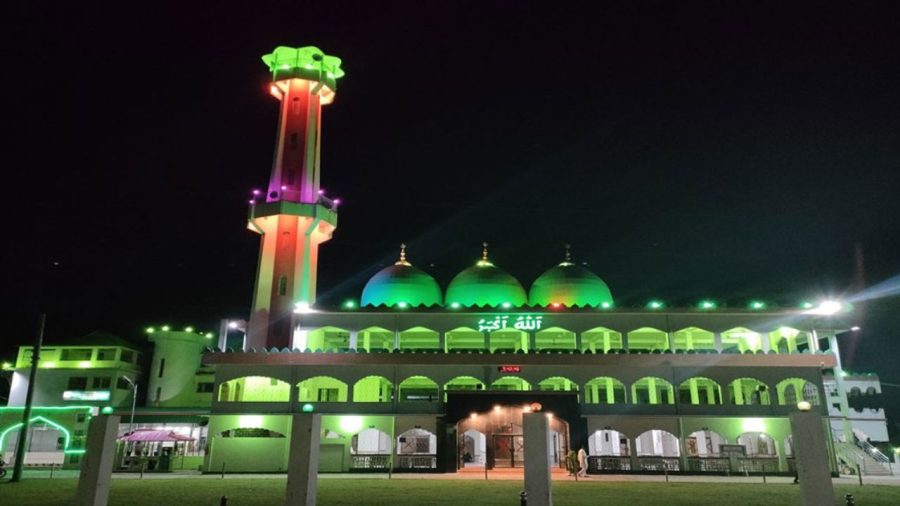
The mosque management committee has also drawn up plans to transform Pagla Mosque into a modern, multi-storey Islamic complex with extensive facilities and an attractive architectural design.
Work on the project’s final design is nearing completion.
Committee Member Secretary Kamrul Maruf said the six-storey complex would be built on five acres of land at an estimated cost of Tk115 crore.




It will accommodate several thousand worshippers at a time, with a separate prayer area for women.
Other planned facilities include car parking, an academic building, a guesthouse, a madrasa and a library.
The complex will also feature a 120-foot illuminated minaret and an automated lighting system.
Once construction is completed, around 40,000 worshippers will be able to offer prayers simultaneously on special occasions, using both the main mosque building and its surrounding grounds, he said.
Meanwhile, separate initiatives have been undertaken to construct three new prayer sheds, a larger ablution facility and a dedicated washroom block for women.
The projects are estimated to cost Tk1,10,88,464, with work orders issued on 27 September.
Donations come from people of all faiths
Pagla Mosque receives donations not only from Muslims but also from Hindus, Buddhists and Christians, according to longtime night watchman Md Mokbul Hossain.
Mokbul has worked at the mosque for nearly 30 years.
He said donations previously came mainly from residents of surrounding areas, but people now travel from across Bangladesh to contribute. Foreign visitors also come to the mosque.
“Just as many people come to donate during the day, others arrive in vehicles late at night to put money into the donation boxes,” he said.
According to Mokbul, worshippers and visitors donate not only cash and foreign currencies but also gold ornaments, ducks, chickens, cattle, goats and various other items.
Donations continue to rise
The substantial donations collected at Pagla Mosque began attracting widespread attention in early 2015, when eight donation boxes were opened and found to contain approximately Tk65 lakh and some gold ornaments.
Since then, contributions have continued to increase.
Towards the end of 2016, the amount collected from the donation boxes exceeded Tk1 crore for the first time.
Donations have grown steadily over the years, both in volume and value.
Pagla Mosque currently has 13 donation boxes.
When the boxes were last opened on 27 June, they yielded Tk15,90,80,146.
Earlier, Tk11,78,48,538 was collected on 27 December 2025, while the collection on 12 April that year amounted to Tk9,17,80,687.
Between 2022 and 2024, the boxes were opened 11 times, yielding a combined Tk56,38,52,660 over the three years.
The mosque’s regular donation boxes are generally opened every four to eight months, while the boxes containing ornaments are opened once every five to six years.
In March 2020, the ornament boxes yielded 420 bhori of gold and 188 bhori of silver jewellery.
Foreign currency worth Tk70 lakh was also collected at the time.
When the ornament boxes were opened again six years later, they contained 1,044 bhori of gold ornaments and 1,088 bhori of silver ornaments, alongside foreign currency worth approximately Tk64 lakh.
The ornaments collected six years earlier were sold for Tk1,15,04,110.
With gold and silver prices having risen and the quantity of ornaments collected this time being significantly higher, the mosque committee expects the latest sale to generate more than Tk20 crore.
The mosque currently has Tk1,31,85,44,810 deposited in its bank account.
Once the proceeds from the sale of the ornaments are added, the total is expected to exceed Tk150 crore.