


The Delhi High Court on Thursday declined to stop the Cockroach Janta Party (CJP), led by its founder Abhijeet Dipke, from holding a protest at Central Park in Connaught Place on Friday, asking the Delhi Police to regulate the gathering in accordance with the law.
A bench comprising Acting Chief Justice Nitin Wasudeo Sambre and Justice Sanjay Sharma took on record the police’s assurance that it would take “all possible measures under the law” to manage and control the gathering.
The court was hearing a petition filed by a licensed street vendor who argued that the planned demonstration could disrupt business and affect the rights of traders and vendors.
The petitioner sought directions for the police to regulate the protest in line with Supreme Court guidelines.
Representing the petitioner, the lawyer said that traders could suffer further losses if central Delhi faced another weekend of restrictions during the festive season.

“A protest is called in the heart of Connaught Place Central Park. It seems we are being targeted. This is not a site for protest,” the lawyer argued, adding that businesses had already begun shutting down ahead of the Dussehra weekend.
Additional Solicitor General Chetan Sharma, appearing for the authorities, told the court that steps had already been taken to regulate the CJP’s activities.
Protest follows earlier detentions
The court’s decision comes days after police detained hundreds of people who intended to travel to the Jantar Mantar Road area near Connaught Place for a CJP protest scheduled for 10 October over alleged electoral fraud.



The protest movement has gained wider political attention as the Congress-led INDIA bloc has also been organising demonstrations over the issue.
The two parallel campaigns against the BJP-led central government appear to be drawing closer.
The Aam Aadmi Party (AAP), which has largely stayed away from the INDIA bloc’s activities, has announced that it will join Friday’s CJP protest.
Dipke has urged participants to carry the national flag.
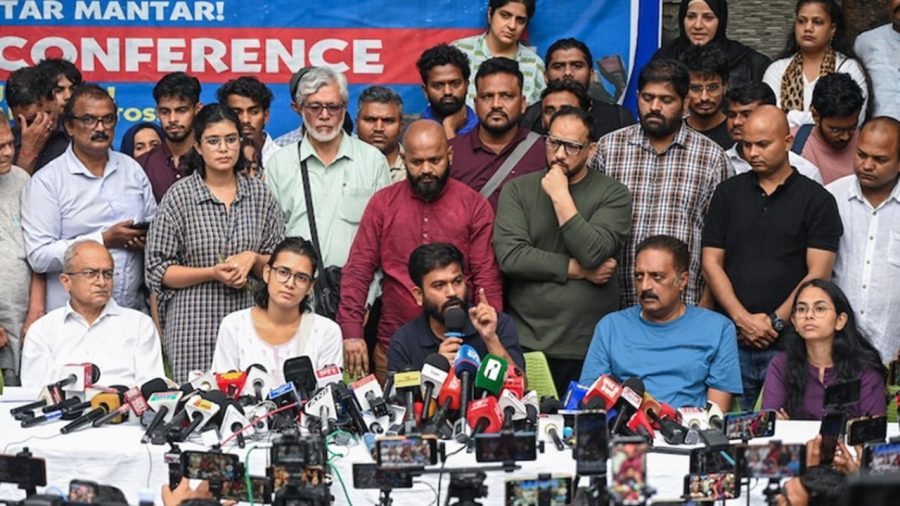
At a press conference on Thursday, Dipke alleged that students and young people had been forcibly removed from Delhi’s streets over the past two weeks. He also claimed that opposition leaders who joined the demonstrations had been detained.
Dipke linked the police action to what he described as Prime Minister Narendra Modi’s efforts to protect Chief Election Commissioner Gyanesh Kumar.
“For the past 10-15 days, students’ organisations and the youth of Delhi have been out on the streets, being dragged away. When the Opposition joined them, they were detained too, including the Leader of the Opposition Rahul Gandhi and former chief ministers like Mamata Banerjee, Arvind Kejriwal and Pinarayi Vijayan. And all this for whom? For one man, Gyanesh Kumar,” he said.
Dipke also said CJP members Saurav Das and Ashutosh Ranka were in jail after raising the national flag at Jantar Mantar earlier this week. They have been charged with trespassing, as the site had been denotified as a protest venue following the party’s original October 10 protest call.
Meanwhile, AISA activist Neha Bora alleged that journalists covering the demonstrations had been beaten, dragged away and detained for hours despite carrying press identification cards. She also alleged that cameras had been snatched from journalists.
Supreme Court takes up electoral roll petitions
Separately, the Supreme Court on Thursday issued notices to the Election Commission of India, Chief Election Commissioner Gyanesh Kumar and the two Election Commissioners on petitions filed by Rahul Gandhi and other INDIA bloc leaders challenging decisions related to the Special Intensive Revision (SIR) of electoral rolls.
Referring to the INDIA bloc’s 12 October march from Barakhamba Road to the Supreme Court premises, Chief Justice of India Surya Kant said, “Nobody can browbeat the judiciary.”
The Supreme Court also issued notices to Gandhi, Akhilesh Yadav and others in a separate petition challenging the march. It directed that CCTV footage from the court premises covering the protest be preserved.