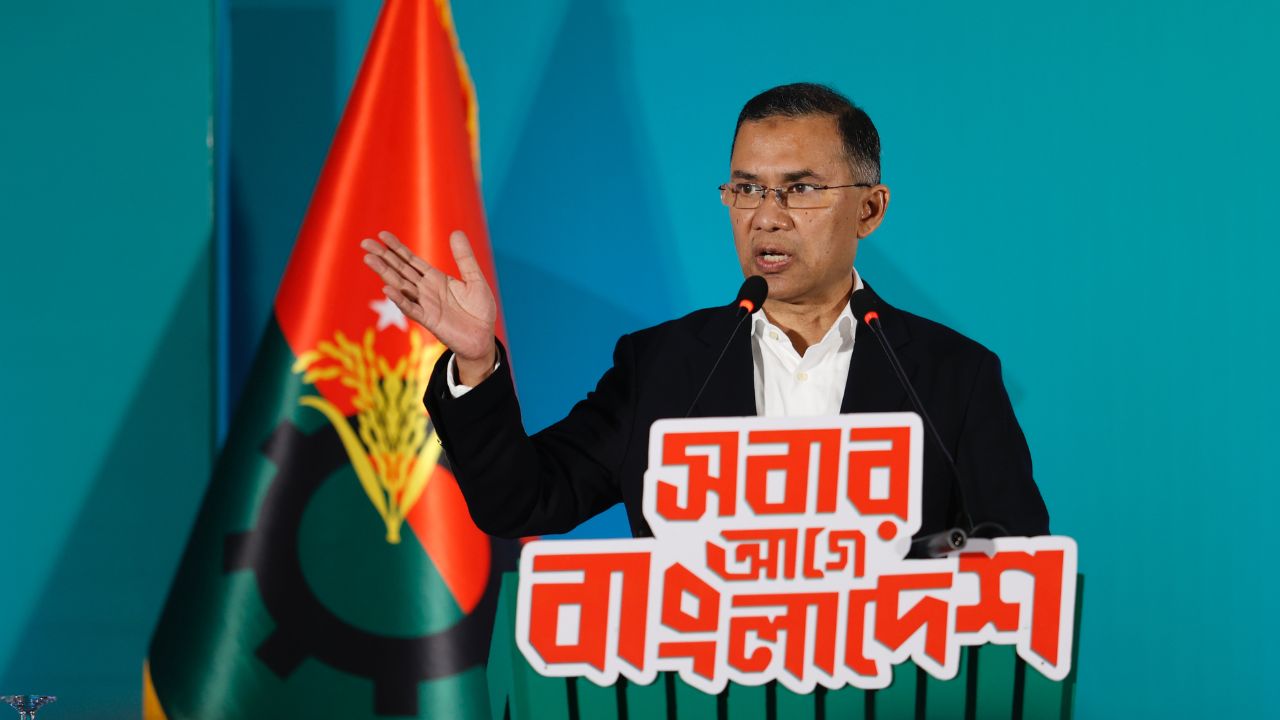



BNP Chairperson Tarique Rahman on Friday unveiled the party’s election manifesto, presenting a centrist liberal vision that promises democratic renewal, economic recovery and social justice, while raising questions over implementation capacity.
Structured into five chapters and nine core commitments, the manifesto sets out what the party describes as a bold political agenda to address long-standing structural weaknesses in state governance and the economy.
The chapters focus on state reform, equitable socioeconomic development and sustainable state capacity, rebuilding a fragile economy, balanced regional development, and ensuring religious and social harmony alongside sports, culture and the restoration of ethics in public life.
The manifesto builds on BNP’s earlier 31-point reform agenda and the July National Charter, which called for rebuilding a united, democratic and inclusive Bangladesh free from authoritarianism and undue foreign influence.
At the policy level, the party pledged to ensure independence of the judiciary and media, strengthen accountability, enhance transparency in foreign agreements, reform the Anti-Corruption Commission, guarantee religious freedom, establish a truth and healing commission for past crimes, and reinforce checks and balances on political power.
To cushion families hit by inflation, BNP promised to expand social protection by initially issuing 50 lakh family cards, providing each household Tk2,000 to Tk2,500 a month in cash or essential commodities, with the long-term goal of universal coverage.

Economists estimate the scheme would require around Tk1.5 lakh crore a year, warning that such spending would depend on higher revenue mobilisation and closing loopholes that drain public funds.
The manifesto also proposes introducing farmer cards to ensure fair prices, subsidies, easy loans and agricultural insurance, with similar benefits extended to fishers, livestock farmers and small agriculture-based entrepreneurs.
On jobs and skills, BNP pledged six months of unemployment benefits, creation of 10 lakh jobs in information and communication technology sector, recruitment of 1 lakh health workers, and six months of paid maternity leave across the economy, alongside mandatory technical education in schools and colleges and the introduction of a third language after Bangla and English.




Healthcare and education are proposed to receive budgetary allocations of 5 percent of gross domestic product each, with commitments to build a humane and corruption-free healthcare system, expand maternal and child health services, and strengthen preventive care.
In education, the manifesto outlines a skills- and values-based policy, prioritisation of primary education, technology support for teachers and students, and the introduction of a midday meal programme.
Youth upskilling, start-up and entrepreneurship support, integration with global e-commerce platforms, merit-based government recruitment, and development of sports as a professional career through district- and upazila-level infrastructure also feature prominently.
Environmental pledges include excavation and re-excavation of 20,000 kilometres of rivers and canals and planting 25 crore trees over five years, alongside modern waste management through public-private partnerships and foreign investment.
To promote religious and social harmony, the party proposed stipend- and training-based welfare programmes for religious leaders of all faiths, while plans to expand the digital economy include introducing international payment systems such as PayPal, establishing regional e-commerce hubs and boosting exports of Made in Bangladesh products.
BNP framed the manifesto as a new social and state contract rooted in justice and humanity rather than revenge, placing citizens’ rights above the pursuit of power.
Economists, however, cautioned that the manifesto’s bold ambitions would hinge on implementation, stressing that political pledges must align with economic realities to deliver results.
They noted that achieving the party’s stated goal of a trillion-dollar economy by 2034 would require sustaining around 8.5 percent annual gross domestic product growth, while current trends suggest growth could remain below 7 percent without sweeping political, administrative and economic reforms.
Raising the tax-to-gross domestic product ratio to 15 percent by 2035 from below 7 percent would require a comprehensive overhaul of tax policy and administration, although the manifesto pledged to roll back what it described as overly generous tax exemptions for businesses.
The party also promised targeted support for competitive local industries and reforms to improve the business climate, aiming to lift foreign direct investment to 2.5 percent of gross domestic product from below 0.5 percent, while ruling out austerity in favour of cautious and disciplined public spending.
Bangladesh’s growth has slowed amid stalled investments and banking stress, said economist Muhammad Shahadat Hossain Siddiquee.
The investment blockage has become systemic and the current condition of financial institutions made even the previous average GDP growth of around 6.5 per cent difficult without restoring confidence, he added.
According to him, fiscal stress further limits policy space, as heavier government borrowing to cover revenue gaps risks fuelling inflation and weakening financial stability, complicating recovery for both the current administration and future governments.