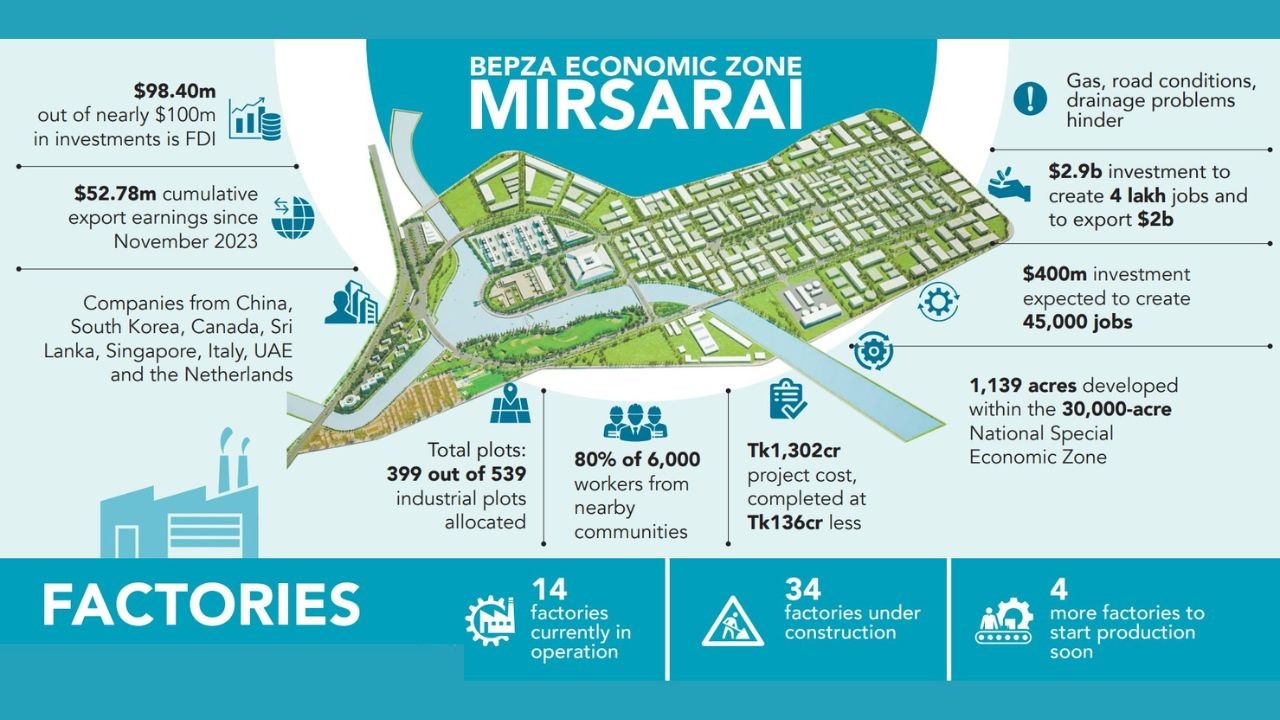

A new industrial cluster taking shape in Mirsarai is moving closer to a key milestone, with the Bangladesh Export Processing Zones Authority (BEPZA) Economic Zone attracting nearly $100 million in investment and generating $52.78 million in exports within two and a half years of commercial operations.
The zone now has 14 factories in production, with 34 more units under construction and another four expected to start operations soon, turning what was once a development project into an emerging manufacturing base.
Located inside the National Special Economic Zone in Chattogram’s Mirsarai, the BEPZA Economic Zone has drawn investors from China, South Korea, Canada, Sri Lanka, Singapore, Italy, the United Arab Emirates and the Netherlands as Bangladesh seeks to build new export hubs beyond traditional industrial centres.
The expansion comes despite a difficult start. The project faced delays from the Covid-19 pandemic, political instability, land development complexities, rising construction costs and labour shortages. The first phase of the Tk1,302 crore development project was completed on June 30, although permanent gas connections and some utility facilities remain unfinished.
BEPZA officials said seven new investment proposals have already been submitted for plot allocation, pointing to further industrial expansion.
Foreign manufacturers lay foundation for export hub
BEPZA data show the economic zone has secured $98.40 million in foreign direct investment (FDI) and $1.46 million in domestic investment, taking total investment to $99.86 million.

Chinese companies account for the largest share of investment, with firms from South Korea, Canada, Sri Lanka, Singapore, Italy, the United Arab Emirates and the Netherlands also setting up factories.
The zone contains 539 industrial plots, of which 399 have already been allocated, indicating strong investor demand even before the area reaches full operational capacity.
Manufacturers operating from the zone have exported products worth $52.78 million, led by footwear accessories, ready-made garments, padding, webbing, composite materials, synthetic products and furniture.
Chinese-owned KPST Shoes (BD) Co. Ltd became the first factory to begin commercial production in November 2023, opening the way for other manufacturers.



The operating factories include Kaixi Lingerie Bangladesh, Fengqun Composite Material, Mingda Bangladesh New Material, Jibin Technology, Youngchang BD, Taisheng Webbing, Sanxin Accessories, Goodwood, YiXin Bangladesh, CartonCraft, Join Win, Giant BD Synthetic and Vernon & Oliver Furniture.
Kaixi Lingerie Bangladesh has emerged as one of the largest early investors, putting in $18.91 million, exporting goods worth $34.56 million and employing 3,651 workers.
The early investment pattern reflects the zone’s initial positioning around export manufacturing, particularly apparel-linked industries, footwear and supporting industries.
Infrastructure and utilities become the next growth test
The challenge now is ensuring that infrastructure keeps pace with factory expansion.
Project Director Engineer Mohammad Anamul Haque said the development project was initially approved at Tk750 crore before the cost was revised to Tk1,302 crore under the updated Development Project Proposal (DPP).
The project, launched in 2018 and originally scheduled for completion in 2021, was delayed by the pandemic, political unrest, complex land development requirements, transportation constraints and labour shortages.
Despite those setbacks, the project was completed with savings of around Tk136 crore against the revised project cost, he said.
The next phase will focus on supporting infrastructure, including a commercial complex, shopping complex, investor residence, investor club, emergency response facilities, internal road improvements and other services.
A visit to the economic zone on July 22 showed factory activity expanding, with thousands of workers commuting daily. But several internal roads remain in poor condition and become difficult to use during the monsoon.
Factory officials and workers said drainage, street lighting and internal road improvements are urgently needed as more industrial units begin operations.
The absence of a permanent gas connection remains a major concern for existing manufacturers and potential investors. For export-oriented factories, reliable energy supply will be critical to maintaining production efficiency and attracting higher-value industries.
The zone currently employs around 6,000 workers, with about 80 per cent coming from nearby communities. Most employees commute from Mirsarai, Sitakunda and surrounding areas using BRTC buses and other transport services.
BEPZA plans to attract another $400 million in investment and create 45,000 jobs over the next five years.
The BEPZA Economic Zone covers 1,138.55 acres within the 30,000-acre National Special Economic Zone, which spans Mirsarai and Sitakunda in Chattogram and Sonagazi in Feni.
Under BEPZA’s long-term development strategy, the fully developed zone is expected to attract $2.9 billion in investment, create around 4,00,000 jobs and generate about $2 billion in annual exports.
The next phase will determine whether Mirsarai becomes merely another industrial estate or evolves into one of Bangladesh’s largest export manufacturing hubs.