The central bank has signalled confidence in managing the economic fallout from the Middle East conflict, despite lacking a clearly defined policy roadmap and relying instead on a set of “ifs and buts”.
Officials say they expect an additional $2 billion to $2.5 billion in remittances during the current fiscal year, alongside a possible $1.5 billion disbursement from the International Monetary Fund (IMF) in June, which they believe could help stabilise the situation.
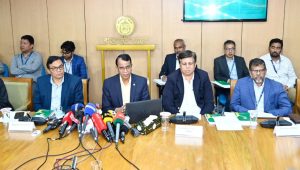
The outlook was presented on Sunday at a meeting between Bangladesh Bank officials and editors and business editors of national dailies at the central bank’s headquarters.
Governor Md Mostaqur Rahman and deputy governors outlined their assessment, suggesting that external inflows could ease pressure on foreign exchange reserves.
However, economists have cautioned that the approach appears to rely more on optimistic projections than on a structured policy response to the evolving crisis.
Deputy Governor Kabir Ahmed said seasonal factors could also provide temporary relief, noting that fertiliser imports are likely to decline during the monsoon period, while import demand has eased following Ramadan.
This, he said, may help contain demand for US dollars in the short term.
“If we receive $1.5 billion from the IMF, and remittances increase by $2.5 billion compared with last year, then I believe we can move into a relatively safe zone,” Kabir Ahmed said.

“Given the current concerns, the situation may not be as alarming as it appears.”
However, experts warn that each element of this projection remains conditional.
If the conflict persists, migrant workers’ incomes could decline, limiting remittance growth below expectations.
At the same time, rising costs of fuel and other imports could quickly erode any seasonal relief, placing renewed pressure on the economy.
Ground-level indicators are already signalling strain.




Imports rose by nearly 3 per cent in January, while overall import spending increased by 4.64 per cent in the first seven months of the current fiscal year.
The upward trend in import costs has continued for several months, with more than $1 billion in payments due to the Asian Clearing Union (ACU) in the coming period.
Foreign exchange reserves have also fallen by more than $1 billion in the past month alone, suggesting that the economic impact of the conflict is already being felt.
Uncertainty also surrounds the expected IMF funding.
Deputy Governor Habibur Rahman said discussions remain at an early stage, with a key decision likely to be taken at a meeting in April.
To cushion the impact on the external sector, Bangladesh Bank says around $5 billion it has purchased from the market during the current fiscal year could act as a buffer.
Economists, however, say this effectively implies a reliance on using foreign exchange reserves if needed – a move that could heighten risks, given reserves are already under pressure.
Birupaksha Paul, former chief economist of Bangladesh Bank, believes that Bangladesh will face another reserve crisis if the central bank fails to take appropriate measures in the current situation.
He told TIMES of Bangladesh that the governor should take the initiative to sit down with the government and formulate an integrated policy.
The central bank said there is currently about $800 million in net open position in the dollar market.
But amid heightened uncertainty, it is not actively buying dollars, signalling a cautious, observation-based stance.
It has also acknowledged the risks of rising energy prices.
Officials said higher oil prices would push up import-driven inflation, with spillover effects across the economy, increasing pressure on subsidies and government finances.
No specific plan has been outlined to manage these pressures.
Governor Md Mostakur Rahman said, “At this moment, we do not have a quick solution.”
While the possibility of bilateral support or price concessions to ensure energy security has been mentioned, such options remain at the discussion stage.
At the meeting, the central bank says it is following a “dynamic” policy approach.
However, analysts suggest this is, in practice, closer to a “wait-and-see” strategy, where decisions depend on how the situation evolves.
Birupaksha Paul suggested that the government should form an Emergency Energy and Monetary Commission to tackle the crisis.
“A sustainable energy policy is crucial for Bangladesh at this moment. If a proper energy policy is not put in place, the monetary policy will be ruined,” Birupaksha said.