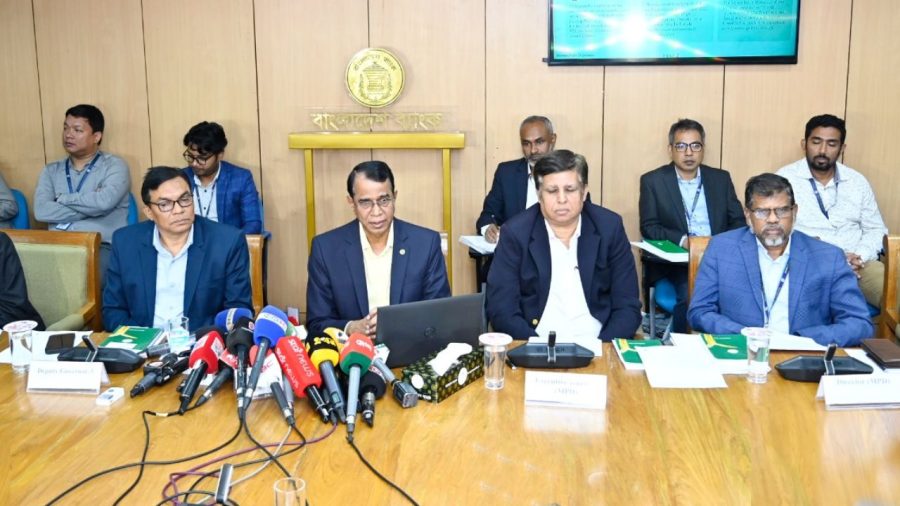



Bangladesh Bank has kept its policy rate unchanged at 9.50 per cent for the October–December quarter, maintaining a cautious monetary stance as inflation has moderated but underlying price pressures remain elevated and economic activity remains weak.
The Monetary Policy Committee decided at its 23 September meeting to retain the policy rate at 9.50 per cent, while keeping the Standing Lending Facility (SLF) rate at 11 per cent and the Standing Deposit Facility (SDF) rate at 7.50 per cent, according to the quarterly Monetary Policy Statement released on Wednesday.
The recent decline in headline inflation was not sufficient to confirm a sustained disinflation trend and it would monitor developments before taking any further easing measures, the central bank said.
Headline inflation fell to a 10-month low of 8.26 per cent in August from 9.16 per cent in June, mainly due to a decline in food inflation to 7.02 per cent.
However, non-food inflation remained high at 9.32 per cent, indicating continued underlying price pressures.

Bangladesh Bank said inflation risks could rise due to global energy price volatility, disruptions in the Strait of Hormuz, recent fuel price adjustments and the potential impact of national pay scale implementation.
It warned that premature easing could raise inflation expectations and delay the return of inflation to the target.
Economic activity also remained under pressure, with real GDP growth estimated at 4.14 per cent in FY26. Growth in the third quarter of FY26 was estimated at 2.2 per cent, while industrial output contracted by 0.28 per cent.



The central bank attributed the slowdown to high financing costs, energy shortages, infrastructure bottlenecks and uncertainty over domestic and external demand.
High-frequency indicators, including industrial production, power generation, fuel supply and private sector credit growth, also pointed to sluggish activity during FY26, although a modest recovery was seen in the first quarter of FY27.
Bangladesh Bank said monetary policy alone could not address supply-side constraints affecting growth. It pointed to the government’s Tk60,000 crore stimulus package, including Tk20,000 crore for reopening closed factories, along with refinance schemes for agriculture, CMSMEs and export diversification, as measures expected to support recovery.
Financial conditions have eased following the 50 basis point policy rate cut to 9.50 per cent, effective from 2 August. Interbank rates and government securities yields declined amid weak private sector credit demand, strong deposit growth and reduced appetite for new lending.
However, the lower rates have yet to translate into stronger private sector credit growth or economic activity. Private sector credit growth stood at 4.75 per cent in August, reflecting weak investment demand, higher borrower risks and weaknesses in the banking sector.
The non-performing loan ratio reached 32.78 per cent in June, highlighting the need for bank restructuring, stronger governance, capital restoration and improved credit discipline.
The external sector improved significantly in FY26, with the balance of payments recording a surplus of $6.6 billion. However, it moved into deficit in the first two months of FY27, mainly due to a deficit in the financial account.
Remittance inflows remained a key external support, rising 18.90 per cent during the period, while exchange rate stability helped contain imported inflation.
Bangladesh Bank expects a gradual recovery rather than a rapid rebound. The World Bank has projected FY27 growth at 4.6 per cent, while the International Monetary Fund has revised its forecast to 3.5 per cent from 4.3 per cent.
The central bank identified prolonged geopolitical tensions, disruptions in the Strait of Hormuz, higher global energy and fertiliser prices, tighter global monetary conditions, domestic energy and infrastructure constraints, fiscal pressures, implementation of the national pay scale and weaknesses in the banking sector as key risks.
It said future policy decisions would remain data-dependent, with a focus on targeted credit support, structural reforms, financial sector strengthening and orderly exchange rate flexibility while maintaining price stability, external balance and financial system soundness.