In the south-western coastal district of Barguna, the arrival of June has brought a chilling transformation, turning this riverside community into what locals now describe as a “dumping ground for corpses.”
Whether a life is found silenced within the perceived safety of four walls or a body is discovered discarded in a ditch near a bridge, the security situation has deteriorated to a point where public terror has reached its peak.
In this month alone, 21 bodies have been recovered across the district, leaving residents in a state of constant alarm as evening falls. However, there is no trace of this public anxiety in the official narrative.
Superintendent of Police (SP) Kudrat-e-Khuda maintains that the situation is far from dire. “The law and order has not deteriorated,” he asserted. “Everything is in a normal state.”
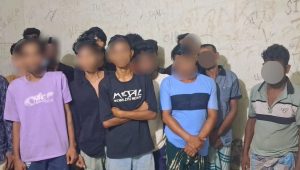
The SP further claimed that of these 21 deaths, nine showed signs of suicide, while others were attributed to accidents. He noted that murder cases have been filed regarding three of the incidents, leading to the arrest of eight individuals.

Despite these assurances, the anxiety among Barguna’s residents is palpable. Khan Naim, founder president of the voluntary organisation “Durbar,” describes a community living under a self-imposed curfew.
“People no longer feel safe,” Naim said. “Unless there is an absolute emergency, no one ventures out after evening. Even school and college students are gripped by fear. The situation has become so horrific that it feels suffocating.”
Unprecedented violence, unanswered questions
Former photojournalist Arifur Rahman Arif told TIMES of Bangladesh that the district has not witnessed such a high volume of body recoveries in a single month since the country’s independence.



The violence reached a fever pitch on 13 June, when five bodies were recovered in a single day.
Among them was Mizanur Rahman, an autorickshaw driver in Patharghata municipality. He had gone to sleep in his own home the night before, only to be found bloody and lifeless on the Water Development Board road the following morning.
Only a day earlier, at 5pm on 12 June, Ibrahim Hossain Kalu was beaten to death by a mob in Patakata village; he had been a suspect in the stabbing of a local Union Parishad official.


The month’s tragedies began at dawn on 3 June at the District Council Dak Bungalow.
By that afternoon, police recovered the bodies of Iti Rani – a resident of the municipality town’s Kalibari area – and her two young daughters, 12-year-old Aradha Biswas and three-year-old Anuradha Biswas.
While the mystery of their deaths sparked public protests, the quest for justice has been a labyrinth for the husband, Dulal Chandra Biswas. He claims he was twice turned away by Barguna Station police and later by the courts, which refused to accept his case without an autopsy report.
Fear of the night
Perhaps the most gruesome discovery occurred on 8 June on the west side of a bridge near Gaurichanna Market, where the headless body of cattle trader Shamim Bepari was found amongst water hyacinths.
To this day, his head remains missing, and his killers remain in the shadows. Veteran journalist and social worker Monir Hossain Kamal finds the official stance “contradictory to reality,” asserting that the district’s security has completely collapsed.
This collapse is felt most acutely by night-shift workers. Swapan Mia, a rickshaw puller from the Dhupati area, confesses that while his family struggles to survive, the “news of death everywhere” makes him tremble at the thought of working after dark.
Monirul Islam Monir, who has transported passengers from bus stands for 27 years, shares this newfound dread, “I was never afraid before. But now, I am afraid to go far at night.”
As June continues, the people of Barguna remain caught between official claims of normalcy and the haunting reality of 21 lives lost – waiting for a sense of peace that remains as elusive as the missing head of Shamim Bepari.