


He died nearly three decades ago. Yet Salman Shah still walks through Bangladesh’s collective memory as if he never really left.
His songs still play, his films still find new audiences, his hairstyles and fashion still get remembered and his name can turn an ordinary conversation into a trip down memory lane. For a generation that grew up with him, Salman Shah was a phenomenon. For those born after his death, he somehow became one too.
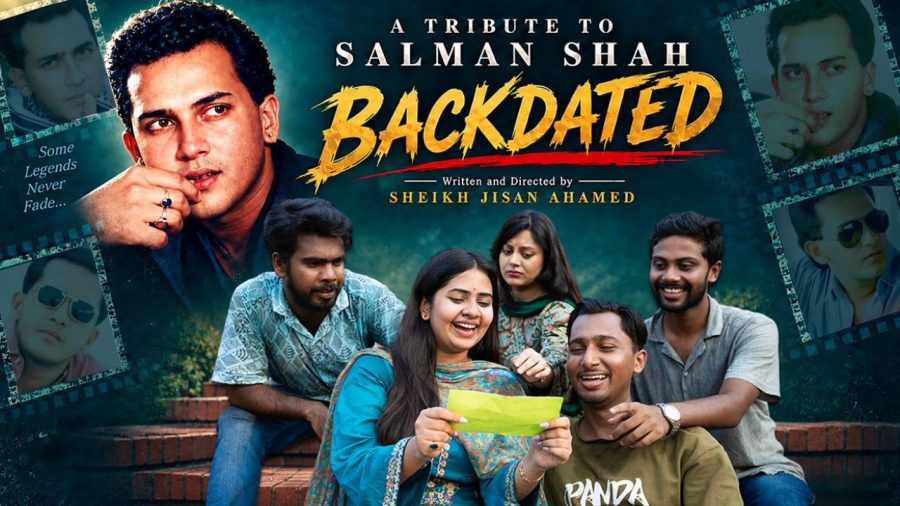
That strange afterlife is at the heart of Sheikh Jisan Ahamed’s short film ‘Backdated’, a nostalgic and quietly moving attempt to understand how a star from another era can still feel startlingly present today.
Released on 19 September to mark Salman Shah’s birth anniversary, the film takes an unusual route for a tribute. Instead of retelling the actor’s life, it follows a young man who never got the chance to experience Salman Shah’s stardom firsthand. Salman had already become a legend and died in 1996 before this generation could know what the craze was really like.
Then the stories begin.

Over the course of a single day, the protagonist hears one memory after another. Parents, older generations and ordinary people become unwitting storytellers, slowly filling in the picture of the star he never knew. By the end, Salman Shah no longer feels like someone from a distant past. He feels almost like someone he has always known.
That is where ‘Backdated’ finds its strongest emotional beat.




The performances keep the film grounded. Veteran actor Faruque Ahmed, playing the father, brings warmth and lived-in familiarity to the story, while the Jahangirnagar University students bring youthful energy to its generational perspective. Their interactions make the nostalgia feel personal rather than manufactured.
The visuals and graphics also play an important role. The film draws on the look and cultural mood of the 1990s while placing them against a contemporary setting. That contrast reinforces its central idea: Salman Shah belongs to another era, but the emotions surrounding him have not aged.
The music and background score carry much of the film’s emotional weight. They help summon the atmosphere associated with Salman Shah without overwhelming the storytelling.
At its best, the sound design makes the memories feel less like exposition and more like fragments of a cultural inheritance being passed down.
Jisan’s direction is similarly restrained. Rather than attempting to squeeze an entire career into a short runtime, he builds the film around a single question: How does someone become a legend to people who never met him?
The answer lies in Salman Shah’s remarkably short but explosive career. He made his debut with Keyamat Theke Keyamat in 1993 and died on 6 September 1996, leaving behind 27 films in roughly four years. He never had the opportunity to grow old on screen, reinvent himself or move through different phases of stardom.
Yet the legend kept growing.
‘Backdated’ understands that his legacy belongs not only to film scholars or hardcore fans, but to ordinary people — to drawing rooms, tea stalls, neighbourhood conversations, television reruns and family stories. His influence crossed social boundaries, turning a film star into a shared cultural memory.
The title itself carries an amusing irony. Salman Shah may belong to a ‘backdated’ era, but the affection surrounding him is anything but.
And perhaps that is the film’s sweetest achievement. It does not simply look back at Salman Shah. It shows why, for so many Bangladeshis, there is still no real distance between Salman Shah and the present.