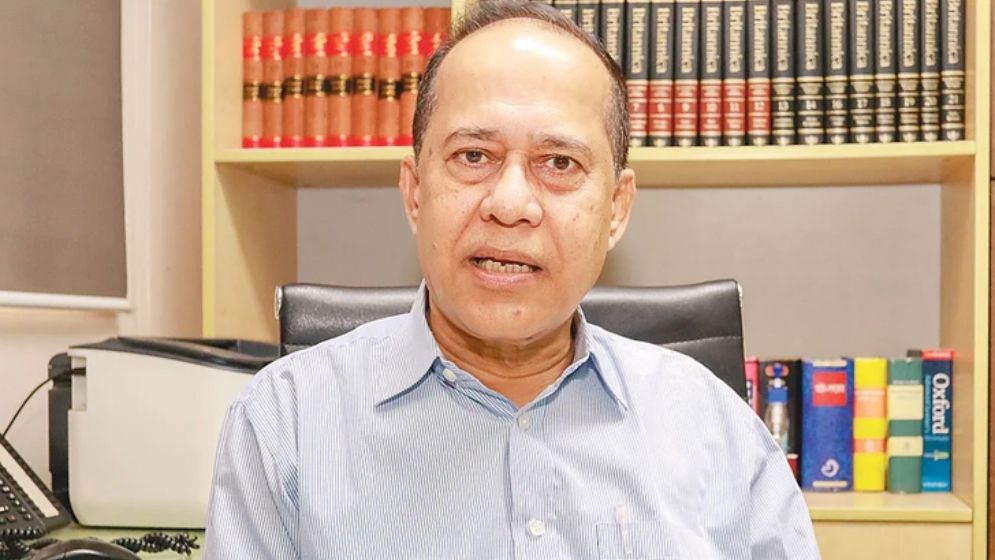

Amending the Constitution, through a simple two-third parliamentary majority to address the year-and-a-half constitutional vacuum following July mass uprising, carries the risk of being declared void by courts in future, warned Supreme Court lawyer Mohammad Shishir Manir.
According to the Jamaat-e-Islami Central Executive Committee member, validating constitutional arrangement between 5 August 2024 and 12 February 2026 requires applying sovereign “constituent power” of the people, rather than ordinary parliamentary amending powers.
Speaking to reporters in front of Supreme Court Annex Building on Monday, Shishir Manir noted that basic structure of Constitution cannot be altered through conventional amendments.
He pointed out that although the Fifth, Seventh, Eighth, Thirteenth, Fifteenth, and Sixteenth Amendments were enacted in past, various provisions of these amendments were subsequently declared unconstitutional or struck down by court verdicts.
“Under conventional rules, the Preamble cannot be changed through amendment, fundamental principles of State Policy cannot be changed, and High Court cannot be relocated outside Dhaka through amendment,” Manir said.
He argued that approval by a two-thirds vote in Parliament alone does not grant final constitutional validity if an amendment conflicts with the Constitution’s basic structure doctrine, which is recognised in Bangladesh’s legal framework.

Constituent power vs amending power
Shishir Manir stated that to bring about structural changes in the state following the July mass uprising, constituent power must be applied instead of the amending power of an ordinary parliament.
Warning of repeated historical mistakes, he said that failing to exercise constituent power would leave reforms vulnerable to the same fate as the Fifth, Seventh, Thirteenth, Fifteenth, and Sixteenth Amendments.
Regarding the period between 5 August 2024 and 12 February 2026, he highlighted that the way the country was governed during this time cannot be explained merely within the 153 articles of the Constitution.
“On 5 August, constitutional continuity became zero. How was the country running until 12 February? Under what law? On what basis? These are not found in the Constitution, but in constitutional law,” he stated.




He explained that finding legal justification requires examining constitutional law, the historical development of the state, and the context of the mass uprising, pointing to the people’s constituent power as the foundation.
Risk of ‘constitutional treason’
Shishir Manir cautioned that if the people’s constituent power is not recognised and the actions of that period are evaluated strictly under the existing 153 articles, explaining the constitutional situation will be difficult and could even raise questions of “constitutional treason.”
To illustrate how constituent power operates, he cited the 1991 precedent when an election-time government was formed under then Chief Justice Sahabuddin to run the country and conduct polls, despite there being no direct provision in the existing Constitution at that time.
Caretaker government provisions were later incorporated into the Constitution.
He added that in the Thirteenth Amendment judgment, the Supreme Court acknowledged the existence of constituent power behind such constitutional changes.
Quoting from that ruling, he remarked that once citizens establish a government and frame a Constitution, their power to construct a new Constitution cannot be taken away, as constituent power fundamentally resides with the people.
Comparing the current situation to past attempts to validate actions retrospectively, Shishir Manir recalled that Shaheed President Ziaur Rahman passed the Fifth Amendment to ensure that actions taken between 15 August 1975 and 9 April 1979 could not be challenged in court.
However, the Supreme Court eventually declared those actions illegal in the Fifth Amendment case, with similar rulings later issued regarding the Seventh and Fifteenth Amendments.
Warning against trying to shield the 5 August to 12 February period from judicial scrutiny via schedule provisions, he remarked, “Will you still state in the schedule that actions taken from 5 August to 12 February cannot be questioned in court? Such provisions were made in the past, but did they survive? They did not.”
‘Constitution reform council only sustainable path’
To avert legal pitfalls, Manir advocated for the formation of a Constitution Reform Council based on the mandate of a referendum. He stressed that completing structural reforms through such a council would provide a clearer constitutional foundation.
He noted that the consensus underlying the 12 February elections included establishing a Constitution Reform Council alongside national polls to execute reforms with all stakeholders.
“This task was supposed to be completed within 180 days. The current government was formed on 17 February, and six months passed on 17 August. What is the point of keeping this controversy alive?” he asked.
Manir urged that a decision should have been taken during the government’s first parliamentary session to avoid wasting time in unnecessary debate. He called for permanent solutions rather than temporary constitutional amendments.
“A permanent solution must be achieved through a Constitution Reform Council in light of the referendum mandate. A temporary solution via amendment will benefit no one. Once reforms are complete, the council can dissolve, allowing the government to function normally,” he concluded, emphasising that this path would ensure a logically interpreted framework of constitutional law for the period from 5 August to 12 February.