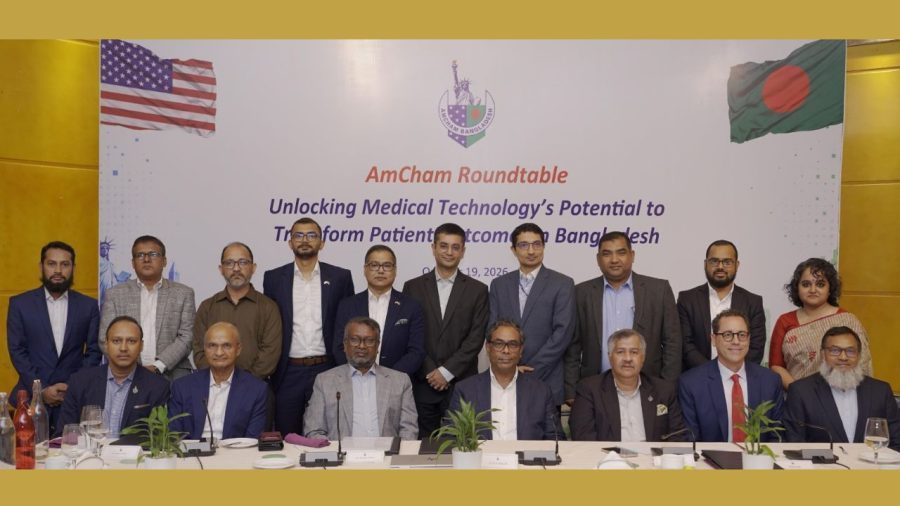



US medical technology companies have urged Bangladesh to introduce a dedicated regulatory framework for medical devices and equipment, arguing that lengthy approvals, import costs and regulatory uncertainty are hampering the sector’s development.
The American Chamber of Commerce in Bangladesh (AmCham) presented five policy recommendations at a roundtable in Dhaka on Monday, calling for faster product registration, predictable pricing approvals, rationalised duties and simplified procedures for importing spare parts and sending equipment abroad for repairs.
The proposals come as AmCham seeks to expand US investment in Bangladesh, including medical technology, while the government pushes foreign suppliers to move beyond equipment sales towards local manufacturing, technology transfer and long-term technical support.
AmCham Bangladesh President Syed Mohammad Kamal said member companies already had more than $5 billion invested in Bangladesh, while the chamber was committed to facilitating another $5 billion over the next five years.
Healthcare technology could contribute to that ambition through innovation, workforce development and improved patient care, he said.
A central demand is separate medical device guidelines under the Directorate General of Drug Administration (DGDA), rather than relying on existing regulatory arrangements.

AmCham also proposed defined timelines for registration, parallel reviews of application dossiers and predictable maximum retail price approvals consistent with the existing markup guideline and 7.5 per cent value-added tax.
Its other recommendations include rationalising duties and taxes on medical equipment and spare parts, and simplifying temporary equipment re-exports for repairs.
The chamber proposed a joint workshop involving the DGDA, American and European medical technology companies and other stakeholders to develop a framework aligned with international standards.




DGDA Director General Md Alamgir Hossain acknowledged the importance of timely and transparent approvals, outlining ongoing efforts to streamline registration and facilitate the resumption of inspections by international regulators.
State Minister for Health and Family Welfare M A Muhit, who attended as chief guest, acknowledged delays in medical device registration and reaffirmed the government’s intention to expedite approvals.
He said the government was prioritising primary healthcare, disease prevention and the decentralisation of specialised treatment to divisional and district levels.
Citing a health budget of approximately Tk70,000 crore and recent tax measures, Muhit called on US medical technology companies to develop sustainable partnerships that extend beyond supplying equipment.
He stressed the importance of lifecycle costs, maintenance, after-sales services, technology transfer and local manufacturing and assembly.
The state minister also sought specialised training for Bangladeshi engineers and healthcare professionals, including those from Bangladesh University of Engineering and Technology and the University of Dhaka.
He outlined plans for a national electronic health system and digital monitoring dashboard to improve the use of medical equipment, alongside innovative financing and transparent procurement.
Muhit also encouraged multinational companies to use corporate social responsibility programmes to support underserved communities, particularly children with disabilities.
Former Medtronic Chairman and CEO Omar Ishrak, who also previously chaired Intel Corporation, discussed advances in medical technology and their potential to improve healthcare access and treatment outcomes in Bangladesh.
Representatives of major medical technology companies, including Medtronic Bangladesh Country Director Mayank Tripathi, Becton Dickinson Bangladesh Business Leader Mirza Shajib Raihan and GE HealthCare Bangladesh Country Head and Director Muhammad Asaduzzaman Romel, presented industry perspectives.
US Embassy Commercial Counsellor Paul Frost and other embassy officials also joined the discussion.
AmCham Executive Director Chowdhury Kaiser Mohammad Riyadh moderated the roundtable, while NATCO Bangladesh Country Manager and Managing Director Al-Mamun M Rashel delivered the vote of thanks. Medtronic Bangladesh supported the event.
The proposals place regulatory predictability at the centre of the industry’s investment demands, while the government’s response ties wider market access to technology transfer, local capabilities and stronger support for healthcare providers.
The chamber and participating companies expressed willingness to work with the health ministry and DGDA on the proposed reforms.