



The US Federal Reserve has resumed raising interest rates while Bangladesh’s government borrowing costs have been falling, creating risks for the Taka, foreign exchange reserves, and investors in stocks and bonds.
On 16 September 2026, the Fed raised its policy rate by 25 basis points to a range of 3.75–4.00 per cent, the first increase since 2023 with its projections indicating the possibility of further tightening this year.
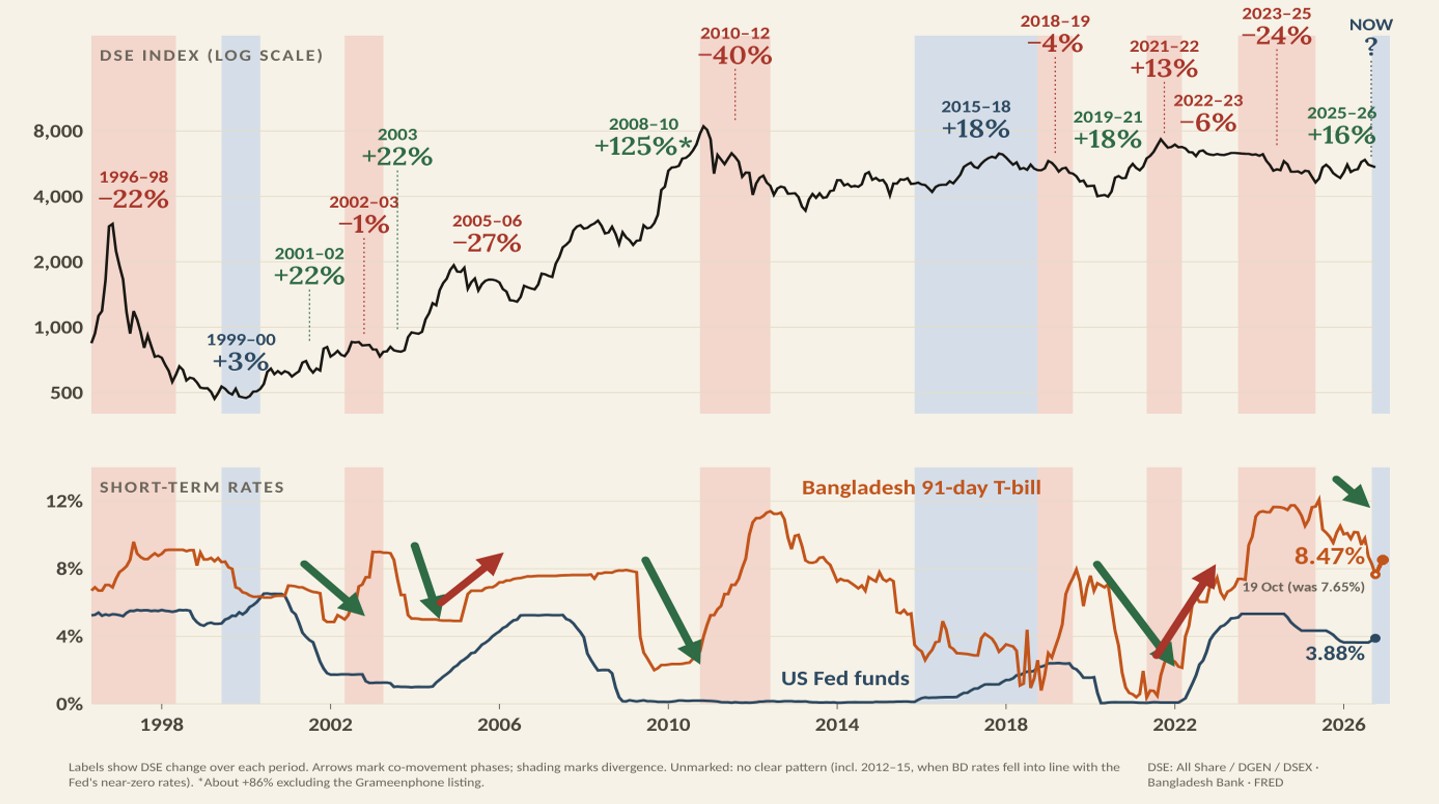
Meanwhile, Bangladesh’s 91-day Treasury bill yield fell from above 10 per cent a year earlier to 7.65 per cent on 11 October, before rebounding to 8.47 per cent in a week.
The divergence matters because US rates influence Dollar funding costs, foreign debt servicing and essential import bills.
Sustained pressure could weaken the Taka, drain reserves or require tighter domestic monetary conditions.
This is not the first time Bangladesh diverged from the Fed.
During 2015–18, the Fed raised rates from near zero to around 2.3 per cent while domestic Treasury bill yields fell below 2 per cent. Yet the Dhaka stock market gained about 18 per cent supported by moderate inflation, cheaper oil and growing reserves.
Conditions are less favourable now. At the 11 October auction, Bangladesh’s 91-day Treasury bill yielded 7.65 per cent against September inflation of 8.34 per cent, implying a negative inflation-adjusted return of 0.69 percentage points.
The 18 October auction partly reversed that position. The 91-day yield rose 82 basis points to 8.47 per cent, while 182-day and 364-day yields reached 8.65 per cent and 8.74 per cent.
Although the benchmarks measure different instruments, the Taka now offers almost the same real return as the Dollar, based on these simplified inflation-adjusted rates.

Bangladesh’s 91-day Treasury bill now offers an inflation-adjusted yield of approximately 0.13 per cent, compared with negative 0.69 per cent before the 18 October auction.
Another quarter-point Fed hike would lift the inflation-adjusted US policy-rate benchmark to approximately 0.43 per cent, assuming inflation remains unchanged.
That would not automatically make Dollar investments more attractive. Exchange-rate expectations, investment risks and actual market yields also influence returns.
Nevertheless, persistent inflation, renewed declines in domestic yields or further Fed tightening could intensify pressure on Bangladesh’s foreign exchange market.
Lessons from 2022–24
When the Fed began tightening in March 2022, Bangladesh maintained a 9 per cent ceiling on bank lending rates despite rising inflation.
Weakening real returns increased incentives to delay converting export earnings, use informal remittance channels and purchase of Dollars ahead of expected depreciation.




Bangladesh Bank sold $13.6 billion from reserves in the 2022–23 financial year to support the Taka.
Reserves fell from around $48 billion in August 2021 to approximately $26 billion by August 2024, or $20.5 billion under the International Monetary Fund’s stricter measurement.
The Taka depreciated from roughly Tk86 per dollar in early 2022 to Tk120 by the end of 2024, while inflation exceeded 11 per cent.
The lending-rate ceiling was removed in June 2023, but Bangladesh’s policy rate did not reach 10 per cent until October 2024.
The episode demonstrated how delayed monetary adjustment can intensify currency pressure, deplete reserves and, eventually, require sharper tightening.
Although reserves have since recovered well, renewed external shocks could threaten that buffer.
Implications for stocks and bonds
For equities, higher Dollar costs threaten corporate profits by making imported materials, machinery, and foreign debt repayments more expensive.
Exporters earning in Dollar may benefit from a weaker Taka, depending on their level of imported inputs and foreign-currency liabilities.
Companies with stable cash flows, limited Dollar debt and pricing power should be more resilient than heavily indebted, import-dependent businesses.
Higher domestic rates also increase borrowing costs and make fixed-income securities more competitive with shares, potentially weighing on valuations.
Bond investors face a different risk. Rising yields reduce the prices of existing fixed-rate bonds, with longer maturities generally more sensitive to interest-rate changes.
The recent rebound in Treasury bill yields raises doubts about further declines in government borrowing costs.
If inflation and external pressures persist, long-dated bonds could suffer capital losses. Moderate maturities offer more flexibility, though they offer less upside if yields fall again.
| Indicator | Bangladesh | United States |
| Interest-rate benchmarks | 91-day Treasury bill | Fed policy-rate midpoint |
| Nominal rate | 8.47% | 3.88% |
| September inflation | 8.34% | 3.70% |
| Inflation-adjusted rate | +0.13% | +0.18% |
| After hypothetical 25-basis-point Fed hike | +0.13% | +0.43% |
Sources: Bangladesh Bank, Bangladesh Bureau of Statistics and US Federal Reserve data. Inflation-adjusted rates are approximated by subtracting annual inflation from nominal rates.
Four signals to watch
Four indicators will help determine whether the divergence remains manageable.
First, a decline in the 91-day Treasury bill yields below 8 per cent without easing inflation would restore negative inflation-adjusted returns.
Second, the Fed’s next policy meetings are on 27–28 October and 8–9 December. Further tightening could raise Dollar funding costs and pressure emerging-market currencies, although another increase is not certain.
Third, the Taka’s ability to hold near Tk123 per Dollar without substantial reserve intervention would indicate foreign exchange stability.
Fourth, accelerated repayment of short-term foreign-currency debt could signal depreciation concerns and increase Dollar demand.
Energy prices pose an additional risk. Bangladesh imports most of its fuel, exposing businesses and government finances to global price increases. Costlier imports can raise subsidies and inflation, limiting the scope for interest-rate reductions.
A narrow path ahead
Bangladesh’s earlier experience shows that domestic rates can fall while the Fed tightens without damaging too much, provided inflation is contained, oil prices are favourable and reserves are growing.
Today, elevated inflation, costly imported energy and marginal inflation-adjusted returns leave less room for error.
Investors should focus on currency exposure, debt and cash-flow strength in equities, and maturity and interest-rate sensitivity in bonds.
The question is not whether Bangladesh must follow the Fed, but whether its inflation, currency and external financing conditions can sustain lower rates without renewed pressure on the Taka and reserves.
NM Al Hossain is a Director and Kazi Ahsan Maruf is the Managing Director of Ekush Wealth Management Ltd
Views expressed are solely those of the authors.