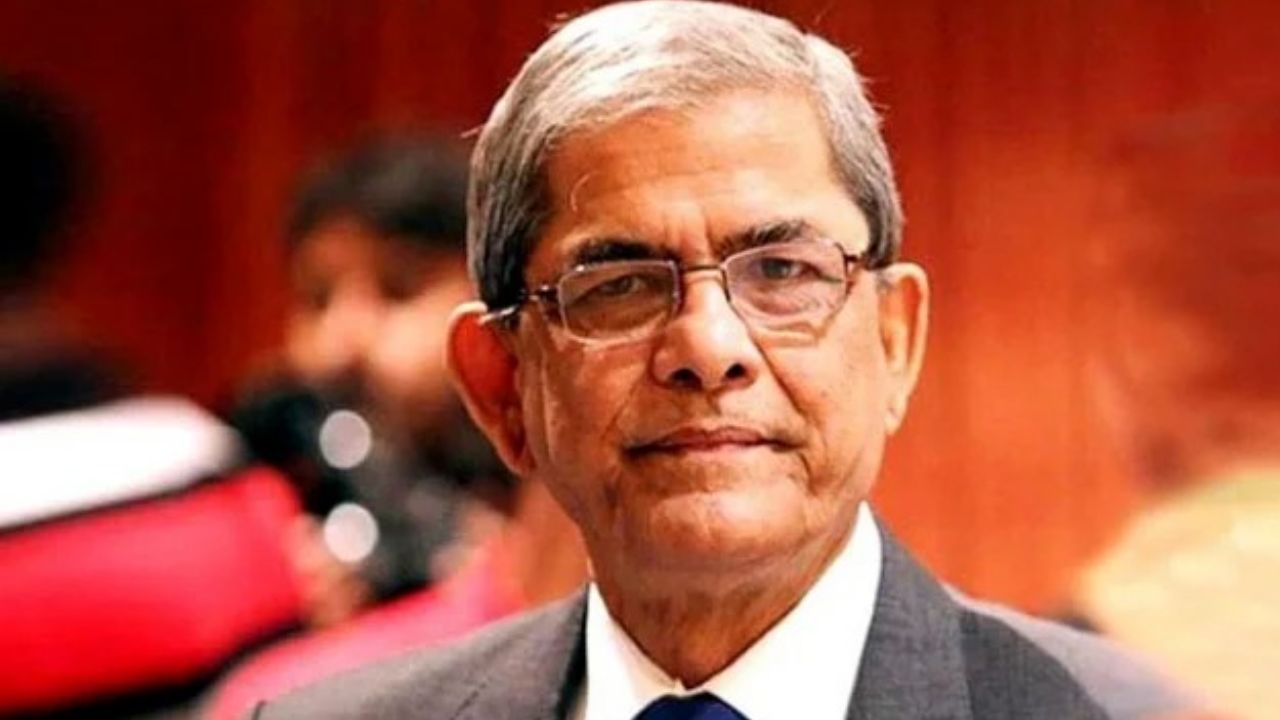
Ahmed Rafiq, a towering figure in Bangladesh’s intellectual and cultural landscape, passed away on Thursday night at the age of 96. He died of cardiac arrest at Dhaka’s Birdem Hospital, where he had been on life support following multiple strokes and complications related to age and kidney function.
A veteran of the historic Language Movement and a passionate interpreter of Rabindranath Tagore’s legacy, Rafiq spent more than half a century writing about the soul of a nation — in poems, essays, and quiet acts of intellectual defiance.
Born on 12 September 1929, in Shahbajpur village in present-day Brahmanbaria, Rafiq completed his higher secondary education at Haraganga College in Munshiganj before enrolling at the University of Dhaka to study chemistry. However, after being denied residential accommodation at Fazlul Haq Hall, he transferred to Dhaka Medical College.
In 1952, while a third-year medical student, he actively maintained connections with students from Fazlul Haq Hall, Dhaka Hall, and Mitford Hospital, regularly participating in meetings, assemblies, and protest marches.
He then defied government bans on assembly and marched at the front lines of protests demanding the recognition of Bengali as a state language in then–East Pakistan — a historic movement that laid the groundwork for Bangladesh’s eventual independence.

His activism came at a significant cost. Following the protests, he spent two years living as a fugitive and was the only student among the protesters at Dhaka Medical College to have an arrest warrant issued against him.
At the end of 1955, he resurfaced publicly and resumed his studies. Although he completed his MBBS degree in 1957, he was again the only student denied an internship because of his political involvement.
Rafiq’s early professional life spanned medicine, pharmaceuticals, and government service. He co-founded a pharmaceutical company, helped shape Bangladesh’s drug policy, and served as a senior officer in the Bangladesh Chemical Industries Corporation.
But he gradually stepped away from these positions to pursue what became his life’s true calling: writing. His literary career began with the poetry collection Nirbasita Nayak in 1966, followed by the essay collection Shilpa Sangskriti Jiban in 1958. Over time, he became a widely respected editor of both literary and scientific works.



Throughout his illustrious career, Rafiq authored dozens of books that span poetry, essays, literary criticism, political analysis, and cultural commentary. He was especially acclaimed for his scholarship on Rabindranath Tagore, producing over 20 volumes exploring the Nobel laureate’s life and work.
In recognition of his contributions, the Tagore Research Institute in Kolkata conferred upon him the title “Rabindratattacharya” in 2011.
But his writing was not limited to Tagore only; he also explored the works of other seminal South Asian literary figures such as Kazi Nazrul Islam, Jibanananda Das, and Bishnu Dey. In addition, he provided critical analyses of major historical events, including the Partition of 1947 and the Liberation War of 1971.
His book Desh Bibhag: Fire Dekha (Partition: A Retrospective View) is widely praised for its fresh and nuanced analysis of the partition’s enduring cultural and political consequences.
He was honoured with several prestigious national awards, including the Bangla Academy Literary Award in 1979 and the Ekushey Padak, one of the country’s highest civilian honors, in 1995. In 2023, The Daily Star named him a “Sentinel of Freedom of Thought,” recognising his lifelong commitment to intellectual independence.
Despite his many achievements, Ahmed Rafiq harboured one lifelong regret: that Bengali had not been fully implemented at all levels of national life. He often emphasized that the Language Movement activists championed three key slogans: “We want Bengali as the state language,” “Release the political prisoners,” and “Implement Bengali at all levels.” Among these, he regarded the last slogan as the most important.
“This slogan was featured on many posters,” he explained in a 2023 interview.
“Implementing Bengali at all levels meant introducing the language in education, higher education, scientific research, the Supreme Court, and everywhere else — establishing Bengali-medium education across the board. My greatest regret is that this goal was never fully realized.”
In his later years, Rafiq led a solitary personal life. His wife passed away in 2006, and the couple had no children. He lived alone in an apartment in Dhaka’s New Eskaton neighbourhood.
How dire the situation had become could be realized from an incident in 2021. After a fall that fractured his pelvic bone, just before he was to be taken to the operating table, a consent form required a relative’s signature. With no blood relatives available, a few familiar but unrelated individuals had to sign the form on his behalf.
Also in the last few years of his life, particularly since 2022, he had become almost immobile and visually impaired. But his memory remained sharp, and he could speak fluently. Hence, to pass his time, he had taken up writing a novel about a year ago with the continuous support of a close companion. Reportedly he even completed the manuscript, but remained unedited and unpublished.
For the public to pay their respects, his body will be kept at the Central Shaheed Minar at 11am today.