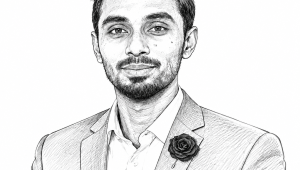
Md Mahmudul Hasan
I have a confession to make. For most of my career, I believed I was fulfilling my moral responsibility to Bangladesh by championing digital banking, financial inclusion and technology adoption. But a painful truth kept returning. You cannot have a healthy nation if one vital organ is collapsing. That failing organ is our healthcare system, and it is bleeding billions into foreign pockets while our own people suffer.
My understanding of this crisis came from watching my wife, an oncologist, work in conditions no doctor should face. I have seen five top-tier oncology specialists share a tiny room at Khulna Medical College, barely large enough for one person. No proper seating, no privacy, no adequate instruments. I have watched her cry over lives she could not save, not because she lacked skill, but because the system itself failed the patient. As a husband, I stood helpless. As a citizen, I realised silence is no longer an option. She is carrying a load that no doctor—no human being—should ever be asked to carry.
Doctors in Bangladesh are our true champions. They never ask a patient’s religion, identity or wealth. They treat human beings as human beings. Yet we assault them, trap them in a system designed to make them fail. Intern doctors receive stipends as low as Tk 15,000 a month—barely $125—less than what entry-level garment workers earn, after years of brutal medical education. General practitioners struggle to practise. Specialists wait a decade for promotion while their peers abroad climb three grades in the same period.
If you have money, you get treatment. If you do not, the system decides your fate. A poor family walking into a hospital becomes prey for dalals who lure them into unnecessary tests, extract hidden fees and push them between windows they do not understand. The quality of care depends entirely on how much you can pay. That is the most painful inequality a nation can allow.

The numbers are devastating. Bangladesh spends just 2.36% of GDP on health, far below the World Health Organization’s 5% recommendation. Out-of-pocket health expenditure is nearly 74%, the second highest globally after war-torn Afghanistan. Every year, around 700,000 Bangladeshis travel abroad for treatment, spending about $5 billion annually—more than the entire government health budget. We are financing healthcare systems everywhere except our own.
Yet this crisis is our greatest opportunity. I am not a public health expert. I am a digital banking and fintech specialist. But I understand ecosystems, incentives and how transparency defeats corruption. Bangladesh can build a national digital health architecture more advanced than anything in South Asia—if we have the courage.
When I worked as a consultant for MedShr, a UK platform connecting verified medical professionals worldwide, I saw a doctor in Ghana post a challenging case and receive guidance from specialists across continents within minutes. If knowledge can travel globally, why cannot dignity travel locally?



We have 180 million people, a tech-driven population and one of the world’s most successful mobile financial ecosystems. We digitised payments before many Western nations. We connected villages to banking long before we connected them to healthcare. Bangladesh is a test case the world is watching. If digital health can work here, it can work anywhere.
Imagine a national platform uniting government, banks, fintech companies, hospitals, diagnostic labs, ambulance networks and insurance providers. Every citizen—from Dhaka to the remotest char—could book specialists the way they book rides, compare treatment costs transparently, access complete medical histories digitally and pay through mobile money, with every transaction generating trackable VAT and tax revenue for the National Board of Revenue.
Banks could finance surgeries through health-based buy-now-pay-later. Fintech firms could deliver micro-insurance through bKash and Nagad. Private capital could build modern hospitals, as Apollo did in India. Young entrepreneurs could create the health super-app integrating everything. And when appointments and payments become digital, billions in untraceable cash transactions suddenly turn visible—formal revenue without raising taxes.
None of this is possible without confronting the syndicate that profits from chaos and opacity. But you cannot bribe a timestamp. You cannot hide referral fees when systems log every transaction. You cannot mislead patients when pricing is public. Digital platforms leave trails, and digital trails are what this syndicate fears most. Technology does not eliminate corruption—but it exposes it. And the moment corruption becomes visible, it begins to die.
We defeated polio through grassroots mobilisation. We built world-class disaster response systems. We survived COVID-19 through the sheer determination of healthcare workers. We can do this again.
The choice is before us. We can keep sending billions abroad, or we can build billions at home—in hospitals, digital platforms and health infrastructure. This is 2025, the era of artificial intelligence. The biggest obstacle now is mindset. If institutions refuse to evolve, they will be replaced by their own irrelevance. But my country—and its people—are not replaceable.
Banks, fintech leaders, entrepreneurs, policymakers: step forward. This is your nation-building moment. And to every Bangladeshi: demand better. Demand dignity. Demand transparency. Demand a future where your health is not determined by your income.
We can transform this nation. Or this nation will be transformed without us. I know which side I choose. Which side do you choose?
The author is a digital banking and fintech strategist focused on financial inclusion, literacy, innovation and platform strategy.