


Living in a city where chaos is almost unavoidable, we seek peace in the comfort of our homes. We drown out the noise by scrolling through social media or immersing ourselves in music. Yet while we distract ourselves from confronting underlying problems, our bodies and minds continue to accumulate memories and experiences that eventually surface as anger, anxiety, and sadness. Disconnecting from the chaos can be liberating, but few are willing – and many are often too sceptical – to take the next crucial step: turning inward and embracing the transformative practice of meditation.
Meditation is a form of alchemy for the mind, and its benefits for the body are a well-established scientific fact. However, the practice itself is often shaped by one’s understanding of it. For some, meditation means bringing their imaginations to life in a painting or getting lost in the complex narratives of an ambitious novel. For others, it means sitting in silence.
The key aspect of meditation is observing one’s own thoughts without judgment or intervention. This allows us to discover the space that exists between each thought, and in that space: clarity, patience, and freedom.
Guided meditation

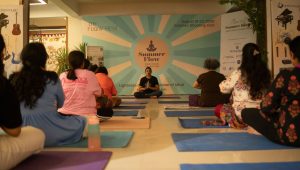
One way to discover this space is through guided meditation. A facilitator asks participants to lie down and breathe: inhale through the nose, exhale through the mouth. As participants enter a state of calm and thoughts populate their mind, they are expected not to entertain these thoughts, as doing so might trigger an emotional response. Instead, taking a step back to observe how these thoughts appear cuts off the active mind.
The practice of not intervening in thoughts with judgment is the key step of this meditation. To go deeper, one learns to identify that their thoughts are separated from one another and begins to feel a sense of self-awareness. The aim is to maintain silence and simply observe. This method requires a guide who talks through the session in a light tone of voice, with peaceful music flowing behind.




Dark room meditation
Another technique is dark room meditation, where a person sits quietly in a room with no light for at least an hour. Eyes remain open throughout. At first, it can be uncomfortable; one may feel resistance within themselves. But as time passes, it can lead to a state of rebirth. This happens because there is a sense of fear in every person that they feel uneasy about encountering. In dark room meditation, one may face old memories that trigger fear.
However, darkness itself does not guarantee transformation. It is the willingness to observe without judgment, without forcing an outcome. By the end, a sense of rebirth arises, calming all the senses in the body.
A journey inward
An advanced meditation practice involves a group of participants sitting inside a smoky atmosphere made using fumes of Ayurvedic plants. This is not for beginners, and it requires an open mind. The main objective is to discover what type of spirit animal one is and how to bring desires to the forefront of the mind. This practice requires an inward vision that is often missed. It is about creating no barriers between fear and desires, with a mindset that truly acknowledges the core of human beings: evolution from the wild to the modern world.

During these sessions, participants are encouraged to surrender to the experience without resistance. The smoke is believed to cleanse not just the physical body but also the energetic spaces within, allowing hidden emotions and suppressed desires to surface. It is here, in this altered state of awareness, that one may confront the primal instincts that civilisation has taught us to bury. The practice does not promise answers, but a deeper understanding of the self, and the courage to face what lies beneath the surface of the modern mind.
The practice of meditation goes back hundreds of years, and thousands have benefited from it. In this day and age, where chaos seems like the only constant, meditation is a beneficial method to find peace. To truly understand the silence in meditation, one must recognise that our respective personal experiences are unique to ourselves, and that observing each of our thoughts without judgment is what ends up being truly transformative.
With the right mindset, anyone can pursue inner peace through meditation. Whether through guided sessions, dark room meditation, or advanced practices, the journey inward is available to all who are willing to take the first step.