
Mujtoba Ahmed Murshed
Sir, please do not dissolve yourself into that infinite cosmic expanse. Though I feared loss, I never wished to lose you. Eternal grief and boundless reverence belong to you, and you alone.
This is the feeling I am left with after the passing of Professor Emeritus Syed Manzoorul Islam, a prominent voice in Bengali fiction.
Sometimes, moments arrive unannounced and strike the heart like a violent storm. Syed Manzoorul Islam’s final farewell came exactly like that. Why does this anguish reside so heavily within me today? It was the profound, subtle affection that I received from him. Beyond his personal intimacy, thousands, even millions, have poured grief to mark him as a patriot and a man of simple, unassuming dignity. The sorrow is felt so deeply because, in a time when the glory of independence of Bangladesh can barely be celebrated, he stood as a patriot, a mentor, and a genuinely good human being.
I had the chance to know him closely, to become entwined in his presence. December 1982. I arrived at Dhaka University from Dinajpur township. I wandered in awe on the campus, seeking him. When I entered the glorious university campus, my direct teacher, Shafiqul Islam, an English professor at Dinajpur Government College, had entrusted me with a small letter. I was to give it to Syed Manzoorul Islam. Classmates, roommates, close friends, entrusting a letter to a friend is a sacred act. That marked the beginning of my stories with him.

Indeed, when my literary and cultural pursuits began to expand on the capital Dhaka’s soil, I left my position as general secretary of the historically renowned cultural organization KRANTI in 2004 and moved to establish the Swabhumi Writers and Artists Center in August 2005. Building a truly independent cultural organization in the capital is never easy. Yet I was fortunate to have Syed Manzoorul Islam as an advisor. The advisory panel also included four other eminent personalities, Professor Sirajul Islam Chowdhury and the cultural stalwart Kamal Lohani. Their kindness and guidance I cherish deeply. I also found a companion in the cartoonist Shishir Bhattacharya. The presidency was delivered to the renowned poet Asad Chowdhury, and I took on the role of general secretary.
With Swabhumi, everyone shared a single dream to create a space for genuine literary and artistic practice, honoring the spirit of free-thinking people of the country. This vision kept the doors of dialogue and collaboration with Syed Manzoorul Islam wide open at all times.
To write about someone with whom one shares such deep intimacy is daunting. The pen falters, and the task feels as intricate as solving a Rubik’s Cube. He worked skillfully across many media; where does one begin to focus?
Alongside his stories and novels, Syed Manzoorul Islam was a keen art critic. He wrote screenplays, cherished poetry, engaged in translation, and was his own harshest critic. He once said, “I write poetry sometimes, and some have been published in newspapers. But I never liked them, so I do not pursue it with much enthusiasm.” His series of columns in the Daily Sangbad, titled Alos Diner Hawa, was a remarkable map of diverse lives. His passion for light-hearted literature was inspired by his maternal uncle, Syed Mujtaba Ali.




Born on the soil of Sylhet, as a child, he dreamed of becoming a shopkeeper. Next door, Atawallah Bhai would arrange his shop at the jewelry store, and later, he aspired to be a footballer, and then, truly, a jet pilot. Finally, he changed course and enrolled in the English Department at Dhaka University.
His childhood home was steeped in culture. In Sylhet, the house where he grew up was surrounded by fruit and flower trees, a shadowy, enchanting natural beauty. Step outside the door, and there was the Manipuri Rajbari, where the colorful festivals of the Manipuri people- Dol Purnima, Ras Purnima, and Archana were celebrated with music and dance, visible from his home.
His schoolteacher mother’s love for books was contagious and had bengali fictions like Ulto Rath, Desh, and Ashapurna Devi. Thus, reading at home became a source of immense joy. And, due to his father’s job transfer, he had to move to Comilla at the age of six. Beyond Victoria College lay Rani Dighi Road, and nearby was Kumar Studio. Kumarda painted banners and also created fine paintings, immersing himself fully in nature and art. It was here that his journey in art appreciation and literary criticism quietly began.
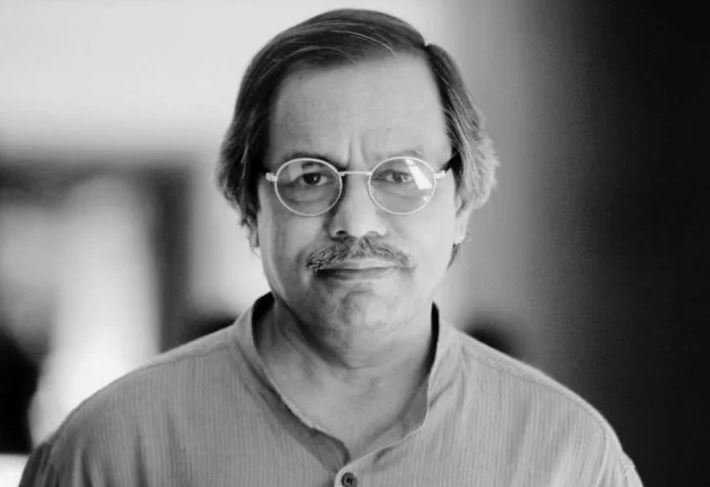
Syed Manzoorul Islam was effortlessly stylish. He often wore maroon color pure cotton pants with off-white shirts, and he also fondness for black shirts paired with off-white trousers. His shirts were always neatly tucked in, a habit that had become second nature. Round-framed glasses perched on his nose, a style he consciously adopted, a remarkable imitation of a fashion he admired. So far, we know, a devoted fan of John Lennon, Syed Manzoorul Islam, once bought an old pair of round frames from Old Dhaka while at university for just thirty takas. He polished and wore them meticulously, and the Lennon style suited him perfectly. It remained his favorite look until the end of his life.
But this stylish literary figure did more than dress well. In his stories and novels, he did not merely narrate events; he mapped the hidden contours of the world in dust-strewn streets, in the dark alleys of the city, in human solitude, and in the unspoken corridors of history. His language was restrained yet profound, each sentence resonating even in silence.
At the heart of his literary power lay the inner world of human beings, where love, time, politics, and memory interwove seamlessly.
In offering a glimpse of his oeuvre, I prefer to draw upon his short story, – The Scent of the Animal World.
“Minara lay motionless beneath the water lilies. Her back rested on the pond’s bed, her eyes fixed on the black sky above, her chest covered with hair and lily leaves, the rest of her body submerged. She felt a terrifying grief, but to cry would ripple the water. Her body was already numb, and too much numbness would make her sink. So she held herself in check. At the same time, she thought that if the water rippled, it would not be entirely bad; the pain might ease. But until then, she must offer a prayer. If the One above heard it…
Eventually, the tears came. But Minara knew how to cry silently. All her life, she had shed many such quiet tears. And then, as she wept, her body shivered. No, this shiver was not from crying; it began in that very spot where police man Ambar Ali had placed his hand and said in his own words, ‘Your geography today will understand how deeply Ambar Ali’s sword can strike.’
The tremor made no sound, but it carried a scent- not pleasant, yet intoxicating- the scent of Ambar Ali’s flesh sword.”
As I mentioned earlier, paying tribute to Professor Syed Manzoorul Islam is a puzzle of its own, and so I anchor my pen here without extending more.
The writer is a poet, political analyst, and litterateur