
The interim government’s approval of the new telecom policy on September 4 has sparked concern among homegrown small and medium-sized telecom operators in Bangladesh, who fear it will marginalize them in favour of larger, more resource-rich players.
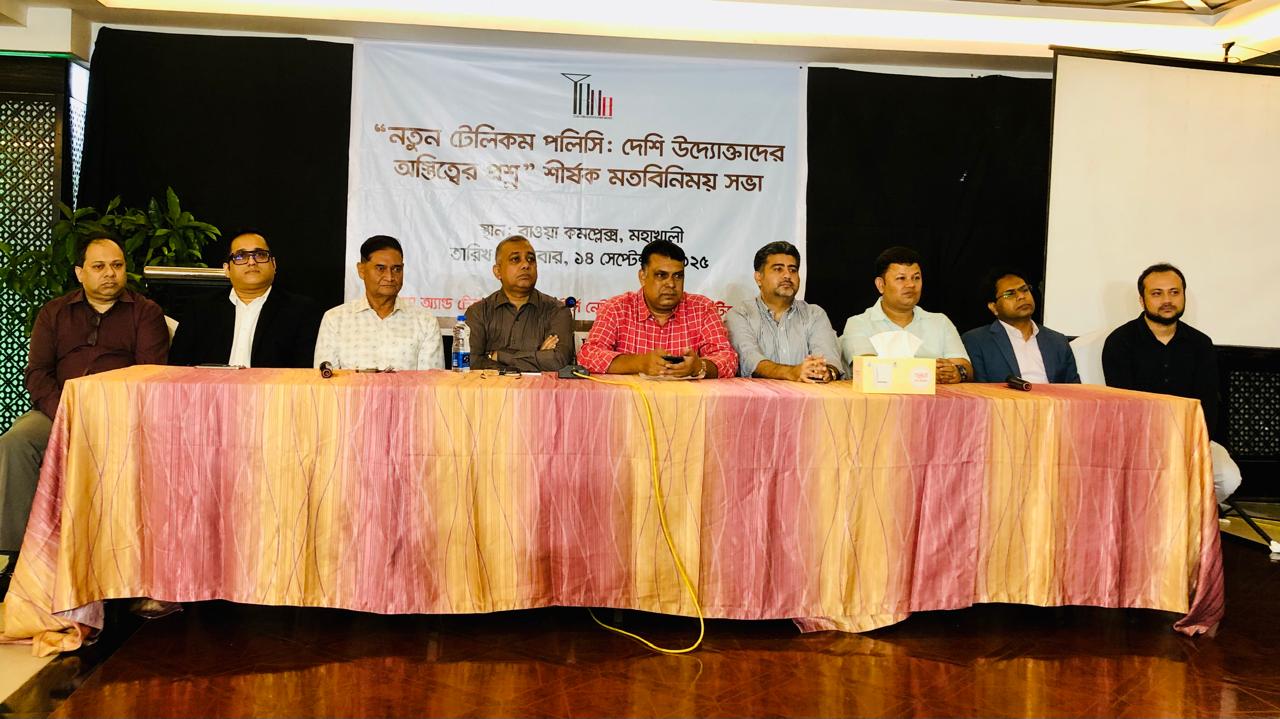
At a discussion with the Telecom and Technology Reporters’ Network Bangladesh, titled “New Telecom Policy: Question of Local Entrepreneurs’ Survival,” industry leaders discussed the potential harm the policy could cause smaller telecom firms.
These small firms, some with over 20 years of service, argue that the policy, particularly Clause 7.4.5, could force them out of business by pushing them to compete with larger, more established operators.
Clause 7.4.5 allows divisional Internet Service Providers (ISPs) to transition into nationwide operators, a move smaller ISPs see as an unfair challenge to their limited resources.
Small internet service providers who currently serve individual districts warn that this shift would pressure them to compete on an uneven playing field with much larger companies.

The Internet Service Providers Association of Bangladesh (ISPAB) has objected to the policy, calling for smaller businesses to be given the option to continue as divisional ISPs or transition to Fixed Telecom Service Providers (FTSPs) voluntarily.
ISPAB believes allowing this option would help smaller operators grow at their own pace, maintaining their community service without being overwhelmed by larger players.




Another contentious issue raised is Clause 7.4.7, which limits district-level FTSPs to providing only internet and data services, with ISPAB calling for a broader service scope to allow all ISPs to participate in emerging digital markets like internet protocol (IP) telephony and telemedicine.
The Bangladesh Association of Interconnection Exchange Operators (AIOB) has also voiced concerns, particularly about the removal of the Interconnection Exchange (ICX) layer, which could stifle competition and allow monopolistic practices to take hold.
AIOB warns that the policy might jeopardize nearly Tk 4,000 crore in domestic investments in IP-based technologies and increase illegal activities, potentially costing the government up to Tk 280 crore in lost telecom revenue.
The International Terrestrial Cable Association of Bangladesh (IIGAB) also raised objections regarding the government’s plan to convert International Terrestrial Cable (ITC) license holders into Internet Connectivity Service Providers (ICSPs) automatically.
IIGAB Secretary General Ahmed Junayed expressed concern about the financial instability of many ITC operators and their lack of infrastructure compared to Internet Gateway operators, which could destabilize the sector.
Despite these concerns, Chief Adviser’s Special Assistant for Posts, Telecommunications, and Information and Communication Technology Faiz Ahmad Taiyeb defended the policy at a press conference on September 4, arguing that it aims to eliminate inefficiencies and middlemen that had been profiting at the expense of the industry.
Taiyeb explained that the new policy consolidates telecom licenses into three categories—Access Network Service Providers (ANSP), National Infrastructure and Connectivity Service Providers (NICSP), and International Connectivity Service Providers (ICSP)—to streamline operations and reduce inefficiencies.
While the policy seeks to promote competition and reduce consumer prices, industry leaders continue to urge the government to reconsider its impact on smaller telecom operators, who they say have been crucial in developing the country’s telecom infrastructure.
They argue that a more balanced approach is necessary to ensure the survival and growth of small businesses, which play a vital role in expanding digital services across Bangladesh.
Leaders of homegrown industries have expressed concerns that the interim government has not engaged in discussions with them on key issues and have called for amendments to the current policies. They warned that if their demands are not addressed, they will pursue legal action.