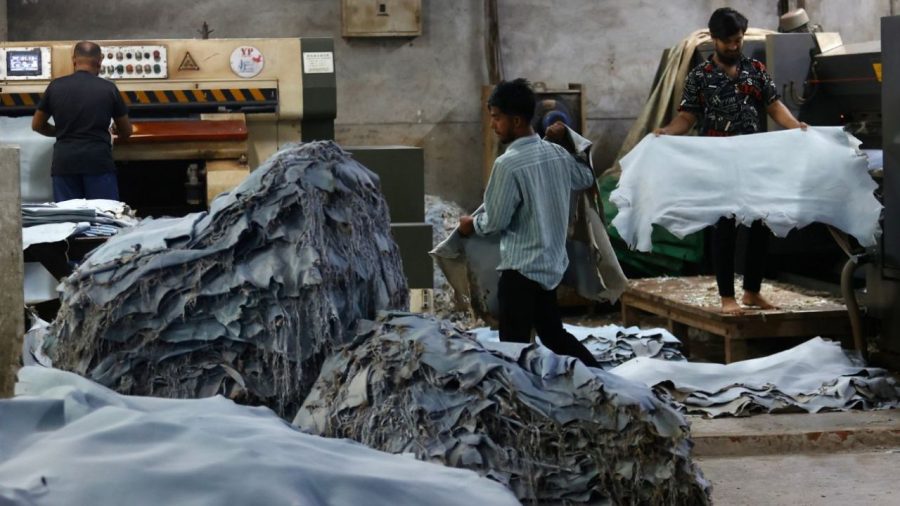

Bangladesh has a large supply of rawhide, a sizeable workforce and a growing domestic footwear market, but the leather industry still lacks a complete supply chain needed to move into higher-value production.
The government now plans to address these gaps through automation, artificial intelligence (AI) and modern manufacturing technologies.
Under a five-year strategic plan, the government has proposed moving the leather industry beyond its traditional dependence on rawhide and labour-intensive manufacturing. The plan focuses on developing domestic production of leather accessories, integrated supply chains, AI-assisted manufacturing, modern processing technologies and stronger design capabilities.
The plan, outlined in the General Economics Division’s Five-Year Strategic Framework for Reform and Development, envisages a three-stage transformation of the sector – from immediate recovery and stabilisation, through restoration and acceleration, to the reconstruction of a globally competitive leather industry.
A key focus of the strategy is developing the sector’s domestic supplier ecosystem.
In the recovery and stabilisation phase, the government plans to strengthen supplier-development programmes, improve rawhide preservation, introduce grading and traceability systems and establish Common Facility Centres.
The strategy also proposes technology adoption among small and medium enterprises, modernisation of production processes, use of CAD/CAM systems and development of stronger design capabilities.

Bonded warehouse facilities, customs simplification and policy-parity reforms would also be introduced in this phase.
The first phase proposes machinery-based technical training, international training partnerships, apprenticeships, overseas placement programmes and reforms to the Leather Technology Institute based on export-oriented industry demand.
Environmental compliance remains a major part of the plan, particularly during the first two phases.
The government plans to establish a high-level Leather Sector Coordination Committee to oversee CETP development, compliance reforms, industrial infrastructure, export promotion and implementation across ministries and industry stakeholders.


It also plans to operationalise and modernise CETP facilities, solid-waste and chromium-recovery systems, upgrade tannery-level compliance and introduce environmental monitoring systems.
Fast-track support for Leather Working Group (LWG) certification has also been proposed for export-oriented tanneries.
In the restoration and acceleration phase, the government plans to develop domestic production of accessories and integrated supply-chain systems, supported by concessional finance, technical assistance and internationally managed technology centres.
The government also wants manufacturers to adopt automation, AI-assisted manufacturing and modern processing technologies.
During this phase, the strategy aims to expand internationally compliant waste-management systems, increase LWG-certified tannery capacity, strengthen traceability and environmental compliance and establish internationally recognised testing and certification facilities.
The second phase would expand advanced technical training, industry-led curricula, automation and engineering skills, international certification programmes and industry-university collaboration.
The strategy also proposes dedicated leather goods and footwear industrial zones with shared compliance facilities, logistics systems, testing laboratories, warehousing and secure industrial plots.
The second phase would bring cluster-based industrial infrastructure, customs automation, export logistics and business-support services, particularly to improve SME competitiveness and export readiness.
The third phase is reconstruction of a globally competitive sector. Here the long-term objective is to create advanced leather and footwear industries with integrated domestic supply chains, high-value product capabilities, modern manufacturing systems and strong innovation and design ecosystems.
By the reconstruction phase, the government wants Bangladesh to become a source of skilled technical, engineering, compliance and design professionals capable of supporting globally competitive leather and footwear industries.
Eventually, the government wants a permanent institutional architecture capable of aligning environmental compliance, industrial upgrading, technology adoption, trade policy and export-market strategies with changing global requirements.
The longer-term goal is to position Bangladesh as a globally trusted supplier of environmentally compliant, traceable, certified and sustainable leather and footwear products, particularly in premium international markets.
Ultimately, the government wants internationally competitive leather industrial clusters supported by efficient infrastructure, integrated logistics, streamlined regulations and predictable competitiveness-oriented policies.
The push comes despite Bangladesh’s significant leather-sector potential.
The country accounts for around 3.5 per cent of global rawhide production, while its domestic leather goods and footwear market is worth about Tk24,000 crore annually. Domestic footwear demand stands at around 350 million pairs a year, and the sector employs roughly 850,000 workers.
Exports of leather, leather goods and footwear increased from $765 million in FY2011 to around $1.7 billion in FY2025, according to the strategic framework.
However, Bangladesh still captures only about 1.5 per cent of global leather-footwear exports, while its share in other major leather-product categories remains below 1 per cent.