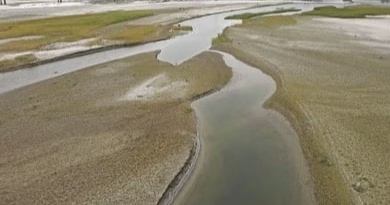

Water and environmental experts have raised serious concerns over the Teesta River Comprehensive Management and Restoration Project, warning that it could trigger a multidimensional disaster. The billion-dollar project, expected to be implemented soon, could exacerbate existing environmental issues, harm the economy, and strain Bangladesh’s diplomatic relations, experts warn.
Although official details about the project remain scarce, experts argue that it lacks scientific justification and could be environmentally destructive. They suggest that the issues the project seeks to address, including flash floods, riverbank erosion, and water shortages during the lean season, may worsen.
“The project will require continuous dredging of the Teesta River and ongoing maintenance of its banks,” said Md Khalequzzaman, a geology professor at the Commonwealth University of Pennsylvania.
Project Overview

The Teesta River Comprehensive Management and Restoration Project is funded by a substantial loan and technical assistance from Power China, a Chinese state-owned company. The plan includes converting the river from a braided to a meandering system, constructing 114 km of embankments, and narrowing the river’s width from 3 km to 1 km. The project also promises to reclaim 170 sq km of land, control floods and erosion, and improve navigation and irrigation.
However, experts contend that dredging alone will not resolve the core issue of water scarcity during the lean season. The Teesta’s flow has dramatically decreased over the decades due to upstream water withdrawals in India’s Sikkim and West Bengal. In the 1990s, the river’s flow was 10,000 cusecs, but it now barely reaches a few hundred cusecs during the lean season.
Environmental Risks




Experts fear that the project’s proposed measures may worsen the situation rather than alleviate it. “Deepening the riverbed may store some additional water, but without a downstream dam or barrage, it won’t address the water scarcity issue,” Khalequzzaman explained. Additionally, embanking the river with concrete could disrupt groundwater recharge and floodplain drainage, threatening the entire river ecosystem, according to Professor AKM Saiful Islam of BUET’s Institute of Water and Flood Management.
Some experts also warn that the project could legitimize India’s unilateral control over Teesta waters without ensuring Bangladesh’s fair share.
Sediment and Flooding Concerns
The Teesta carries an unusually high sediment load of about 3,200 tons per sq km per year. Narrowing the river could accelerate bank erosion and increase the frequency of flash floods. Continuous dredging would be necessary to maintain navigability, but according to Khalequzzaman’s analysis, the dredged channel could fill up within seven years.
Reducing the river’s width from 3 km to 700 m would leave only 25–38% of its original cross-sectional area, potentially causing floods to fill the narrow channel in less than five hours during a 50-year flood. This would be far quicker than the typical flood duration, experts warn.
Calls for Halt
Water expert Ainun Nishat urged that the project undergo thorough consultation with local residents, specialists, sociologists, and civil society before approval. Sharif Jamil, head of Waterkeepers Bangladesh, called for the project to be halted unless it is clearly proven to safeguard both the people’s interests and the environment.
“The Teesta region is geopolitically sensitive, attracting the attention of both India and China,” Jamil said. “Without a fair share of upstream water, keeping the Teesta alive is impossible.”
Attempts to reach Water, Environment, Forest, and Climate Adviser Syeda Rizwana Hasan and Water Resources Secretary Mokabbir Hossain for comment were unsuccessful.