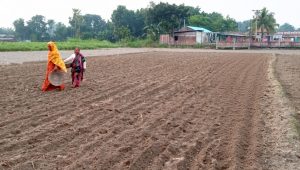



Favourable weather, adequate rainfall and enough water for retting have helped produce a good jute crop in Naogaon this season, while higher prices have brought fresh hope to farmers after years of declining cultivation.
Dry jute is selling for Tk3,800 to Tk4,500 a maund in markets across the district, depending on quality and variety. Prices are at least Tk600 a maund higher than at the same time last year.
Farmers say the combination of better yields, improved fibre quality and stronger prices has made jute profitable again.
Data from the Department of Agricultural Extension show that both jute cultivation and production have declined steadily in Naogaon over the past five years.
Jute was cultivated on 5,725 hectares in 2021-22, producing 15,560 tonnes. Cultivation fell to 5,330 hectares in 2022-23, with output dropping to 14,650 tonnes.

Cultivation declined further to 4,560 hectares in 2023-24, producing 12,710 tonnes, and to 3,550 hectares in 2024-25, when output fell to 9,965 tonnes.
This season, jute has been cultivated on 3,170 hectares.
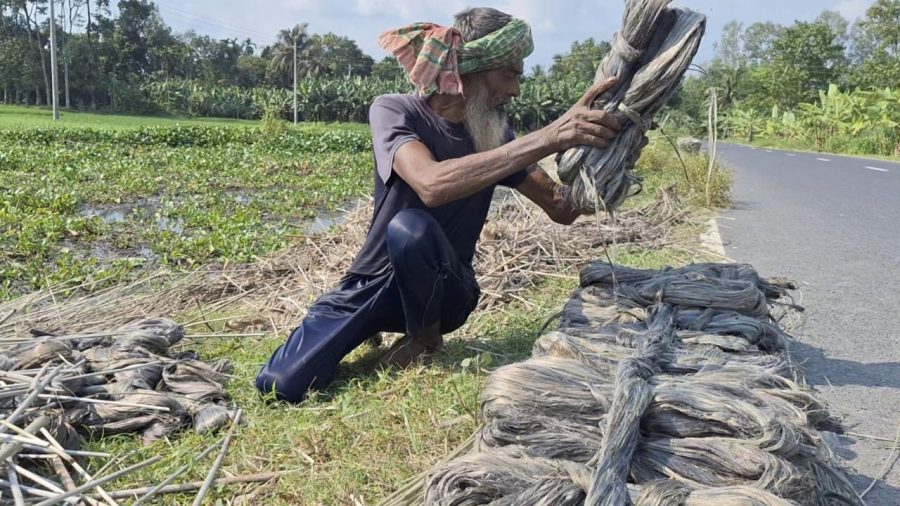
Farmers have already harvested much of the crop and are stripping, washing and drying the fibre before taking it to market.
At Satihat in Manda, the district’s largest jute market, prices range from Tk3,800 to Tk4,500 a maund.




Farmers said cultivating one bigha of jute costs about Tk16,000 to Tk17,000, including land preparation, seeds, fertiliser, crop care, harvesting, retting, fibre extraction, washing and drying.
At current prices, they estimate net profits of Tk30,000 to Tk32,000 a bigha.
A recent visit to Satihat found farmers arriving from early morning with local, tossa and mesta varieties. Traders checked the fibre’s colour, moisture, quality and variety before offering prices.
Strong demand allowed farmers to bargain with several buyers before selling.
Dulal Hossain, a farmer from Khalishakuri in Naogaon Sadar, cultivated five bighas this year.
He said traders had booked 10 maunds of his crop before retting at Tk3,800 a maund, while he later sold the remaining jute for Tk4,000 a maund.
He received about Tk700 more per maund than last year.
Atish Kumar of Dakshin Moinam village in Manda said sufficient rainfall had made retting easier and improved fibre quality.
“Because there was enough water, we did not face the usual problems with retting. The colour of the fibre is also better this year,” he said.
He expects good-quality jute to fetch as much as Tk5,000 a maund if farmers can hold stocks for some time.
Monjur Rahman, deputy director of the Department of Agricultural Extension in Naogaon, said 3,170 hectares had been brought under jute cultivation this year, with a production target of 8,910 tonnes, while 800 marginal farmers received free seeds, fertiliser and cash support for transport and other costs under a government incentive programme.
He said wider use of environmentally friendly jute products, along with favourable weather, sufficient water and strong market prices, could boost demand, improve farmers’ returns and encourage more growers to return to jute cultivation in the coming years.