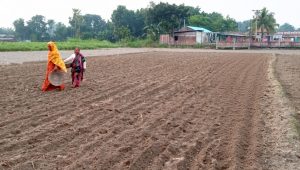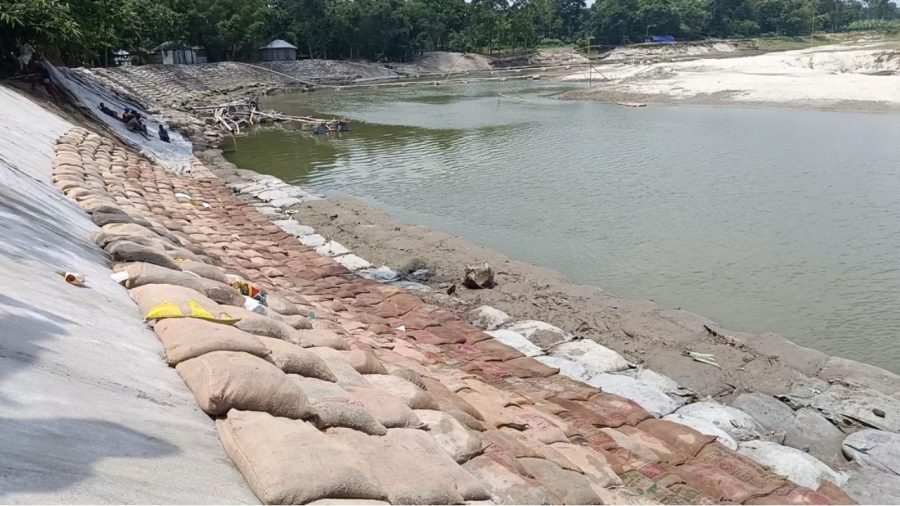



Allegations of irregularities have surfaced in a Tk2.37 crore riverbank protection project on the Charalkata River in Jaldhaka upazila of Nilphamari, with residents claiming that sand is being taken from the riverbed and used to fill geobags meant to stop erosion.
Locals also alleged that silt-laden river sand is being used instead of the specified coarse sand and that the prescribed ratio of sand and cement is not being maintained.
They questioned how erosion could be prevented if sand was removed from the same river where the government is spending crores of taka on protection work.
According to the Bangladesh Water Development Board, emergency protection work is under way along 1,035 metres of the river’s right bank in erosion-prone areas including Harishchandra Path, Basuniapara and Babupara.
The work is being carried out under nine packages.
Tender conditions require dry, coarse sand of a specified quality to be brought from elsewhere for filling geobags.

Sand from the riverbed is not supposed to be used.
The upper section of the protective structure is also supposed to be built with jute sacks filled with sand and cement in a specified ratio.
Residents alleged that the requirement of one bag of cement for every six bags of sand was not being followed properly.



Several shallow engine-powered machines were seen extracting sand close to the section where geobags were being placed.
Locally, the machines are known as “bomb machines”.
Residents said the 24-horsepower machines were digging deep pits within about 50 metres of the riverbank and alleged that the extracted sand was later being used to fill geobags.
They also claimed that silty sand was being used instead of coarse sand meeting the specified fineness modulus, or FM, standard.
Under Section 4 of the Sand Quarry and Soil Management Act, 2010, extracting sand with shallow dredgers or similar machines within one kilometre of a riverbank, embankment or important government installation is prohibited.
Violations are punishable under Section 15(1) by up to two years in prison, a fine of Tk50,000 to Tk5 lakh, or both.
Officials concerned said Water Resources Ministry guidelines prohibit the use of riverbed silt or sand from erosion-prone areas in river protection projects.
A local resident, Sahadev Roy, said their area was already low-lying and warned that increased erosion could put homes and farmland at risk. Residents fear the protective structure could collapse during the coming monsoon.
Residents further alleged that old and torn jute sacks were being filled with silty sand and only a nominal amount of cement, causing some sacks to deteriorate and spill their contents even before the work is completed.
Residents said they had tried to stop the contractor’s workers from over the alleged irregularities but received no remedy.
They also alleged that influential people linked to the work threatened and intimidated them.
Nilphamari Water Development Board Executive Engineer Md Reza Ahmed said, “We will assess the items. If there is any inconsistency, the assessment committee will act accordingly. We will proceed based on the committee’s report. The matter will be examined after completion of the project.”
Nilphamari Deputy Commissioner and District Magistrate Mohammad Nairuzzaman said, “There is no scope for illegal sand extraction from the river. The administration has already conducted drives and imposed fines. Tougher measures will be taken to stop sand extraction.”
Residents have demanded an on-site investigation into both the quality of the protection work and the sand extraction, warning that removing sand from the riverbed could worsen erosion during the monsoon.