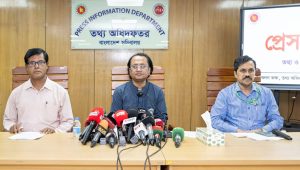
Authorities in Jammu and Kashmir shifted 150 “Bangladeshi nationals”, who were allegedly residing in the Union Territory without valid documentation, to West Bengal on Monday as part of an ongoing deportation process.
However, there was no statement from the Bangladeshi authorities regarding the deportation.
Quoting official sources, Indian news agency PTI reported that the group was flown to Bagdogra aboard a special Indian Air Force aircraft.
Upon landing in West Bengal, the individuals were handed over to Border Security Force (BSF) personnel.

Before their transfer, the individuals were housed at a facility operated by the Srinagar Police and were later transported to Bagdogra, from where they are expected to be sent back to Bangladesh.
Officials added that another group of 150 “Bangladeshi citizens” is scheduled for deportation on October 7, according to Free Press Kashmir.


The deportation drive follows a comprehensive survey conducted across the Kashmir Valley by the Jammu and Kashmir administration with assistance from local police.
The identification exercise found around 600 “Bangladeshi nationals” staying in different districts of the Union Territory without legal documentation.
This development comes after the Ministry of Home Affairs constituted the High-Level Committee on Demographic Change (HLCDC) on 26 May to examine demographic shifts resulting from illegal immigration and other unusual factors in border regions, as well as to suggest remedial measures.
Headed by retired Justice Prakash Prabhakar Navlekar, the panel has been mandated to scientifically examine these population shifts, determine their causes, and formulate policy, legislative, and administrative recommendations within a one-year timeframe.
Over the past two months, the panel sent communications to states and Union Territories requesting year-wise demographic statistics alongside related administrative information.
It has also sought state governments’ evaluations of key demographic trends, data on the religious makeup of tribal populations since 2011, and details regarding “visible changes” in the religious composition of districts, industrial clusters, and border areas over the preceding 15 years.