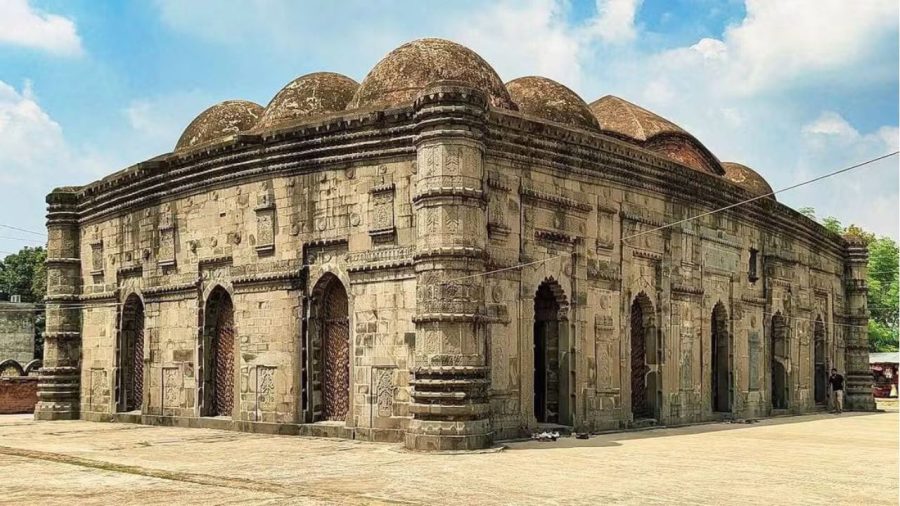



A striking dark-stone structure rises near the ancient settlement of Gaur in Shibganj upazila of Chapainawabganj.
Its 15 domes, intricate stonework and arches make it a remarkable icon of Bengal’s Sultanate era.
Known as a “Jewel of Sultanate Architecture”, Chhoto Sona Mosque stands in Shahbazpur, about 35–38 kilometres from Chapainawabganj town.
Steeped in Gaur’s history, it continues to draw tourists, history enthusiasts and architectural researchers from home and abroad.
An architectural feat of the reign of Husain Shah
Historical records suggest that the mosque was built during the reign of Sultan Alauddin Husain Shah of Bengal, between 1493 and 1519.
An inscription above the main entrance identifies its builder as Majlis-i-Majalis Majlis-i-Mansur Wali Muhammad bin Ali.

However, part of the inscription bearing the construction date has been damaged, leaving the exact year unknown.
The mosque is popularly believed to be nearly 500 years old.
Its name is thought to have originated from a golden coating that once covered its domes and exterior, making them shimmer in sunlight.
As another larger Sona Mosque exists in the region, it became known as Chhoto Sona Mosque, or “Little Golden Mosque”.




The gilding is no longer visible.
The mosque has 11 entrances, five on the eastern wall and three each on the northern and southern walls.
Four octagonal turrets stand at its corners, while floral and vine motifs adorn its dark stone walls.
Though stone-covered, the mosque’s core structure is made of brick, a notable feature of Sultanate-era architecture.
A raised chamber in the northwest is believed to have been reserved for the ruler or royal family.
Damaged by earthquake, but still standing
The 1897 earthquake damaged parts of the mosque, which were later repaired. Despite centuries of weathering and natural disasters, much of its original structure remains intact.
The Department of Archaeology currently protects and conserves the historic site.
Sultanate history meets the Liberation War
The historical significance of Chhoto Sona Mosque extends beyond its medieval architecture.
The graves of two Liberation War heroes, Bir Sreshtho Captain Mohiuddin Jahangir and Major Nazmul Haque, commander of Sector 7, are located near the mosque.
The site thus brings together two important chapters of Bangladesh’s history which are the Sultanate-era architectural heritage and the legacy of those who fought for the country’s independence.
A surviving landmark of the lost city of Gaur, the mosque reflects the artistic, architectural and technical skills of Bengal’s Sultanate period.
Its nearby graves further link its medieval past with Bangladesh’s Liberation War, making it more than an old place of worship.
Chapainawabganj Deputy Commissioner said Chhoto Sona Mosque is an important example of the artistic and architectural heritage of the Indian subcontinent.
“Everyone must come forward to protect this historic monument so that future generations can learn about and appreciate its heritage,” he said.