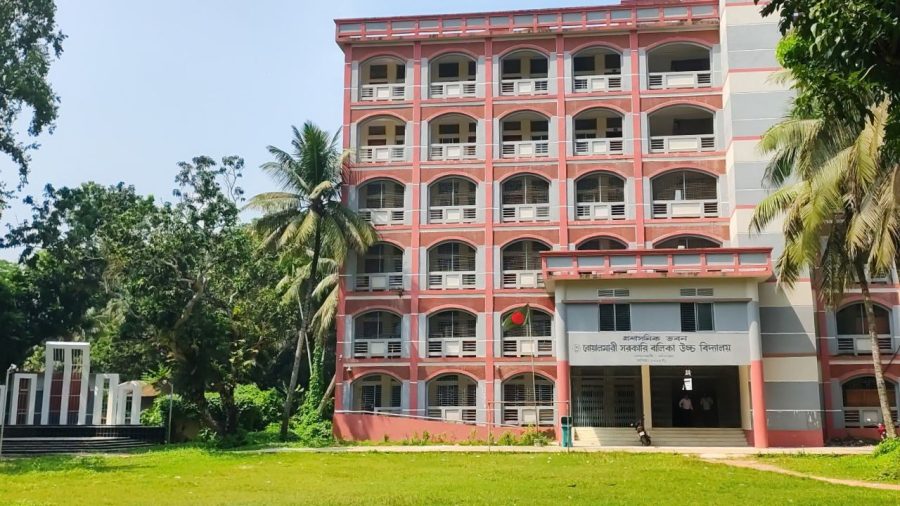



More than 500 students at Boalmari Government Girls’ High School in Faridpur are being taught by just three teachers, one of whom is currently undergoing BEd training.
Of the school’s 12 approved teaching posts, nine remain vacant, leaving the institution severely understaffed.
The school has hired four part-time teachers to keep classes running, but the teacher shortage continues to disrupt regular academic activities.
Classes in science, mathematics, English, Bangla and religious studies have been particularly affected, with assistant teacher posts in these subjects remaining vacant.
Established in 1965 on nearly 1.5 acres of land, the school was nationalised on 22 December 1987.
It initially had 11 approved teacher posts, including the principal and vice-principal, with an ICT teacher’s post added later, bringing the total to 12.
Anika Sarker, a class nine science student, said higher mathematics classes are not held regularly because of the teacher shortage.

“Although there is a laboratory, practical classes have not been held there for a long time because of the teacher shortage,” she said.
Tasnim Mridha, a class six student, said regular classes are frequently disrupted.
“We have to take private lessons outside the school to make up for the shortage,” she said.
Abdul Gaffar Molla, guardian of class six student Jannati, said the shortage should be resolved immediately.




“Our children’s education cannot be allowed to suffer because of the shortage of teachers,” he said.
The staffing crisis extends to the school’s administrative section.
Only a night guard is working against four approved posts for third- and fourth-class employees.
There is also no ayah or cleaner at the school.
Part-time teacher Beauty Parvin said the teachers receive only a small honorarium for teaching throughout the month.
“The honorarium is very low considering the current cost of living,” she said.
Masudul Islam, the school’s physical education and sports teacher, said the teachers are struggling to cope with the workload.
“Four part-time teachers, along with me and the principal, are having to handle the workload of 12 teachers.
We have to take several periods every day and move from one class to another as soon as one class ends,” he said.
“As a result, we do not get enough time to prepare for lessons. This is affecting the quality of teaching.”
Acting Principal Sukanto Chandra Mondal said he informed the deputy director of the Dhaka region of the Directorate of Secondary and Higher Education about the teacher and staff shortages in writing after joining the school in February this year.
“I also informed the local member of parliament and the upazila nirbahi officer, but no positive response has been received so far,” he said.
He said the school is collecting funds locally to pay the part-time teachers because there is no government allocation for the purpose.
Boalmari Upazila Nirbahi Officer SM Rakibul Hasan said he had informed the concerned directorate and the Prime Minister’s Office about the shortage.
“Efforts are continuing from my side to resolve the teacher shortage. I hope teachers will be appointed to the vacant posts soon and the school’s learning environment will improve further,” he said.
Locals said the school had satisfactory educational standards before it was nationalised, but the teacher shortage became severe afterwards, affecting the quality of education at the upazila’s only government girls’ school.
Local education enthusiasts and guardians have urged the Ministry of Education and the government to take immediate measures to fill the vacant posts and improve the quality of girls’ education.