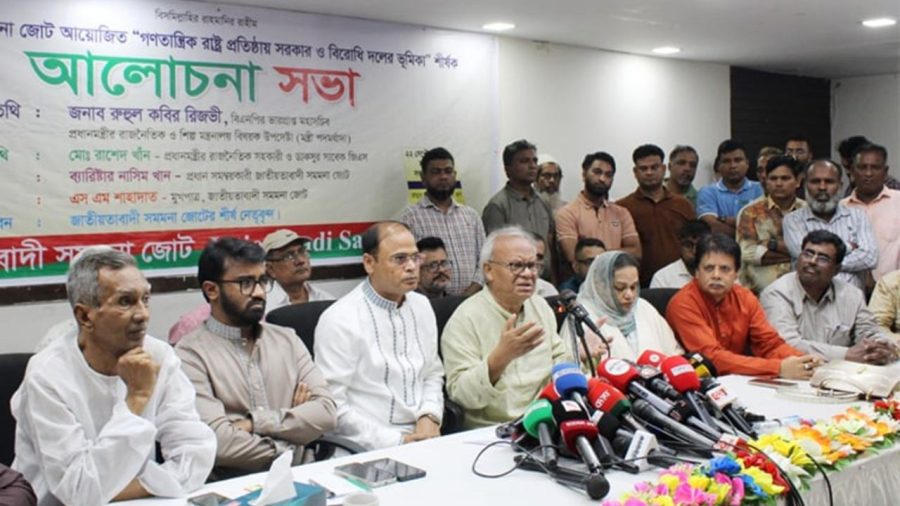



BNP Acting Secretary General and Prime Minister’s Political Adviser Ruhul Kabir Rizvi urged the opposition to focus on the underlying causes of the country’s ongoing crisis rather than making sweeping allegations or launching personal attacks against the government.
He said citizens have the democratic right to criticise the government and that the opposition can strongly raise its voice both inside and outside parliament.
Rizvi made the remarks while addressing a discussion titled “Role of the Government and Opposition in Establishing a Democratic State” at the National Press Club in Dhaka on Tuesday.
He claimed that the government had maintained a democratic environment and had not obstructed opposition programmes, including long marches and other political activities.
Referring to a recent opposition long march to Rangpur involving around 450 vehicles amid the fuel crisis, Rizvi alleged that some vehicles in the procession did not pay road tolls.
He also claimed that the programme was intended to create confusion among the public rather than explain the impact of the global crisis on fuel prices.

The opposition, he said, should highlight the international factors behind rising energy prices instead of resorting to personal attacks on the government.
Rizvi also spoke about recent incidents of violence and arson, including the setting of buses and trains on fire and explosions involving cocktails in different parts of the country.
Those responsible for such incidents should be identified and exposed before the public, he said.
He added that those organising long marches against rising commodity prices or extortion should also hold marches, rallies and processions to protest such destructive activities.
Rizvi warned that misinformation about government activities could obstruct legitimate state operations and disrupt the functioning of the administration.



Referring to an incident at Rajshahi Railway Station, Rizvi alleged that activists of a “secret organisation” had carried out an unprecedented attack there.
He also claimed that Jamaat-e-Islami had failed to gain public acceptance because of what he described as repeated deception of the people.
“Even now, they are continuously deceiving the people,” he said.
Explaining the recent fuel price adjustment, Rizvi said Bangladesh was purchasing diesel at around Tk205 per litre while selling it to consumers at Tk115, resulting in a loss of approximately Tk90 per litre. Even after the latest price adjustment, the government would still incur a loss of roughly Tk 70 per litre, he said.
Rizvi said diesel prices in Bangladesh remained lower than those in India, Nepal, Myanmar, Sri Lanka and the Philippines.
He attributed the price adjustment to rising oil prices in the international market.
He also warned that significant differences in fuel prices between countries could encourage fuel to flow from markets where it is cheaper to those where it commands a higher price.
Rizvi said the country’s foreign exchange reserves had increased significantly compared with previous levels, while remittance inflows had also risen recently.
The increase in reserves, he said, had strengthened Bangladesh’s ability to purchase gas and fuel oil amid the ongoing crisis.
He expressed hope that public hardship would ease once global economic pressures subside.
On the financial sector, Rizvi said the government is working to reorganise the country’s banking and financial system.
Several banks had been merged, he said, adding that depositors were receiving their money through allocations from Bangladesh Bank.
The discussion was organised by Jatiyatabadi Samamona Jote and chaired by its chief coordinator, Barrister Nasim Khan.
Alliance spokesperson SM Shahadat moderated the programme, while Political Assistant to the Prime Minister Md Rashed Khan attended as a special guest.
Central leaders of the alliance also spoke at the event.