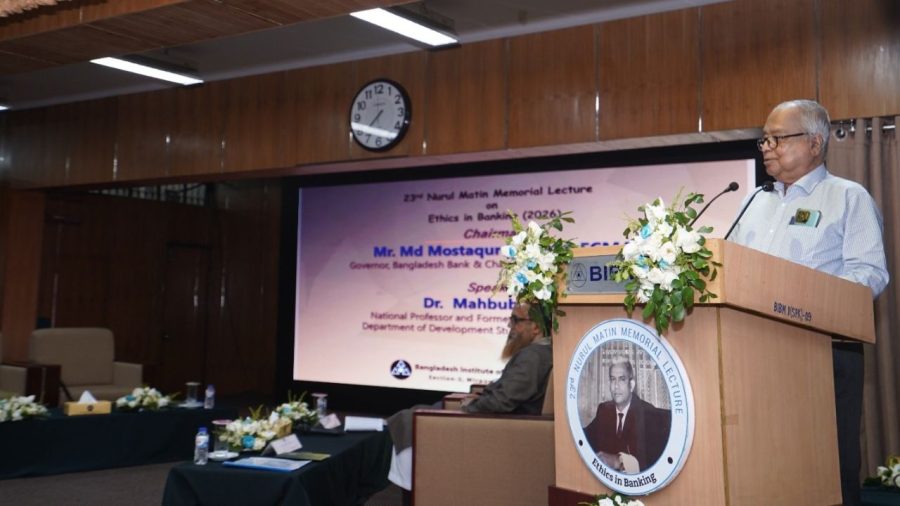

More than 32 per cent of total loans in Bangladesh are now classified as defaulted, disrupting banks’ normal cycle of loan recovery and reinvestment, National Professor Mahbub Ullah said.
He warned that bank profitability, capital adequacy, fresh loan disbursement and overall economic activity are being negatively affected by the growing trend of non-performing loans (NPLs). The National Professor was delivering the 23rd Nurul Matin Memorial Lecture on “Ethics in Banking”, organised by Bangladesh Institute of Bank Management (BIBM) on Saturday.
Bangladesh Bank (BB) Governor and BIBM Governing Board Chairman Md Mostaqur Rahman presided over the session.
BIBM Director General Md Ezazul Islam delivered the welcome remarks and Director (Research, Development and Consultancy) Md Shihab Uddin Khan offered the vote of thanks, said a press release on Sunday.

Mahbub Ullah observed that the core driving force of banking is the continuous recycling of loan funds. Banks collect deposits and disburse them as loans; as instalments and interest are repaid, the funds are reinvested.
Rising defaults are disrupting this, with a significant portion of depositors’ funds not returning on time, pressuring liquidity and lending capacity. Banks are being forced to exercise greater caution in new lending, he said.




Due to prolonged losses and rising defaulted loans, some banks are struggling to maintain capital reserves required under international Basel-II standards, limiting fresh credit, Mahbub Ullah said adding that even banks still capable of lending are taking an extremely cautious approach.
Eligible entrepreneurs and industrial enterprises are facing difficulties securing working capital and investment financing, which could affect production, employment and overall economic growth.
Mahbub Ullah warned risks could increase without effective, sustainable measures to control defaulted loans. He stressed good governance, accountability, ethics and proper risk management in loan approval and recovery, and coordinated action to restore confidence, recover defaulted loans, strengthen capital and maintain normal credit flow.
Governor Md Mostaqur Rahman stressed ethics, good governance, accountability and professionalism. He said a bank’s core strength does not depend solely on capital, technology or liquidity but on the trust of depositors, borrowers, investors and the wider economy. Bankers must uphold the highest professional and ethical standards.
Md Ezazul Islam said banking differs because banks manage public deposits and channel them into economic activities, so a banker’s decisions affect not just one bank or customer but ripple across sectors. A skilled banker must also be honest, responsible, ethical and accountable, particularly in loan approval, rescheduling, asset valuation, customer selection and risk management. The board and top management have a crucial role in establishing an ethics culture.
Md Shihab Uddin Khan said the goal of banking sector reform is not merely to keep troubled banks afloat but to build a governance-based system in which depositors’ interests are protected, loans flow into productive sectors, and transparency and accountability are maintained in bank asset management.
The event was attended by economists, bankers, university professors and individuals from various sectors.