
Bangladesh’s banks need separate supervisory authority, independent credit approval process and distressed asset management firms with a modern bankruptcy regime to deal with the sky-high bad loans, financial experts said on Saturday.
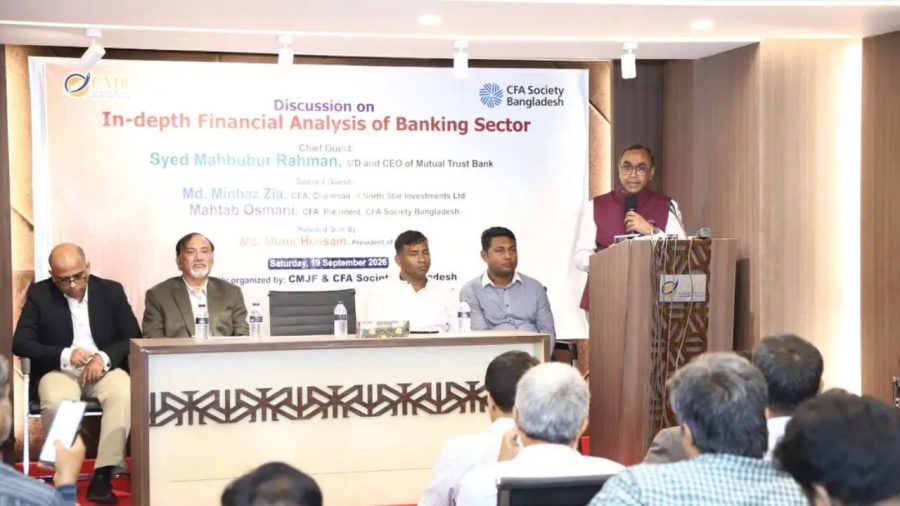
Bankers, investment bankers, financial analysts proposed the changes for proper handling of the banking sector crises at a discussion titled “Assessing the financial condition of the banking sector”, organised by the Capital Market Journalists’ Forum (CMJF) and CFA Society Bangladesh at the CMJF office.
It is tough for the central bank to oversee the operations of so many lenders said NorthStar Investments Chairman Minhaz Zia, adding that Bangladesh should opt for separate independent regulators models such as the UK’s Prudential Regulation Authority and Financial Conduct Authority, either within or outside Bangladesh Bank.
“A single structure cannot deeply supervise 50-60 banks,” said the country’s first chartered financial analyst.
Syed Mahbubur Rahman, former chairman of the Association of Bankers, Bangladesh and the Managing Director of Mutual Trust Bank stressed reforms to prevent worsening of the banking sector that saw bad-loans surging to over Tk6 lakh crore or above 32 per cent of the total, from only Tk22,000 crore in 2008.
Banks earned from foreign exchange and government securities in recent years, but their core lending business had suffered a severe setback, with net interest income declining, he said while speaking as the chief guest.
The formal implementation of International Financial Reporting Standard 9, or IFRS 9, would further increase banks’ provisioning requirements, he said. Provisioning needs setting aside profits to plug loops created by business losses.

Cost cutting alone will not help banks thrive, the banker said, adding that about 75 per cent of banks’ costs are difficult to control, including rent, salaries and insurance.
“Artificial intelligence and other technologies could improve efficiency over time, but operating costs could not be cut abruptly,” he said.
On mergers, he said a strong bank could benefit from merging with another institution to integrate technology and capabilities. Combining several weak banks, however, was unlikely to create similar benefits.
In a keynote UCB Stock Brokerage Head of Research Sakib Chowdhury, Shanta Securities Head of Research S M Galibur Rahman and Sonali Bank Chief Financial Officer Iqbal Hossain challenged several commonly held views about the banking sector.




One is that banks are making more money from government securities than lending.
In 2025, gross interest income was Tk1.35 lakh crore, or 61.9 per cent of total income, while investment or non-interest income was Tk83,200 crore, or 38.1 per cent, according to the central bank.
They also distinguished between the lending-deposit spread and net interest margin. In December 2025, the sector’s spread was 5.69 per cent, while net interest margin was negative 0.49 per cent.
Another misconception concerns “idle money”. Of the Tk4.08 lakh crore classified as idle money in the banking sector as of June 2026, over 81 per cent was tied up in approved government securities. Only Tk32,600 crore was held as cash, the analysts said.
The slowdown in private-sector credit also cannot be attributed solely to banks’ reluctance to lend, they said, adding that demand for new investment has weakened, with settlement of letters of credit for capital machinery imports falling 10.5 per cent in FY26.
CFA Society Bangladesh President Mahtab Ur Rahman Osmani said banks’ financial condition and capital adequacy should be explained to ordinary depositors and investors in simpler terms.
Minhaz Zia said as banks hold 80-90 per cent of the country’s total savings, a banking-sector failure would therefore have consequences across the wider economy, he said.
Alongside, regulatory oversight separation, he proposed several other specific structural changes.
At least half of the directors at commercial bank boards should be independent who are not shareholders or nominated by any shareholder.
“Board members should be barred from serving on credit committees, while loan decisions should be handled by an independent credit team and an internal control committee made up entirely of independent directors,” he added.
The bankruptcy law should be modernised and enforced properly, he said, adding that the establishment of a distressed asset management company should be accelerated.
Also, the property-transfer process should be smoothened so distressed loans can be converted into tradable financial assets.
Minhaz Zia also said banks with little or no asset value but large liabilities were unlikely to attract new investors.
“Repeatedly using taxpayers’ money to keep such institutions alive should end,” he said, arguing that banks that are no longer viable should be allowed to close.
He described the approval of so many banks under past policies or political considerations as a historical mistake.
CMJF President Md Monir Hossain chaired the event, while General Secretary Ahsan Habib Russell moderated the discussion.