
The Bangladesh Garment Manufacturers and Exporters Association (BGMEA) and the World Bank-backed ASSET project have completed factory skills training for 2,328 garment workers, as the apparel industry steps up efforts to build a more productive workforce and meet evolving global manufacturing standards.
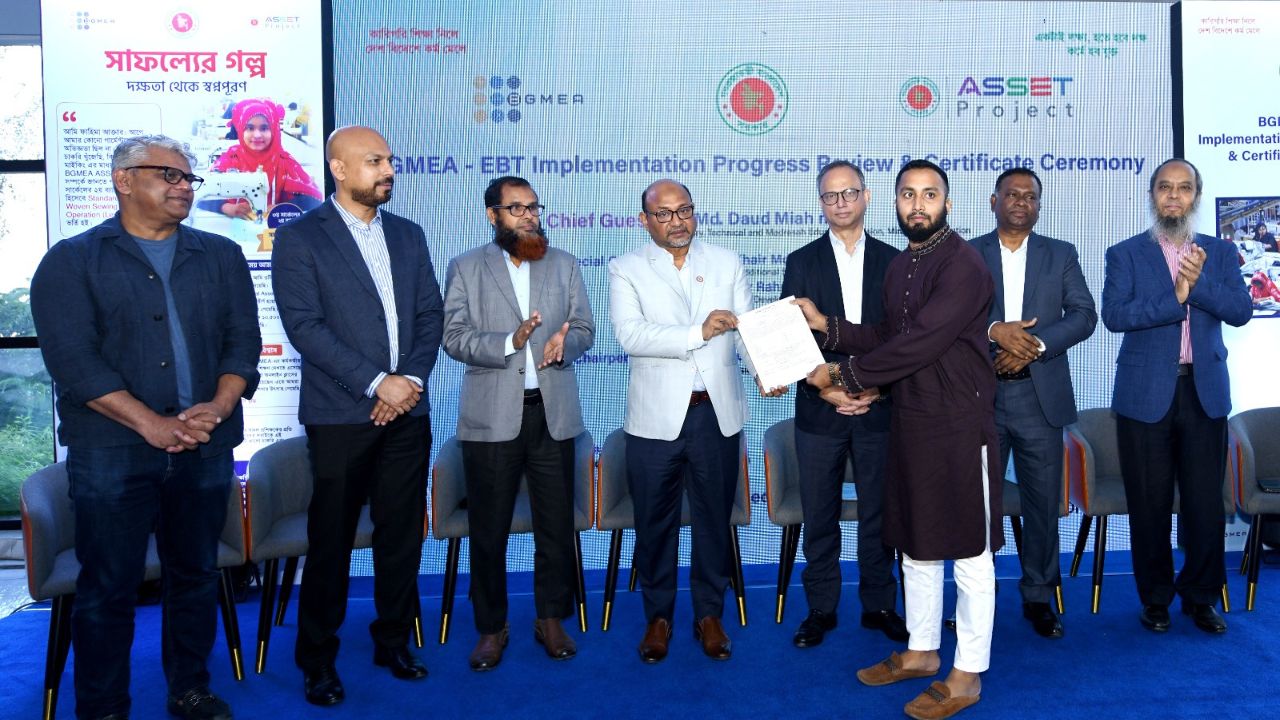
The workers received certificates on Saturday after completing the Enterprise-Based Training (EBT) programme, an industry-led initiative that provides structured, on-the-job training inside garment factories to improve technical skills, productivity and employability.
The programme is being implemented by BGMEA under the Accelerating and Strengthening Skills for Economic Transformation (ASSET) project, financed by the World Bank and executed by the Directorate of Technical Education under the Technical and Madrasah Education Division.

So far, the EBT programme has enrolled 4,632 trainees through 193 batches across three training cycles. Certificates were awarded to participants from 97 batches under the second and third cycles, while training for another 96 batches is currently under way.
Speaking at a review workshop and certificate award ceremony at the BGMEA Complex in Uttara, Technical and Madrasah Education Division Secretary Md Daud Mia said developing a skilled workforce was essential to achieving Bangladesh’s economic goals and sustaining the competitiveness of its largest export industry.




Although the ASSET project is scheduled to conclude in December 2026, he said the government would continue launching skills development initiatives and invited BGMEA to help shape future programmes by strengthening collaboration between industry and technical education institutions.
He also said upgrading garment workers’ competencies to National Technical and Vocational Qualification Framework (NTVQF) Levels 3 and 4 would be critical for the sector to remain competitive in the global market.
BGMEA President Mahmud Hasan Khan said the Enterprise-Based Training model had proved effective in developing factory-ready workers and improving productivity.
He said the association was focusing not only on increasing apparel exports but also on creating greater value through a more skilled workforce, adding that continued policy support would help generate employment and strengthen the industry’s long-term competitiveness.
The workshop reviewed the progress of the Enterprise-Based Training programme and discussed future cooperation between the government and the garment industry to align workforce skills more closely with manufacturers’ needs.