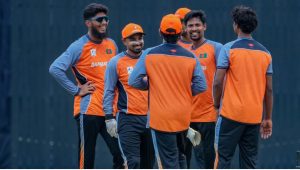
Bangladesh will face India in the SAFF U-19 Championship final at Pokhara Rangasala Stadium in Pokhara, Nepal, on Saturday, with an unbeaten group campaign setting up a high-stakes rematch. Bangladesh topped the group with three wins, while India’s only defeat came against the same opponents they now meet again.
Captain Arpita Biswas struck a calm note rather than a fiery one. “The team is in very good condition. There are no injuries and everyone is fit.” That fitness underpins everything Bangladesh do, from their compact defending to their ability to keep pressing late into games.
Arpita tied belief directly to performance rather than emotion. “We have already beaten India once in this tournament, and because of that there is a special energy within the team.” That energy grew out of a disciplined 2-0 win where Bangladesh absorbed early pressure, trusted their structure, and punished India when spaces appeared.
Coach Peter Butler made sure nobody treated the group-stage win as a shortcut. “It’s a bit unfair, isn’t it? We’ve beaten them once, now we’ve got to go and beat them again.” He understands that finals erase context and demand fresh execution.

Arpita did not shy away from the ambition either. “We believe we can beat them again and bring the championship trophy back to Bangladesh, Inshallah.” It reads as confidence rooted in evidence, built over three very different matches.
That realism has shaped Bangladesh’s entire campaign. “No, it is what it is. We’ll just go about it the way we always do, we’ll be thorough.” That line from Butler fits a team that never chased headlines, only control.
The opening 12-0 win over Bhutan showed Bangladesh’s attacking ceiling. They created situations Bhutan simply could not defend, struck repeatedly from wide deliveries, and never eased off. Even with a heavy lead, they pressed, crossed and attacked like a side still chasing its first goal.




The group match against India tested a different muscle. India pressed early and tried to disrupt Bangladesh’s rhythm, but Bangladesh stayed compact and calm. Once Arpita reacted quickest to a loose ball from a dangerous delivery, the game tilted decisively.
Bangladesh kept the ball moving, rotated without panic, and doubled their lead before the break. India pushed harder in the second half and turned the match into a more physical contest, but Bangladesh defended with discipline and managed the game with maturity.
That control returned against hosts Nepal, but with a different rhythm. Bangladesh struck early from a set-piece, absorbed a brief spell of resistance, then let Alpi Akter take centre stage. Her hat-trick mixed direct free-kicks, counters and simple finishes, showing how varied Bangladesh’s attacking threats have become.
Those three matches explain Butler’s caution about favourites. “It’ll be tough because India have got some good players.” India showed in the group game that they can raise tempo, press higher and force mistakes if given space.
Butler spelled out the core challenge. “They’re strong, tall, physical and it’ll be a tough game.” India will want aerial battles, second balls and duels, especially in a final where margins shrink and nerves stretch.
Bangladesh will try to avoid that chaos by doing what they have done best all tournament. They will stay compact when under pressure, move the ball quickly to the flanks, and trust their decision-making in both boxes. Control, rather than dominance, will define their approach.
Bangladesh’s previous three matches offer a clear blueprint. They defend compactly under pressure, attack decisively from wide areas, and manage games with maturity when momentum swings. Saturday’s final will test that control again, but Bangladesh arrive knowing exactly who they are and how they want to win.
Predicted lineup: Mst Yearzan Begum (GK), Arpita Biswas Arpita, Mst Surovi Akter Arfin, Mst Joynob Bibi Rita, Mst Munki Akhter, Sree Moti Trishna Rani, Kranuching Marma, Mamoni Chakma, Alpi Akter, Puja Das, Sauravi Akanda Prity