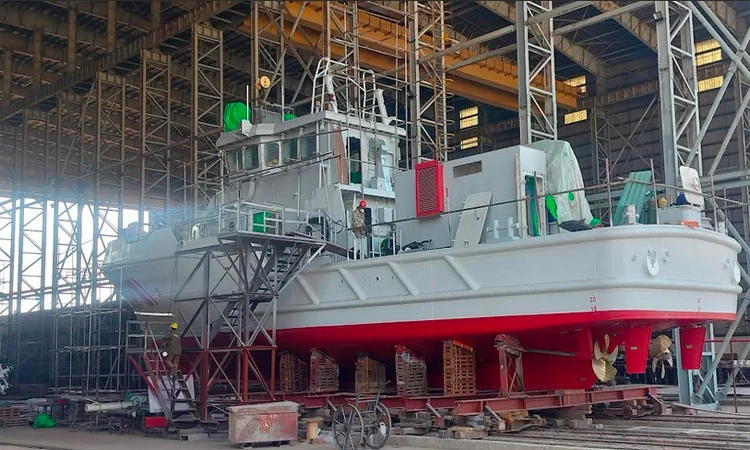



Bangladesh has a realistic opportunity to emerge as one of the world’s major ship-exporting nations, if policy support, financing reform and technology upgrades advance together, speakers said at an industry dialogue held in the capital on Saturday.
The discussion, titled Anchor of Growth: Diversifying Exports Through Mid-Sized Shipbuilding, was organised by YoungShip Bangladesh, a platform of young maritime professionals and industry stakeholders, in collaboration with Global Chamber Dhaka, Movementum Consultancy and Facilitation Group and Interport Advisory Services.
YoungShip Bangladesh Founding President Tanjil Ahmed Ruhullah, in his opening remarks, said export diversification has become an economic necessity as traditional growth drivers face limitations.
“While Bangladesh has historically relied on garments exports and remittances, a shift toward the production of mid-sized vessels has become an economic necessity for future growth,” he said, adding that coordinated action between industry, finance and policymakers is essential.
Islamic University of Technology Vice-Chancellor Professor Dr Mohammad Rafiqul Islam, in his keynote address, said global shipbuilding has shifted away from the West, with Japan, Korea and China accounting for about 90 per cent of global orders and Bangladesh may capture some of that.
He said rising demand for greener ships and an approaching replacement cycle are creating new opportunities, positioning Bangladesh well for small and medium-sized vessels. The global market for such vessels is expected to reach $84 billion by 2032, up from $32 billion in 2023.

Bangladesh currently ranks 35th globally with 291 registered ships, while growing local investment in vessel ownership is expected to boost domestic demand, he said.
Professor Islam said that with its several centuries of heritage in shipbuilding, Bangladesh began modern shipbuilding in 2005 and has demonstrated the capacity to build vessels of up to 20,000 deadweight tonnes for European buyers.
Stressing the importance of clear targets, he cited India’s ambition to become a top 10 shipbuilding nation by 2030 and a top five by 2047.




Outlining a three-phase roadmap, he said Bangladesh should initially aim to capture at least 1 per cent of the global small and mid-sized ship market, starting with exports of inland and coastal vessels, tugboats, barges, dredgers, patrol boats, landing crafts and service vessels to Africa, East Asia, South Asia, Southeast Asia and the Middle East.
Bangladesh Bank refinance schemes allow loans of up to Tk2,000 crore at 4.5 per cent interest, while tax relief and reduced duties on raw materials could ease early-stage pressure. A 10 per cent cash incentive on ship exports and a dedicated Shipbuilding Facilitation Cell were described as critical.
The second phase, covering years six to 10, would focus on exporting mid-sized vessels through capacity expansion, requiring buyer’s credit, export credit guarantees and incentives for automation and domestic manufacturing of marine equipment. The third phase would target higher-value exports while strengthening domestic supply chains.
Professor Islam said around 90 per cent of domestic ship demand is met locally and Bangladesh has more than 130 registered shipyards, with about 70 per cent located in and around Dhaka and Narayanganj. Twelve shipyards currently have export-quality capacity.
Other speakers, at a panel discussion moderated by YoungShip Bangladesh Advisor Khan Muhammad Saqiful Alam, warned that structural weaknesses could undermine the ambition.
Bangladesh Maritime Law Society President and Supreme Court Advocate Captain Mohiuddin Abdul Kadir said weaknesses in banking governance and the letter of credit process have eroded foreign buyer confidence.
Ananda Group Deputy Managing Director Abdullah Nahid Niger said the shipbuilding policy 2021 remains largely unimplemented, while outdated construction methods, limited automation and shortages of advanced welding skills are hurting competitiveness. She added that financing remains expensive despite shipbuilders not being wilful defaulters.
City Bank Corporate Banking Division Vice-President Md Sadiqur Rahman said trust is the most critical issue in shipbuilding finance, noting that about 70 per cent of components are imported and construction timelines of two to three years significantly increase costs.
Marine House Managing Director Engr Shamsul Alam said Bangladesh is a major global source of shipbuilding manpower and specialised shipbuilding zones could help the industry even surpass apparel.
LightCastle Partners Managing Director Zahedul Amin said prioritising green shipbuilding could unlock low-cost global financing.
Japan-Bangladesh Chamber of Commerce and Industry President Tareq Rafi Bhuiyan, who attended as chief guest, called for joint ventures with Japan, Korea and China and recommended a dedicated shipbuilding fund and specialised zones to attract foreign investment.
Global Chamber Dhaka Executive Director Maimun Ur Rashid Mustafa said adopting global standards at the national level is critical to improving competitiveness in shipbuilding and allied industries.
Speakers agreed that without coordinated action across policy, finance, law and technology, Bangladesh risks missing a rare opportunity to position shipbuilding as a key pillar of export diversification and industrial growth.
TIMES of Bangladesh was the media partner of the event.