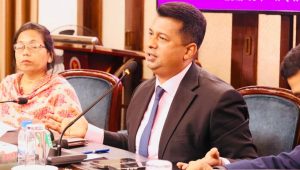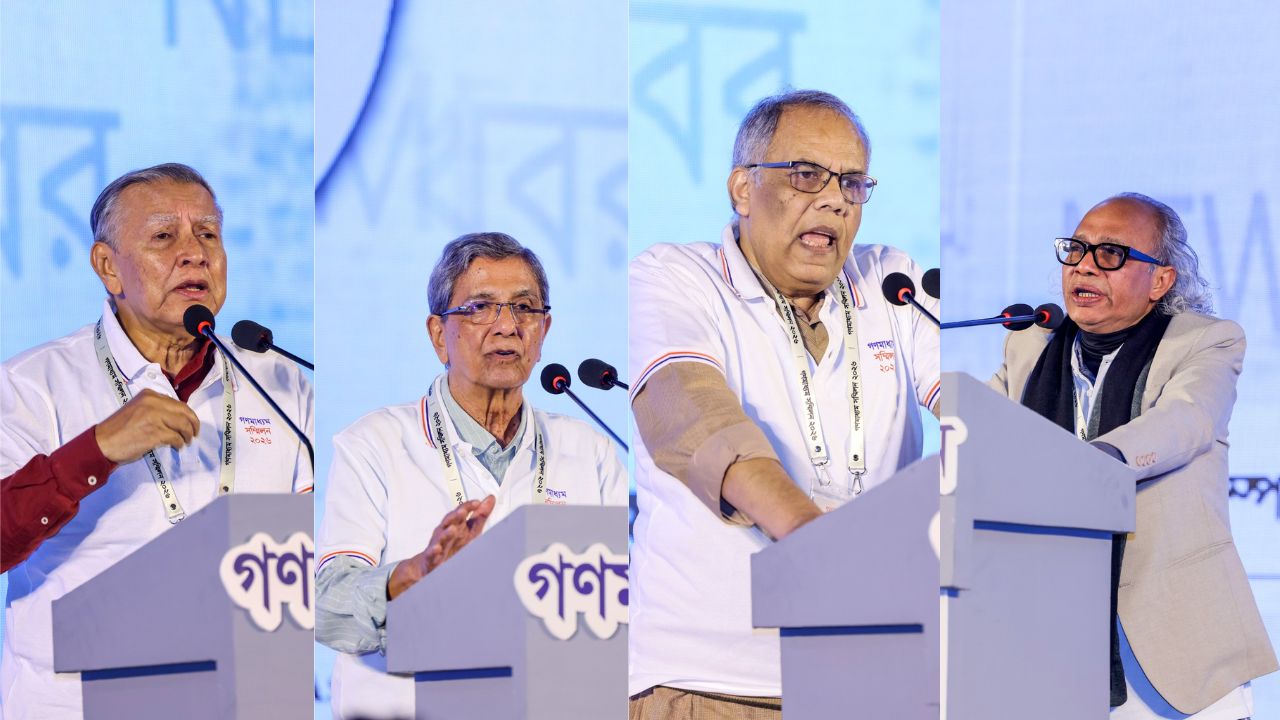

Journalists from across the country gathered on Saturday in a rare show of unity, warning that a wave of organised violence, intimidation and mob attacks now threatens the very foundations of free expression and democratic life and stressing that solidarity among journalists is paramount to overcoming the crisis.
The Media Convention 2026 aimed to bring journalists together against growing threats, reaffirm their commitment to independent and responsible reporting, and demand a safe environment in which they can work without fear. Speakers stressed that protecting journalists’ safety, dignity and professional rights is inseparable from protecting democracy itself.
The event was jointly organised by the Newspaper Owners’ Association of Bangladesh (NOAB) and the Editors’ Council at the Krishibid Institution Bangladesh (KIB) auditorium in the capital’s Khamarbari area.
According to the organisers, the country has recently witnessed a series of organised incidents of violence, including mob attacks, which they described as unprecedented assaults on freedom of expression and democratic principles.
They said the convention sought to register a united protest against such incidents, while reaffirming collective support for independent, responsible and courageous journalism. It also aimed to safeguard a democratic media environment, ensure the safety of journalists, and uphold the professional dignity and rights of media workers.
Addressing the gathering, Matiur Rahman, editor of Prothom Alo, stressed the importance of unity and solidarity among journalists, cautioning that the arrival of a new government would not automatically solve the country’s problems.
“Unity among journalists is essential. Any kind of dispute, on any issue, at any time, is harmful,” he said.
“We should not assume that all issues will be resolved automatically once the next elected government takes office. It has not happened in the past, and it will not happen automatically in the future either,” said Matiur Rahman.

Drawing on his 55 years of experience in journalism, he noted that no government had ever refrained from imposing some form of control over the media, urging journalists to stand together and support one another.
Mahfuz Anam, editor and publisher of The Daily Star, said the government that truly believes in independent journalism is the one that benefits the most.
“There are very few people within the government who speak the truth. Party affiliates, the bureaucracy or intelligence agencies often do not present the real picture,” he said. “Independent journalism is the only institution that can tell the truth to the government.”
He added that independent journalism can assess whether government projects and programmes are being properly implemented, whether people are accepting them, and whether corruption is taking place.
Nurul Kabir, president of the Editors’ Council and editor of New Age, said Bangladesh is currently undergoing a difficult transition from an authoritarian system to a democratic one.
Amid ongoing struggles for political and institutional reform, he said, attacks were being carried out on democratic institutions in the name of democracy, which he described as deeply alarming.
He noted that the recent movement began with attacks on two newspaper offices, questioning under what identity and in whose name such violence was being carried out.


Referring to the attack on The Daily Star building, he said the slogans written and posters hung inside the building clearly reflected democratic aspirations. “If a newspaper office is set ablaze to erase those memories, the meaning is obvious,” he said.
“They have not embraced the spirit of July; rather, they are using the name of July to try to destroy that spirit.”
He described vandalising buildings, destroying equipment or setting fires as “sheer barbarity”, adding that trying to trap journalists inside a building and set fire around them amounted to an attempt to burn them alive.
Nurul Kabir said a democratic society must allow for diverse opinions and voices, arguing that this diversity enriches society. He warned that attacks on the media ultimately endanger the rights of the entire population.
“When media outlets are attacked or silenced, it threatens the rights of society as a whole. If the media does not raise its voice, many forms of wrongdoing can spread across society,” he said.
Veteran journalist Shafik Rehman expressed anger at the growing tendency to label journalists as “agents”, warning that such practices were eroding the profession’s dignity.
“If we go down this road, our honour will not increase, it will diminish,” he said.
He added that restoring the dignity of journalism requires discipline, learning and professionalism. “To be a respected and dignified journalist, one must work hard and read extensively. You must read good books. It is you who must restore this honour,” he said.
Kamal Ahmed, head of the Media Reform Commission, said there were multiple reasons behind the erosion of journalistic standards, noting that many journalists now carried overlapping identities as teachers, contractors or politicians.
He questioned how such individuals should be identified in news headlines if they were arrested, and said the commission’s reform recommendations had effectively been shelved.
“Before elections, journalists face extreme risk. If the reform proposals are not implemented, then any future attack on journalists will be the responsibility of the government,” he said.
He also criticised the use of arrests against journalists, saying, “In a democracy, arrest cannot be a form of expression. Democracy is about reasoning, debate, and finding a solution through discussion.”
Rezwanul Haque Raja, president of the Broadcast Journalist Centre (BJC) and chief editor of Maasranga Television, urged journalists to stay away from political affiliation.
“If journalists cannot rid themselves of political ties, we will never be able to unite,” he said, adding that political divisions within journalists’ organisations were the greatest obstacle to collective action.
“We claim to be neutral, yet our unions are split along political lines. Leaders of our organisations each have their own political affiliations,” he said.
He added that no government wants truly independent journalism, and alleged that the current administration—despite promising a new political settlement and state reform—was following the same path.
Journalists who travelled from outside Dhaka said they lived in constant insecurity. They alleged that people with little education were publishing newspapers purely for business interests, calling for legal reforms to address the issue.
“Outside Dhaka, we live in constant insecurity, twenty-four hours a day. A forum should be created so that genuine field reporters can work properly during the next election,” one participant said.
The event was moderated by Dewan Hanif Mahmud, editor of Bonik Barta and general secretary of the Editors’ Council.
Among those present were Josim Ahmed, acting editor of Daily Times of Bangladesh; MA Malek, editor of Chattogram-based Daily Azadi; Kader Gani Chowdhury, secretary general of the Bangladesh Federal Union of Journalists (BFUJ); AHM Mostaqur Rahman, president of the Lakshmipur Press Club; Ekram Uddoula, president of the Jessore Newspaper Council; Faruq Wasif, director general of the Press Institute of Bangladesh (PIB); and Reaz Ahmed, editor of Dhaka Tribune.
Participants included members of NOAB and the Editors’ Council, the Association of Television Channel Owners, the Broadcast Journalist Centre, the National Press Club, the Bangladesh Federal Journalists’ Union, the Dhaka Journalists’ Union, the Dhaka Reporters Unity, the Diplomatic Correspondents’ Association, the Economic Reporters Forum, the Photojournalists’ Association, the Crime Reporters’ Association, and several other journalists’ organisations. Journalists from outside Dhaka, as well as editors and publishers, were also in attendance.