


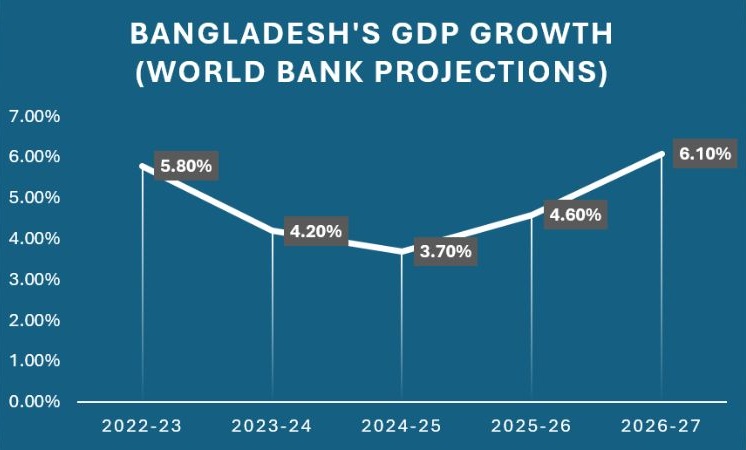
The World Bank has projected that Bangladesh’s economy will grow at a rate of 4.6 percent in the current 2025-26 fiscal year.
According to the organisation’s latest “Global Economic Prospects” report, this growth rate is expected to rise further to 6.1 percent in the 2026-27 fiscal year.
The report, published in January 2026, outlines various challenges and prospects for the Bangladesh economy. Notably, the growth estimate for the previous 2024-25 fiscal year stood at 3.7 percent.
Current economic landscape, reforms
The report states that despite severe financial constraints, various reformatory works are currently underway to increase revenue collection.

However, a contractionary monetary policy remains in place as inflation continues to exceed the government’s target. Furthermore, the pace of the transition period following political unrest has slowed.
Due to a business slowdown and high interest rates, the demand for credit in the market remains low.
Signs of stabilisation
Highlighting several positive aspects, the World Bank noted that signs of macroeconomic stability are beginning to emerge. Specifically, the foreign exchange rate has remained stable since mid-2025.




This improvement was made possible by the adoption of a flexible exchange rate method in May 2025.
Future prospects and elections
The report indicates that political uncertainty is diminishing ahead of the national election scheduled for early 2026. Consequently, inflationary pressures are expected to ease, which will enhance personal spending and the purchasing power of the public.
According to the World Bank, if the new government initiates structural reforms after taking office, the industrial sector will regain momentum in the 2026-27 fiscal year. The pace of government expenditure and investment is also expected to increase.
It is hoped that the increased revenue generated through reforms will help meet this additional expenditure. Additionally, a reduction in inflation will create opportunities to lower interest rates and relax monetary policy in the future.
Risks and challenges
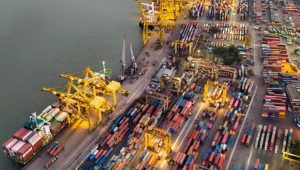
The World Bank also identified certain risks facing the economy. The imposition of increased tariffs or new trade restrictions could damage Bangladesh’s export demand. Furthermore, uncertainty regarding global trade policies may impact the economy.
Risks are relatively higher for South Asian countries like Bangladesh and Sri Lanka, which maintain significant commercial ties with the United States.
In conclusion, the report suggests that if strong macroeconomic management and a commitment to structural reforms are ensured following the 2026 election, investor confidence will increase, leading to a major surge in the country’s economic activities.