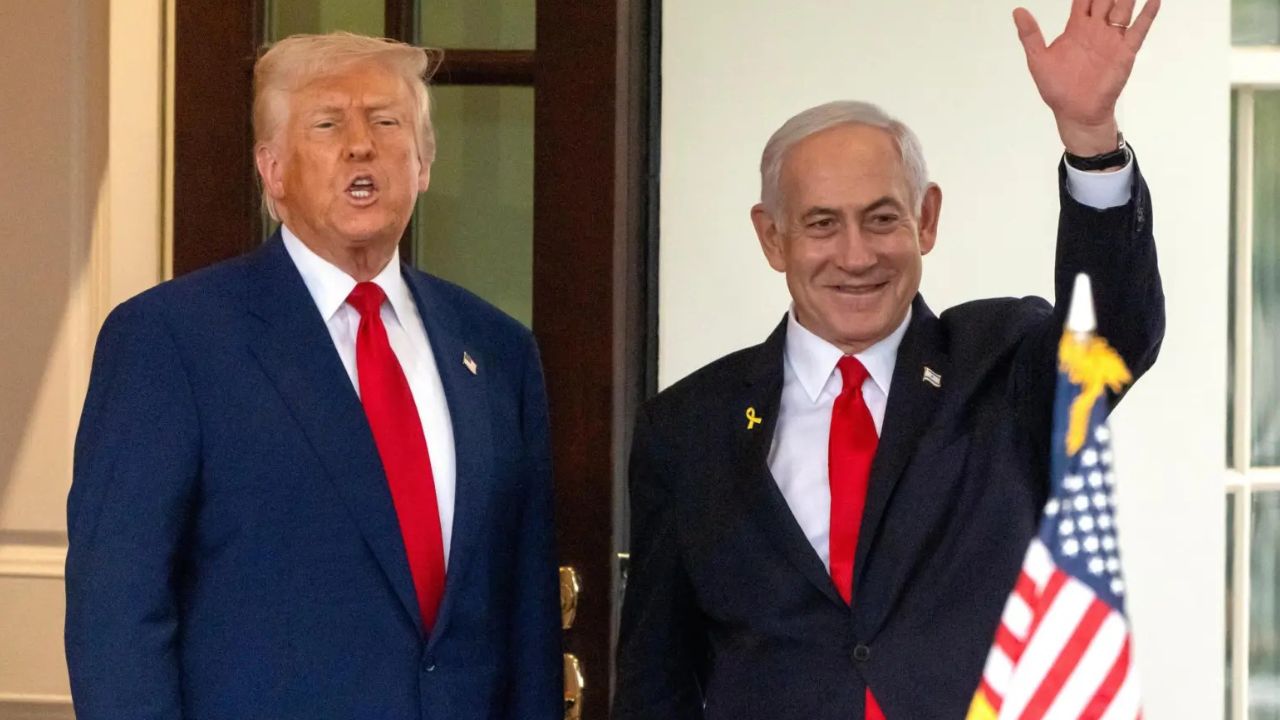

Israeli Prime Minister Benjamin Netanyahu visited Washington on Tuesday for his first meeting with US President Donald Trump since the Iran war began, at a time when he faces mounting political challenges at home and growing questions about his standing in Washington ahead of Israel’s general election, which must be held by 27 October.
The visit comes as Netanyahu faces pressure on several fronts. His ties with Trump appear less certain, while a corruption trial and deep domestic divisions continue to weigh on him.
Analysts say his handling of the Gaza war, Iran, and relations with the United States has reshaped Israel’s international standing and his own political prospects.
Netanyahu seeks to reinforce ties with Trump
Al Jazeera reports that Netanyahu’s visit is aimed at reinforcing his close relationship with Trump as Israel heads toward elections. However, the meeting comes amid growing strains after reports suggested Netanyahu convinced Trump of the feasibility of the Iran campaign.
Tensions have also increased over Washington’s plans to sell F-35 fighter jets to Turkiye, a nuclear cooperation deal with Saudi Arabia, and criticism in the US over Israel’s handling of settler violence.
Alon Pinkas, a former Israeli ambassador and consul general in New York, told Al Jazeera: “The real reason Netanyahu’s got this visit [to Washington] is purely cynical.”

He added, “But really this is about two things: hoping to assure allies and critics within Israel that the relationship with Trump holds and, separately, hoping that Trump will again call for his pardon in the corruption trial.”
Trump also dismissed Netanyahu’s public opposition to the proposed F-35 sale to Turkiye, telling reporters aboard Air Force One: “Nobody tells me what we should be selling.”
Ahron Bregman, an Israeli security analyst and senior teaching fellow in the Department for War Studies at King’s College London, told Al Jazeera: “Netanyahu arrives in Washington at a time when even many around [Trump] are suspicious of him. He has become toxic in the US.”
He added, “He is regarded in the US – rightly or wrongly – as the one who dragged Trump into a war of choice that has turned into a strategic catastrophe. Nobody, not even Trump, will let him pretend to be the cleverest guy in the room. Those days are gone.”



Mitchell Barak, an Israeli pollster and a former Netanyahu aide in the 1990s, said, “We’ve seen tension through Trump’s comments on the various F-35 sales, including most recently to Turkiye, as well as US criticism of Netanyahu at the start of the Iran war, so I’m not too sure if Trump’s going to be stumping for Netanyahu for all that much longer.”
He added, “It could easily be that Trump declares Netanyahu was a great wartime leader, but that it was time for Israel to move on, before meeting with [other Israeli politicians] and endorsing a new prime minister for Israel.”
Election challenges at home
According to Time, Netanyahu enters the election facing pressure not only over the wars but also over domestic political issues. Voters are expected to consider the corruption charges still pending against him, his past efforts to weaken Israel’s Supreme Court, his reliance on ultra-Orthodox political parties, and concerns about his health. Netanyahu, 76, has previously battled prostate cancer and heart disease.
The report says the opposition remains divided despite recent gains by former Israel Defense Forces Chief of Staff Gadi Eisenkot’s new party. Former Prime Minister Naftali Bennett, opposition leader Yair Lapid, and Gadi Eisenkot could potentially form a government together, but both Bennett and Eisenkot are seeking the premiership.
According to TIME, a fragmented opposition could allow Netanyahu to remain in power, potentially through a deal with Blue & White party leader Benny Gantz.


The publication also says an opposition-led government would likely improve Israel’s relations with Europe, reducing the risk of sanctions over the Gaza war, and would be less likely to pursue annexation of the West Bank, though it would not be expected to advance a Palestinian state.
It adds that a new prime minister would likely seek to repair ties with Washington and would be far less likely than Netanyahu to launch major new strikes inside Iran, instead focusing on military preparedness while keeping limited attacks and covert operations as options.
Debate over Netanyahu’s legacy in Washington
An analysis published by The Atlantic argues that Netanyahu has failed in what it describes as his defining political mission: preserving Israel’s bipartisan support in the United States.
According to the analysis, Netanyahu became Israel’s deputy ambassador in Washington in 1982 and later ambassador to the United Nations, spending decades cultivating Israel’s image in the United States.
It argues that support, once bipartisan, has eroded sharply in recent years, with criticism now coming from both Democrats and Republicans.
The analysis contends that Netanyahu’s increasingly partisan approach to US politics accelerated that shift. It highlights his 2015 address to the US Congress opposing President Barack Obama’s Iran nuclear deal, arranged without informing the White House, and argues that his close alignment with Trump tied Israel more closely to one side of America’s political divide.
It also says Netanyahu publicly challenged President Joe Biden despite Biden’s military and diplomatic support for Israel after the October 7 Hamas attack.
Netanyahu rejected proposals backed by the Biden administration for post-war governance in Gaza, including transferring control of captured territory to a reformed Palestinian Authority supported by Arab peacekeepers. The analysis argues that he did not present a clear plan for governing or rebuilding Gaza or for removing Hamas from power, instead prioritising the stability of his governing coalition.
The analysis also criticises Netanyahu for retaining National Security Minister Itamar Ben-Gvir despite his controversial rhetoric, arguing that Ben-Gvir’s statements have become evidence cited in allegations against Israel and that Netanyahu neither dismissed nor meaningfully condemned him because his party is essential to maintaining the governing coalition.
It further argues that Netanyahu missed an opportunity to advance Saudi recognition of Israel by refusing to commit to a process toward the creation of a Palestinian state, a condition sought by Saudi Arabia for normalisation.
Regardless of the role of antisemitism, Netanyahu’s political decisions contributed to Israel’s growing international isolation and the erosion of long-standing American political support.