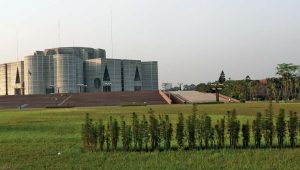

On February 12, more than a hundred million registered voters queued at polling stations across Bangladesh to elect a new 300-seat parliament. Two days earlier, a district Jamaat-e-Islami leader was intercepted at Saidpur Airport in Nilphamari carrying Tk74 lakh in cash. Around the same time, the Election Commission was fielding complaints of money changing hands for votes in Dhaka, Khulna and Cumilla. None of this was supposed to happen. Bangladesh’s election law caps what a candidate can spend at Tk10 per registered voter, or Tk25 lakh, whichever is higher. Almost no one, it turns out, was spending within it.
That gap, between what the law permits and what actually moves through Bangladesh’s political economy, is the real story of who pays for politics here. And the results of the 13th parliamentary election have made the picture unusually clear.
According to an analysis of candidates’ affidavits, 59 percent of the MPs elected in February are businesspeople by profession – making them, by a wide margin, the single largest occupational group in the new Jatiya Sangsad. Lawyers, teachers and career politicians trail far behind. Transparency International Bangladesh (TIB), which has tracked candidate wealth since affidavit disclosure became mandatory in 2008, found that 236 of 297 winners whose data could be analysed – nearly 80 percent – are millionaires in taka terms, and 13 have declared assets exceeding Tk 100 crore. The single wealthiest candidate, BNP vice-chairman Abdul Awal Mintoo, declared combined household assets of Tk 607 crore. This is not simply a story about wealthy people winning elections. It is a story about what it now costs to become a candidate in the first place and who is left out as a result.
TIB’s executive director, Iftekharuzzaman, has been blunt about what this concentration means. Rising business dominance in parliament, he has argued, gradually shifts state power toward a narrow set of influential groups, blurs the line between commercial interest and public policy, and creates fertile ground for what he calls kleptocracy – a system in which public office becomes a vehicle for private enrichment rather than representation. He points to specific sectors – banking, energy, power, public procurement – where the fusion of business and political power has historically produced tax evasion, trade misinvoicing and collusive contracting.

On paper, the 2026 election looks almost transparent. All 1,981 candidates filed expenditure affidavits with the Election Commission, declaring a combined Tk396 crore in campaign spending. BNP candidates said 56 percent of their funds came from personal pockets; Jamaat-e-Islami reported 58 percent from grants, donations and party funds; the newly formed National Citizen Party (NCP) said 62 percent of its spending relied on donations. But almost no one who studies Bangladeshi elections believes these figures. Badiul Alam Majumdar, who chaired the now-dissolved Electoral Reform Commission, dismissed the affidavit numbers outright, noting that securing a party nomination alone can cost candidates several crore taka – money that never appears in any official return. A 2025 study by the London-based Westminster Foundation for Democracy, titled The Cost of Politics in Bangladesh, estimated that aspiring candidates typically spend Tk5–10 crore in the years before an election simply building the local networks and patronage relationships needed to be considered ‘electable’ – long before any spending limit legally applies.
The clearest evidence of the gap between declared and real spending came from Bangladesh Bank itself. In the two months before the February election, cash circulation outside the banking system rose by nearly Tk41,000 crore, a surge the central bank’s own spokesperson attributed largely to election-related withdrawals. TIB’s field survey of 70 randomly selected constituencies told a similar story from the ground: 68.6 percent of candidates exceeded the legal spending ceiling, with BNP candidates overspending by an average of 327 percent and independents by 315 percent.
Even before the campaign begins, money shapes who gets to compete. Political parties in Bangladesh sell their own nomination forms to aspiring candidates — a practice so normalised that it barely draws comment. In a single day of sales ahead of the 2018 election, the then-ruling Awami League collected more than Tk 13 crore from nomination-seekers; in 2023, it took in over Tk 11 crore in two days. One Bangladeshi lawmaker, quoted in a study by Norway’s Chr. Michelsen Institute, put it more bluntly: “You can now buy yourself an MP nomination the same way as you buy an air ticket to Singapore: pay up and off you go.”



The practical effect is a filtering mechanism that has nothing to do with merit or public support. Only about 15 percent of candidates receive meaningful financial backing from their parties, and that support tends to flow toward candidates who can already self-fund – reinforcing, rather than correcting, the advantage of wealth. Women and younger candidates, who are less likely to have accumulated business fortunes, are systematically squeezed out. The newly elected parliament has just seven directly-elected women, the lowest number since 2008.
There are signs that Bangladesh’s political class knows this system needs fixing. A November 2025 amendment to the Representation of the People Order now requires parties to publish detailed donation records on their websites, a modest but real step toward transparency. The law already bars parties and candidates from accepting foreign donations altogether, a restriction that, notably, is enforced far more strictly on foreign-funded NGOs than on the murkier flows of domestic cash.
The most interesting experiment, though, is coming from the political margins.
The NCP, formed by leaders of the 2024 student uprising, has explicitly framed crowdfunding – small, disclosed donations gathered online and offline – as an alternative to dependence on business patrons. It is a strategy borrowed from Barack Obama’s 2008 campaign and India’s Aam Aadmi Party, and Bangladesh’s own Electoral Reform Commission has acknowledged that, done properly, it could offer a genuinely cleaner funding model. Whether it can scale to compete with parties backed by crore-taka business donations remains an open question; the NCP itself declared the lowest campaign spending of any major party in February, just Tk11.7 crore for 32 candidates.
Other democracies offer a menu of harder fixes: the United Kingdom requires parties to report donations above £7,500 to an independent Electoral Commission; Germany matches small donations with public funds, rewarding parties for building broad citizen support rather than courting the wealthy; Canada bans corporate and union donations outright. Constitution Reform Commission member Imran Siddiq has pointed to exactly this kind of mandatory, independently audited disclosure as the missing piece in Bangladesh’s framework.
None of these models is a perfect fit, and none will arrive overnight. But the underlying diagnosis is now hard to dispute, and it comes from the country’s own election data, not from outside critics: as long as a parliamentary seat requires several crore taka in undisclosed spending before a single vote is cast, Bangladesh’s democracy will keep answering to its financiers before it answers to its voters.
The views expressed in this article are solely those of the author
Mohammad Aynul Islam, Professor of Political Science and Director, Applied Democracy Lab, University of Dhaka. E-mail: [email protected]
Tasfia Ahmed, Research Intern, Applied Democracy Lab, University of Dhaka.