
Why has the Mecca Joint Defence Agreement (MJDA) among three Muslim countries become a topic of intense discussion in Bangladesh these days? Maybe Bangladesh is weighing options on joining or not – a decision dilemma that goes on in almost all geopolitical events. However, a sustainable political decision under any democratically elected government needs scrutiny of many factors. The first and foremost are the national interest, national purpose and national objectives around which foreign, economic, diplomatic and defence policy revolve. Bangladesh government, before it decides whether to join or not to join in MJDA, should draw a clear, full effect map of the terrain ahead – political, economic, legal, technological, informational and internal security domains that move from first to second- and third-degree effects. Without that map, even the most well-intentioned measure might lead to unforeseen consequences.
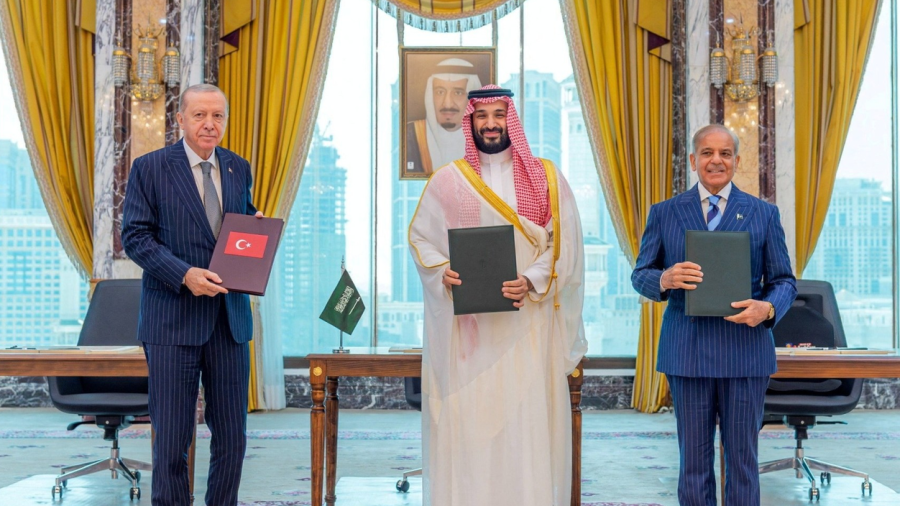
On 07 August 2026, Saudi Arabia, Türkiye and Pakistan signed the MJDA. The central clause of the agreement stipulates that an armed attack on one country will be treated as an attack on all three. The joint defence pact remains in its foundational stage, and the alliance still requires an integrated command structure, standing forces, coordinated planning and a specified trigger mechanism. On 31 August 2026, the three member states held the inaugural meeting of the Strategic Political and Defence Committee in Istanbul, where they agreed to establish a General Secretariat in Saudi Arabia, led initially by a Secretary General from Pakistan. The strength of the pact lies in the support of Pakistan’s nuclear umbrella to the other member states, the financial strength of Saudi Arabia and the modern military technology of a NATO country, Türkiye. The MJDA would also allow member states to deepen defence industry cooperation, joint technology development and production that Dhaka does not currently enjoy.
But the vulnerabilities of activating the MJDA appear more complex due to uncertainties in the present-day geopolitics, especially in the Middle East and Yemen. Saudi oil revenue plummeted, and Riyadh now seeks fiscal support through expanded borrowing amid conflict in the ME and the war with Yemeni Houthis. Pakistan and Türkiye may not be able to offer full military assistance given their own commitments along their borders. The first real-world test came in September 2026, following Houthi missile attacks on Saudi Arabia. Pakistan’s foreign ministry spokesperson on 10 September 2026 said that no military response was under discussion at present, adding that Islamabad would act under the agreement when the time came. Against this backdrop, should Bangladesh move ahead or wait to see MJDA mature and decide whether to join or not to join?

The MJDA is a conventional defence pact. The three countries under MJDA have significant divergence in their threat perceptions- a structural difficulty to any unified military response. Bangladesh faces mostly unconventional and non-traditional security threats like garments sector unrest, street protests and vandalism, trade in illegal arms and drugs, cyber intrusions, rampant corruption affecting the economy, disinformation campaigns, conflict in Myanmar and climate-induced migration. A formal defence alliance like MJDA, designed to counter territorial aggression by third countries can do little to address Bangladesh’s more immediate and tangible vulnerabilities. However, MJDA might allow Bangladesh tactical benefits like joint exercises with Turkish special forces or Pakistani counter-terrorism units, and technology transfer for defence production. But Bangladesh should assess the trade-off between the strategic flexibility it already enjoys and the tactical benefits offered by the defence pact.
Bangladesh’s foreign and defence policies are rooted in its values: culture, constitution, and people’s need- a triad that gives legitimacy to any foreign commitment. Joining a defence pact might shift the focus of decision-making away from sovereign control. The core pillars of national unity during crisis, national purpose and objectives, and century-old traditions present Bangladesh’s historical commitment to non-alignment and its growing engagement with the West Asian powers. Dhaka’s traditional strength has been its ability to balance competing global powers- China, India and the United States without formal alignment. Equally significant is the matter of vulnerability and environmental uncertainty- the safety and security of food and livelihood. Rising sea level, erratic monsoons and riverbank erosion constitute a threat that compels the decision-makers to ask: is a military alliance an effective tool to respond to a cyclone or a crop failure?




‘Bangladesh First’ policy sounds good, and it may be effective when the policy issues are deliberated not at the first tier only, but also at the second, third and subsequent tiers. For government decision-makers, the path forward demands rigorous, transparent and multi-stakeholder engagements. Besides, the government should seek clarity on MJDA’s operational provisions – particularly the scope and objectives of the collective defence commitments.
Parliamentary scrutiny and public consultation, especially with civil society and strategic thinkers, would benefit the decision-making process. The principle that ‘one enemy costs more than a hundred friends gain’ warrants more than rhetorical weight and deserves in-depth evaluation against the tactical benefits the pact can offer. Whatever decision the government makes, it must always seek the collective mutual benefit and wellbeing of the people, making Bangladesh a land of peace, prosperity, and harmony. Bangladesh is ours, and to make it a place of better living, Bangladesh should look at the world of tomorrow, not the world of yesterday.
The views expressed in this article are solely those of the author
The author is a freelance writer