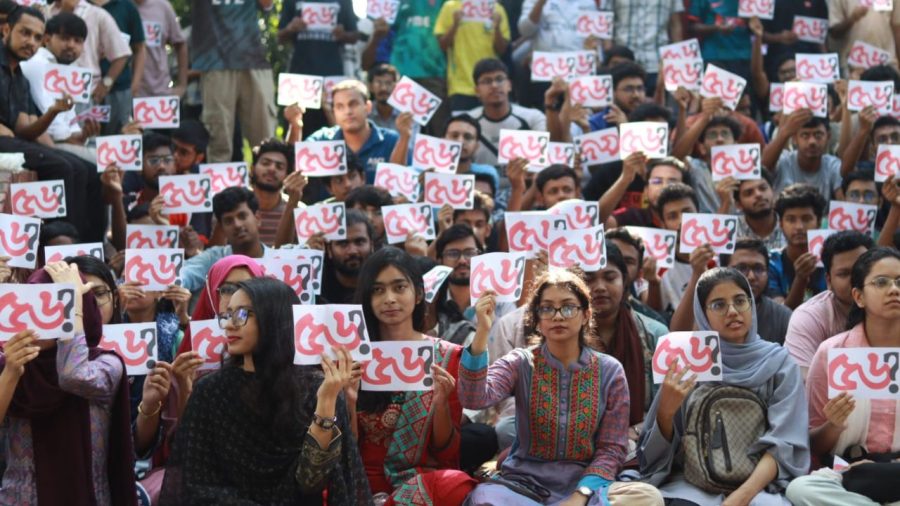



What began as a localized protest against the abrupt removal of a vice-chancellor has escalated into a full-blown institutional crisis at Chittagong University of Engineering and Technology (Cuet).
The ongoing deadlock has raised troubling questions over political interference, factionalism amongst faculty and students, and the government’s opaque approach to university appointments.
The turmoil erupted after the Ministry of Education summarily dismissed Professor Abu Sadat Muhammad Sayem as vice-chancellor on 21 September, just 56 days into his four-year tenure.
Without offering a public explanation, authorities appointed Professor Sheikh Shariful Alam, former Pro-VC of Khulna University of Engineering and Technology (Kuet), as his successor.
The decision sparked immediate outrage.
Academic life has ground to a complete standstill: classes and examinations remain suspended, students have enforced a campus-wide lockdown, and protesters continue to guard the main gates to physically block the new VC from entering.
A substantial coalition of faculty, administrative officers, and staff has joined calls for Sayem’s reinstatement, forcing Shariful Alam to conduct official duties remotely from Chattogram Circuit House.

Political allegations and campus divisions
Beneath the confrontation lie bitter accusations of political partisanship. Rifts within the Chattogram BNP over dominance also contribute to the stalemate.
Opponents of Sayem attempted to paint him as an Awami League loyalist by circulating photographs on social media, allegedly via Jatiyatabadi Chhatra Dal (JCD) networks, showing him at official events during the previous administration.
Sayem firmly rejected the claims, clarifying that attending mandatory university functions alongside government figures does not constitute political affiliation.
Incoming vice-chancellor Professor Shariful Alam faces his own political scrutiny.



Critics claim local Chhatra Dal leaders support him due to his links with a powerful state minister from a nearby constituency, considered a key figure within the state apparatus. Shariful Alam dismissed these assertions as baseless.
“The position of vice-chancellor is a statutory institutional responsibility accountable to the state, not a political faction,” he said, questioning the motive behind such speculation.
Cuet unit JCD President Wasif Rashed also denied campaigning for the new VC, appealing for restraint.
“Everyone has the right to protest, but ordinary students should not suffer through prolonged suspensions of classes and exams,” Rashed said, urging protesters to give the new leadership a chance.
Faculty revolt and administrative hesitation
The impasse deepened when the Cuet Teachers’ Association joined administrative staff in a coordinated work stoppage.
Faculty members gathered at the central auditorium, unanimously declaring their opposition to external appointments.
“We do not want anyone from outside CUET to be appointed as vice-chancellor,” said the association president, Mohammad Ahsan Ullah.
Sayem’s brief tenure managed to cultivate significant goodwill across campus, making his sudden removal particularly jarring.
During Cuet’s 24th University Day on 1 September, Finance and Planning Minister Amir Khosru publicly praised Sayem’s vision for the institution, making his unexpected dismissal three weeks later all the more baffling to supporters.
Meanwhile, local authorities remain in limbo.
Following a high-level meeting at Chattogram Circuit House on 7 October, Divisional Commissioner Md Ziauddin confirmed that the district administration has briefed the Ministry of Education on the situation and is awaiting clear instructions.
“Our priority is to prevent any untoward incidents while maintaining law and order,” Ziauddin noted, adding that administrative security would be provided if the new VC requests assistance to enter campus.
A campus frozen in limbo
For now, Shariful Alam remains barred from physical administrative facilities.
His attempt to manage affairs remotely, which included a controversial, quickly retracted directive regarding staff salary accounts at the local Sonali Bank branch, has done little to establish authority.
With students maintaining their blockade, faculty refusing to cooperate with an external appointee, and the government silent on its rationale, Cuet remains caught in an unprecedented standstill.
What began as an administrative reshuffle has evolved into a stark test of institutional governance, leaving thousands of students paying the ultimate price for an unresolvable leadership vacuum.