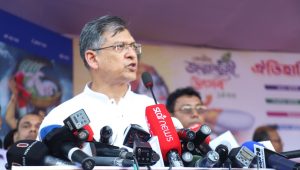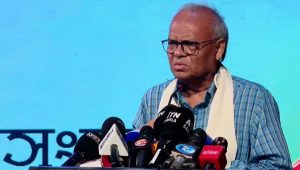



The United States’ perception of Jamaat-e-Islami has evolved in recent years, amid growing diplomatic engagement and changing political realities ahead of the upcoming parliamentary election, say diplomats and political analysts in Bangladesh.
The assessment comes following renewed debate sparked by a recent report in The Washington Post, after which allegations surfaced in political and electoral circles suggesting a “secret understanding” between US and Jamaat.
Analysts, however, argue that increased contact between Washington and Jamaat reflects broader geopolitical interests rather than covert political arrangements.
They say Jamaat’s growing engagement with US is a natural outcome of Bangladesh’s current political configuration, where the party has emerged as a key electoral actor alongside BNP following the temporary exclusion of the Awami League from the political process.
Former Bangladeshi ambassador to China Munshi Faiz Ahmed told TIMES of Bangladesh that Jamaat has long maintained communication channels with major global powers, including US, China, and Russia. He said the party’s relevance has increased following recent political shifts.
“After the political change, the main players on the ground are BNP and Jamaat. Naturally, Jamaat’s importance has grown for these countries,” he said.
Ahmed added that Jamaat has sought to present itself as a modern Islamic political party rather than an extremist organisation, and that Washington’s earlier suspicions appear to have softened.

“US perception of Jamaat has changed. It is now more positive, though American interests clearly play a role,” he said.
Analysts say Washington’s interest in South and Southeast Asia has intensified in recent years, driven by strategic concerns over the Bay of Bengal, blue economy prospects, international shipping routes, energy resources, and maritime security.
Regional instability linked to the Rohingya crisis and Myanmar’s internal conflict has further increased international scrutiny, while potential cooperation between Bangladesh and US in energy and gas exploration has added another layer of engagement. Against this backdrop, analysts view US diplomatic outreach to major Bangladeshi political parties as routine and strategic.
Dilara Choudhury, former head of the Government and Politics Department at Jahangirnagar University, dismissed claims of US interference or secret political deals as political rhetoric.


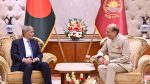

“The idea that America would secretly engineer an election outcome is a political statement, not a fact,” she said. “Earlier, US reacted sharply to anything associated with political Islam. That reflex no longer exists.”
She added that Jamaat’s adherence to constitutional and existing legal frameworks has eased Western concerns. “Whether BNP or Jamaat comes to power is no longer seen as a problem. US no longer views Bangladesh solely through India’s lens,” she said.
Jamaat’s Nayeb-e-Ameer Syed Abdullah Mohammad Taher rejected allegations of any secret understanding with Washington.
“There is no question of secret dealings,” he told TIMES. “Our policy is to maintain good relations with all democratic countries. Relations with US exist and will continue, based on mutual interests.”
The debate intensified after a Washington Post report published on 22 January cited an audio recording of a closed-door meeting between a US diplomat and female journalists in Dhaka.
According to the report, the diplomat suggested that Bangladesh was becoming more Islam-oriented and predicted Jamaat would perform better in the 12 February election than ever before, adding, “We want them to be our friends.”
On 24 January, BNP Secretary General Mirza Fakhrul Islam Alamgir, citing the report during a public event in Thakurgaon, said that alleged US-Jamaat ties were “not good for the country” and called for an explanation from the Ministry of Foreign Affairs.
The issue has since become a recurring topic in political discourse.
On 26 January, Jamaat candidate for Barguna-2 Sultan Ahmed told an election rally that US does not want Islamic parties to come to power anywhere, and that Washington now prefers a different political outcome in Bangladesh.
Dhaka University political science professor Sabbir Ahmed said Washington is assessing whether a BNP-led government would prioritise Indian interests over American ones. He suggested that recent statements by BNP leaders could be aimed at reassuring India ahead of the election.
“BNP’s turn may appear tactically sound, but excessive focus can sometimes produce the opposite result,” he said.
Further controversy emerged following remarks by Jamaat leader Taher at an election meeting in Feni-2, where he said Jamaat had broadened its alliance to avoid being labelled extremist.
He recounted an exchange at the US Embassy, claiming an American official questioned Jamaat’s alliance with Islamic Andolan Bangladesh, and responded positively when told Jamaat was distancing partners from extremism.
The comments triggered strong criticism from Islamic Andolan Bangladesh, which formally protested the remarks and questioned whether it had been excluded from alliances to appease a foreign power.
Most analysts believe Western governments no longer view Jamaat as a hardline extremist party, a shift they say has also influenced Jamaat’s own political positioning. The party has moved away from rigid demands for Sharia law, instead emphasising good governance, anti-corruption, and reform within the existing legal framework.
With Awami League temporarily barred from political activity following its fall amid mass uprising in August 2024, the 13th parliamentary election is expected to be fought primarily between the BNP-led alliance and the Jamaat-led bloc.