Professor Mamun Ahmed, chairman of the University Grants Commission (UGC), has proposed three key initiatives to enhance teacher skills, conduct joint research, and improve the quality of teaching and student services through international cooperation.
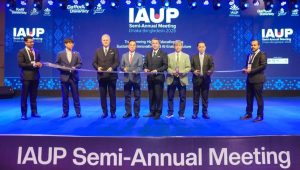
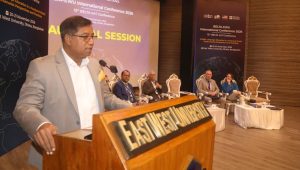
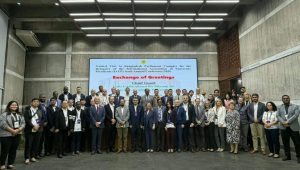
Speaking as the chief guest at the closing session of the International Association of University Presidents (IAUP) 2026 semi-annual meeting at Hotel Sheraton in Dhaka on Friday, UGC chairman outlined these measures. The three-day conference, attended by 150 delegates from 25 countries, was jointly organised by Daffodil International University (DIU) and the IAUP, following its formal inauguration earlier in the morning.
Three proposed initiatives focus on partnerships to enhance the professional skills of teachers, joint research and project adoption to solve problems in industry or society, and the improvement of teaching and student service quality.
To implement these measures, the chairman proposed nominating a designated individual for each initiative within 30 days, starting initial activities within 90 days, and reviewing progress within six months, while urging interested universities to nominate designated representatives and set work targets.

Mamun Ahmed said university education and research must be linked to the needs of the industrial sector and practical national issues. He noted that graduates should not merely earn degrees, but must also develop skills to identify workplace challenges, work collaboratively in teams, and deliver practical outcomes through new ventures.
To achieve this, he emphasised expanding industry-supervised internships, joint projects with commercial entities, and entrepreneurship education programmes, though he clarified that not every graduate is required to become an entrepreneur.




Addressing research priorities, the chairman called for international collaborative research in fields including climate change, agriculture, public health, and renewable energy. He pointed out that alongside basic research and humanities subjects such as literature, history, and philosophy, the application of research to solve real-world problems must be expanded, while strictly maintaining academic freedom and research standards.
On international academic partnerships, he added that signing memorandums of understanding (MoUs) alone is insufficient, stressing that ties must be made effective through joint research, faculty exchanges, joint teaching, and co-supervision of PhD research.
The UGC chairman also highlighted the growing role of artificial intelligence (AI) in higher education, calling on universities to formulate clear policies regarding permitted AI uses, disclosure requirements, and personal data protection.
He explained that alongside verifying AI-generated data, institutions must evaluate students’ capacity for original thinking and reasoning, which requires building teachers’ proficiency in emerging technologies.
However, he urged universities to gather student feedback, regularly review curricula, improve assessment methods, and maintain research integrity, noting that international standing cannot be judged by rankings alone but depends on educational quality, degree acceptance, and student experiences.

Mamun Ahmed further called for integrating digital communication systems with academic and administrative services, while ensuring equal opportunities for female, disabled, and underprivileged students, as well as students attending institutions outside major cities.
During a session focused on transforming university education, research, and institutional frameworks in the AI era, key participants included Pavel Luksha, chief executive officer of Global Education Futures, Serbia, and Assylbek Kozhakhmetov, president of Almaty Management University, Kazakhstan.
The event was also attended by Dr Shawn Chen, president of IAUP and chairman of Sias University, China, alongside Dr Md Sabur Khan, treasurer of IAUP and founder and chairman of Daffodil International University.