The US Supreme Court has struck down President Donald Trump’s sweeping reciprocal tariffs, intensifying criticism in Dhaka over the interim government’s decision to sign the Reciprocal Tariff Agreement (RTA) days before handing over power to the elected administration.
The court ruled that tariffs imposed under the International Emergency Economic Powers Act (IEEPA) of 1977 were unlawful, restoring the pre-tariff competitive landscape for Bangladesh in its single largest export market.
President Donald Trump subsequently announced a flat 15 per cent additional tariff on all trading partners, which he may continue for up to 150 days under relevant US law.
With the reciprocal tariff nullified, Bangladesh’s competitive edge in its largest single export market has rolled back to the pre-Trump tariff era.
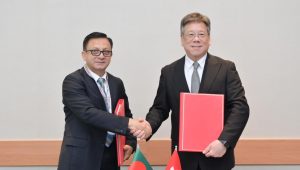
Economists and business leaders said the interim government moved hastily in signing RTA on 9 February, barely a week before the national election.
“It was completely unnecessary and mysterious for the interim government to sign RTA just three days before the national election,” said Policy Exchange Bangladesh Chairman M Masrur Reaz.
He said negotiations and drafting had been completed and the matter could have been left to the elected government, especially as a Supreme Court verdict was pending.
“Meanwhile, the US Supreme Court verdict would have come,” he added.

Under RTA, Bangladesh secured a 19 per cent reciprocal tariff ceiling for ready-made garments and zero reciprocal tariff for apparel manufactured from US raw materials.
In exchange, Dhaka agreed to purchase 14 Boeing aircraft and energy and agricultural commodities worth around $3.5 billion annually to narrow its roughly $6 billion annual trade surplus with Washington.
The agreement also requires Bangladesh to align with certain US export-import, technological and geopolitical embargoes, raising concerns about its long-standing foreign policy principle of “Friendship to all, malice to none.”
Defence procurement commitments have emerged as another sensitive issue, as Bangladesh agreed to purchase US equipment and refrain from sourcing certain items from other countries, potentially limiting access to cheaper alternatives such as Chinese, Russian, French or Turkish suppliers.
Former Bangladesh Ambassador in Washington Humayun Kabir said several clauses in RTA could complicate Dhaka’s balanced foreign policy, which he described as essential for development.
“Since the reciprocal tariff itself does not exist, Bangladesh should seriously engage with USA to renegotiate RTA,” he said.




Two advisers to the immediate-past interim government told TIMES of Bangladesh on Saturday they were under enormous pressure from the US side to conclude the deal before the polls, though neither agreed to be quoted.
Research and Policy Integration for Development Chairman Mohammad Abdur Razzaque criticised the absence of consultation with experts and business communities before signing the agreement and said several provisions may contradict World Trade Organization rules.
Former Commerce Adviser Sk Bashir Uddin told TIMES on Saturday the interim administration acted at exporters’ request to safeguard the competitiveness of Bangladesh’s key export items in its single biggest market.
“RTA has both entry and exit clauses. The elected administration may prefer to refrain from implementation,” he said.
Centre for Policy Dialogue Distinguished Fellow Mustafizur Rahman said signing a deal with a country like USA and subsequently exiting it would not be straightforward.
He said that had the interim government not rushed to sign the agreement at the eleventh hour, the pressure to defend or pursue it would not have built up.
President Donald Trump on Friday expressed hope that countries would honour bilateral reciprocal tariff agreements and said he retains other legal tools to impose tariffs on a country-wise or commodity-wise basis.
The agreement provides for entry into force 60 days after both governments notify completion of procedures, while either side may withdraw with six months’ notice.
Uncertainty over the RTA between Dhaka and Washington is mounting as Bangladesh authorities seek clarification from the USA on the implications of the ruling.
Commerce Secretary Mahbubur Rahman told TIMES of Bangladesh the court verdict had made implementation uncertain and officials had contacted the US side for further information.
“We have been informed on a preliminary basis that an additional flat-rate tariff may be imposed,” he said.
“There is a need for clarity on the issue, and by Monday, the first working day of the week there, we expect to have a better understanding of the situation,” he added.
The reciprocal tariff being declared illegal does not automatically render all clauses of RTA null and void, said Ambassador Humayun Kabir.
Echoing him, Sparrow Group Managing Director Shovon Islam said that as the reciprocal tariff itself now stands unlawful, any clause in trade agreements that specifically relates to it would be considered ineffective following the Supreme Court ruling.
“However, the remaining provisions of those agreements would continue to be valid,” he said.
According to the apparel exporter, if President Donald Trump, after the 15 per cent new tariff for 150 days, seeks to reimpose permanent tariffs, he would need to introduce a new bill in the US Congress.
Such legislation is widely seen as difficult to pass, given the lengthy and complex approval process through Congress and the Senate, and the current political climate.
Former Bangladesh Garment Manufacturers and Exporters Association director Mohiuddin Rubel said that after the reciprocal tariff was scrapped, the administration adopted a two-step strategy from 20 February — a short-term “bridge” and a long-term “fortress”.
In the short term, the 15 per cent temporary tariff, which Trump on Friday announced to be 10 per cent and raised it to 15 percent on Saturday, would serve as a stopgap.
Rubel said that in the longer term, the Trump administration plans to expand the use of Section 301 investigations into what it terms “unfair trade” practices to build a higher, more targeted and longer-lasting tariff framework.
These measures are expected to be rolled out gradually in the second half of 2026. At the same time, safeguard duties, anti-dumping and countervailing duties, and national security-based tariffs remain available as additional legal trade instruments, he added.